

Pakistan’s Strategic Counterterrorism Evolution
For decades, Pakistan’s fight against terrorism has often been portrayed as an internal struggle, framed narrowly around domestic extremist groups. Yet this narrative misses a critical dimension:...

For decades, Pakistan’s fight against terrorism has often been portrayed as an internal struggle, framed narrowly around domestic extremist groups. Yet this narrative misses a critical dimension: Pakistan has long faced a concerted campaign of Indian-sponsored terrorism aimed at destabilizing the country. From covert sabotage operations to proxy insurgencies, this external threat has shaped Pakistan’s security landscape as much as internal militancy. Recognizing this reality, Pakistan’s counterterrorism evolution is not merely a domestic security effort but a strategic response to foreign state-engineered destabilization. Pakistan’s modern counterterrorism strategy reflects a multi-dimensional approach against both homegrown militancy and externally orchestrated threats, particularly those stemming from India.
The Unseen Threat: Indian-Sponsored Terrorism
Western narratives frequently overlook this external dimension, portraying Pakistan’s security challenges as isolated internal issues. Evidence, however, points to India’s intelligence apparatus, particularly RAW, in funding, training, and facilitating militant groups within Pakistan, from Balochistan to the tribal districts. These groups act as proxies in a broader hybrid warfare campaign designed to weaken Pakistan from within without overt military confrontation.
India’s frequent accusations against Pakistan, such as claims of “bombing its own people” at the United Nations, are a classic case of projection. Meanwhile, incidents like the 2016 capture of Indian spy Kulbhushan Jadhav, who confessed to orchestrating sabotage and terrorist activities, reveal the depth and coordination of India’s covert operations. By exporting terrorism under the guise of diplomacy, India has deliberately blurred ethical boundaries, while Pakistan is often disproportionately criticized for defending its sovereignty.
Pakistan’s Modern Counterterrorism Doctrine
In response, Pakistan has developed a sophisticated, multi-layered counterterrorism strategy that goes beyond traditional military operations. It integrates advanced technology, intelligence fusion, and regional cooperation to confront both domestic and externally sponsored threats.
Key Pillars of Pakistan’s Counterterrorism Strategy:
| Strategy Pillar | Key Actions & Technologies | Impact |
| Technological Edge | Drone surveillance, Data analytics, Predictive modeling | Enhanced ability to preempt attacks, dismantle networks, and conduct precision operations. |
| Intelligence Fusion | Collaboration between various intelligence agencies; Real-time data sharing | Improved identification and tracking of threats, both domestic and externally funded. |
| Border Management | Fencing of Pakistan-Afghanistan border; Advanced surveillance systems | Severely restricted infiltration routes; Denied sanctuary and disrupted supply chains for militants. |
| Community Engagement | Development projects, De-radicalization programs, Local policing; Youth engagement | Built resilience against extremist propaganda; Fostered local ownership in peace and security. |
| Regional Diplomacy | Continuous efforts with Afghanistan and other partners to prevent cross-border militancy | Aims to deny cross-border havens and dismantle support networks originating beyond Pakistan’s borders. |
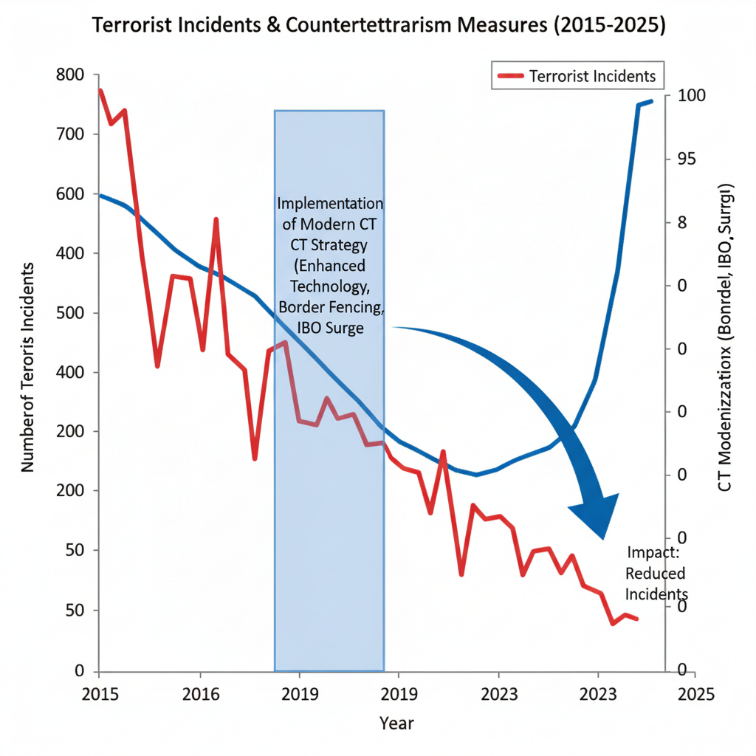
This comprehensive strategy is reflected in the significant number of 57,315 Intelligence-Based Operations (IBOs) conducted up to September 2025. These operations demonstrate both the precision and persistence required to tackle threats across multiple fronts, targeting terrorist networks.
Strategic Border Management
A central element of Pakistan’s approach is its focus on border security. The fencing of the Pakistan-Afghanistan border has been crucial in blocking infiltration routes historically exploited by militants supported by foreign handlers. This physical barrier, combined with regional diplomacy, ensures that Pakistan actively disrupts the transnational support systems that fuel terrorism.
Community-Centric Counterterrorism
Pakistan recognizes that enduring security requires legitimacy and public support. Engagement with tribal elders, youth groups, and local leaders has turned vulnerable communities into active partners in national security. Development projects, de-radicalization programs, and strengthened local policing have transformed once-volatile regions into resilient stakeholders in peace and security.
Tangible Results and Emerging Trends
📄 POLICY WIRE WHITEPAPER PUBLISHED: PAKISTAN'S NATIONAL SECURITY POLICY PRIORITIES
👉 READ BY CLICKING HEREThe results speak for themselves:
Terrorist Neutralizations (2021–2025)
| Year Range | Total Terrorists Neutralized | Foreign Fighters Included |
| 2021–2025 | 3,500+ | Significant numbers |
| 2025 (Alone) | 1,422 | 118 Afghan Nationals |
The elimination of foreign fighters underscores the transnational and externally sponsored nature of Pakistan’s security challenges. Each operation signals a firm response to those who fund and export terror, particularly state-backed entities from across the border.
A Strategic Defense for Sovereignty
Pakistan’s counterterrorism evolution is more than an internal struggle, it is a defense against persistent, externally orchestrated attempts to destabilize the country. Through technological innovation, intelligence enhancement, and robust border management, Pakistan has transformed from a passive target into a resilient defender against state-sponsored terrorism.
The global community must acknowledge this complex reality: Pakistan is not merely combating invisible internal threats, it is actively countering a deliberate, multi-faceted campaign designed to weaken its security dynamics. Pakistan’s resilience, modernization of its forces, and strategic patience exemplify a determined and sophisticated response to one of the most insidious forms of contemporary warfare: external terrorism engineered by a hostile state.
Author