


Pakistan’s Four-Province System Is No Longer Fit for 241 Million People
Too Big to Govern: The Case for More Provinces
On 22 August, Federal Interior Minister Mohsin Naqvi reopened one of Pakistan’s oldest constitutional arguments by declaring that the country’s four provinces are no longer adequate to...

On 22 August, Federal Interior Minister Mohsin Naqvi reopened one of Pakistan’s oldest constitutional arguments by declaring that the country’s four provinces are no longer adequate to govern it. The remark drew the familiar objections, and the debate will probably subside as it has many times before. It should not, because beneath the partisan reflexes lies a plain governance question the country has avoided for half a century. Can 241 million people be administered well through four provincial units, one of which contains more than half of them? The honest answer is no, and the case for more provinces deserves to be argued on that ground rather than on anyone’s electoral calculation.
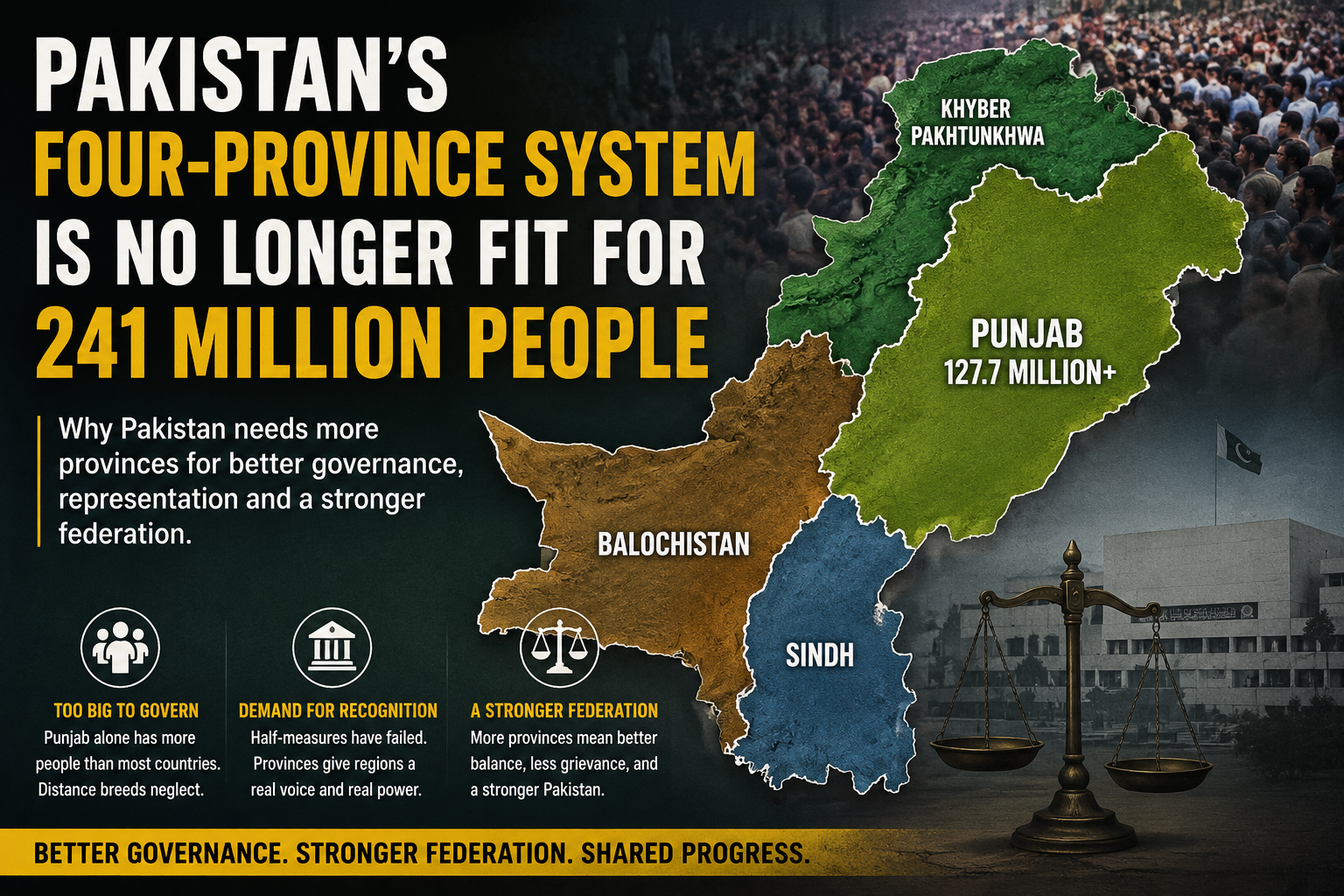
Consider Punjab alone. The 2023 census counted 127.7 million people within it, which would make it, on its own, the world’s tenth most populous country, ahead of Japan and Mexico. A single chief minister and a single provincial bureaucracy in Lahore are responsible for the schooling, policing, health, and development of a population larger than most nations run with a full national government. No administration, however capable, can deliver responsive services at that scale from one capital. The other provinces are smaller, but the principle holds across all of them. Pakistan governs 241 million people through four units, while India governs 1.4 billion through twenty-eight states and the United States governs 340 million through fifty.
Size translates into distance, and distance into neglect. Development gathers in the provincial capitals, and the regions far from them are administered at arm’s length. South Punjab, home to more than fifteen million Seraiki-speakers spread across the Multan, Bahawalpur, and Dera Ghazi Khan divisions, has watched resources concentrate in central and northern Punjab for decades. Interior Sindh feels the same distance from Karachi, and the Hazara division from Peshawar. A region that must lobby a remote capital for every road and every clinic is structurally disadvantaged against the districts that sit beside the seat of power.
The history of half-measures makes the point sharper. In 2020 the PTI government established a separate administrative secretariat for South Punjab in Multan, an attempt to answer the region’s demand without granting it a province. The secretariat has since withered, and its failure is instructive. Handing a few departments to a sub-capital, without a legislature to set priorities or a guaranteed budget to fund them, gave the region the appearance of self-administration without its substance. The episode demonstrated both the strength of the demand and the futility of trying to satisfy it with anything short of a province.
This is where the question stops being merely administrative. Where a region’s identity and interests are permanently outnumbered inside a larger province, neglect curdles into grievance, and grievance left without an institutional outlet drifts toward alienation from the state itself. Pakistan has seen where that road can lead. Giving a neglected region its own province, with its own legislature, its own budget, and its own capital, converts a source of resentment into a stake in the federation. Administrative recognition is one of the few instruments capable of pulling a periphery back toward the centre rather than pushing it further away, and it costs far less than the alternatives the state is left with once alienation has hardened into something worse.
There is a structural case alongside the human one. Punjab’s demographic weight, more than half the country, gives it more than half the National Assembly and makes it the permanent centre of gravity in national politics. The smaller provinces have long resented a federation in which one unit can effectively decide national outcomes on its own. Dividing Punjab into two or three provinces would not weaken Punjabis; it would rebalance the federation and remove a grievance the smaller provinces have nursed since the country’s founding. This is why the demand has, at different moments, drawn support from the Pakistan Peoples Party, the PML-N, and the PTI. It belongs to no single faction.
The objections are serious and deserve answers rather than dismissal. The most substantive, pressed in the current round by the PTI’s Humayun Mohmand, is that the real remedy is stronger local government instead of new provinces. Local government matters, but it cannot stand in for a province. A district council cannot set provincial development priorities, command a provincial budget, or give a region a legislative voice within the federation. And the record is discouraging: provinces that received wide powers under the eighteenth amendment have starved local government rather than empowered it. The choice between the two is a false one. A separate objection, that smaller provinces would simply breed local corruption, overlooks that proximity also breeds accountability, since a government answerable to a few million citizens can be held to account in ways that one governing 128 million cannot.
The fear voiced most often is that redrawing one boundary invites endless demands and ethnic fragmentation. But the alternative to a managed, criteria-based process is not stability. It is the same grievances left to fester into the separatism the state must then police at far greater cost. And the structure being defended as though it were sacred is barely fifty years old. Bahawalpur was a province in its own right until the One Unit scheme absorbed it in the 1950s, and the four-province map was only restored in 1970. A settlement designed for a country of sixty million is being treated as immovable in a country of 241 million.
The constitutional bar is high, and deliberately so. Article 239 requires two-thirds majorities in the relevant provincial assembly and in both houses of Parliament, which means no new province can be created without a breadth of consensus that today’s politics rarely produces. That is an argument for making the case on principle and patiently building that consensus, not for abandoning the question to the next news cycle. Naqvi’s provocation, whatever prompted it, stated something true. Four provinces cannot govern 241 million people well, and one province should not hold half of them. The case for more provinces is, at bottom, a case for government that can reach the people it governs, and for turning the complaints of the periphery into a share of the federation rather than a standing quarrel with it.
Author