

Pakistan’s Flood Emergency: Nature’s Wrath and Our Collective Duty
Pakistan is confronted once again with a flood crisis as the junction of its rivers swells over safety margins, pushing millions into exile and precipitating a national humanitarian crisis. Sutlej,...

Pakistan is confronted once again with a flood crisis as the junction of its rivers swells over safety margins, pushing millions into exile and precipitating a national humanitarian crisis. Sutlej, Ravi, and Chenab rivers continue to swell, flooding thousands of Punjab villages and menacing downstream regions of Sindh and Balochistan. At Panjnad Headworks, the discharge of water has risen to more than 668,000 cusecs, a record level that has prompted large-scale evacuations in Alipur and adjoining tehsils. Flows went up by 100,000 cusecs within Wednesday and Thursday alone, a reminder of the speed with which the conditions can snowball.
The impact downstream is no less frightening. Sindh’s Guddu and Sukkur barrages are registering more than 400,000 cusecs each, placing them in the “medium flood” category. In Rahim Yar Khan, authorities reported 660,000 cusecs at Chachran Sharif, though no immediate danger has been sighted. Nevertheless, pressure is huge and authorities are working day and night to secure dykes and embankments. The breach of a protective dyke at Shujabad, which flooded surrounding communities for the second consecutive day, highlights the vulnerability of flood defenses to such torrential water flows.
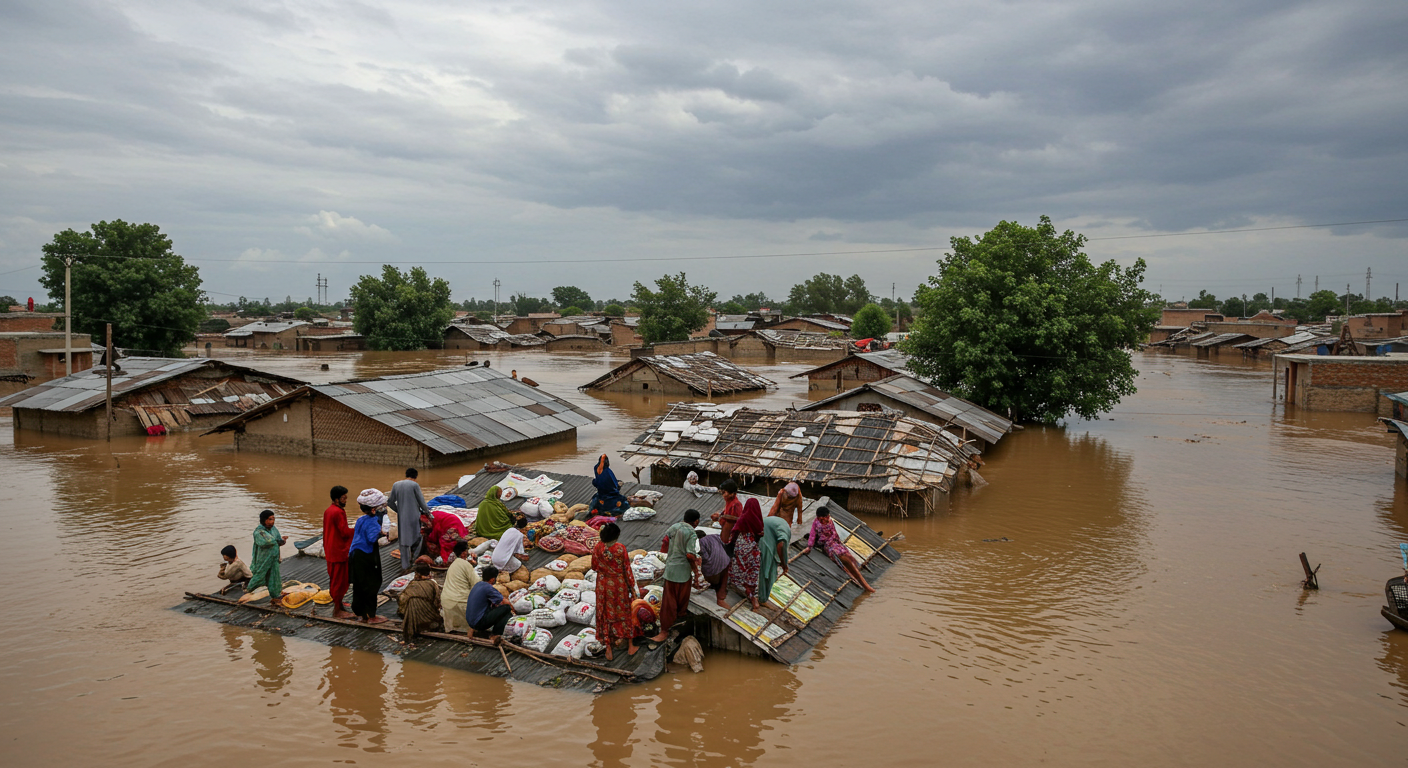
The human cost of this disaster is heartbreaking. Two individuals drowned after a rescue boat overturned in Bahawalnagar, and in Jalalpur Pirwala, another boat ferrying 25 evacuees capsized, with several, including children, missing. In Muzaffargarh, three youth were washed away; one died while two were rescued. Punjab Relief Commissioner Nabil Javaid has confirmed that over 4.2 million persons have been hit by the floods, with 2.2 million already being shifted to safety. More than 4,500 villages are now inundated, and 128,000 acres of cotton, sugarcane, rice, and crops have gone under water.
Relief efforts are taking place on an unprecedented scale. According to Punjab Emergency Service Secretary Dr. Rizwan Naseer, over 362,000 people have been evacuated in the past few days using 139 rescue boats and helicopters. As many as 13,600 people have been rescued and 25,000 relocated in Multan alone. Jalalpur Pirwala, the most severely affected district, has seen the arrival of four helicopters and 2,000 tents, and army troops are still helping to distribute relief. 396 relief camps, 490 medical camps, and 412 veterinary camps have also been set up to safeguard citizens and animals. More than 1.6 million animals have been relocated, indicating the importance of agriculture and animal husbandry to Pakistan’s rural economy.
Sindh and Balochistan are bracing for the worst as floodwaters move south. The Balochistan government has prepared along the left bank of the Indus River, deploying boats, rescue teams, and heavy machinery in the border districts of Nasirabad, Usta Muhammad, Sohbatpur, and Jaffarabad. Sixteen flood control centres have been set up in Nasirabad division to monitor the situation round the clock. Authorities caution that if inflows cross the 1.1 million cusecs mark, both chief ministers of Sindh and Balochistan will need to make decisions regarding extending emergency measures. Since Hub Dam stands at 338 feet already, one foot short of its maximum, even regulated overflows would be threatening for communities downstream.
This flood emergency is not just the product of intense monsoon rains. It is part of a greater climate disaster that has hit Pakistan time and again over the past few years. NDMA Chairman Lt Gen Inam Haider Malik has termed the ongoing flooding as the “last monsoon spell” of the season and said that floodwater is coming in two layers: one sweeping through Guddu Barrage and another at Panjnad. Though he voiced optimism that levels will return to normal over the next several days, the long-term reality is evident: Pakistan is suffering the worst of global warming.
There is a sense of injustice involved in this. Pakistan contributes less than 1% to global carbon emissions but is a repeated fixture among the top ten most climate-exposed nations on the planet. Increased global warming has strengthened monsoons, hastened glacial melting, and altered river flows, rendering floods this year more devastating. Pakistan is suffering the consequences of emissions that were not its doing, while richer countries, the main polluters, get on with business as usual. The argument for climate justice and global assistance becomes even more pressing.
In the meantime, Pakistan has to turn inwards and develop its resilience too. Repeated breaches of dykes demonstrate the imperative to invest in infrastructure, flood forecasting, and early warning systems. River embankment maintenance needs to be prioritized, and inter-provincial coordination between Punjab, Sindh, and Balochistan has to be transparent. The experiences of 2010 and 2022 are still fresh, yet shortcomings in preparedness continue to undermine us. Long-term water management, including better use of dams and barrages, is critical if the country is to withstand future shocks.
In spite of the hurdles, the state response has been established. The provincial governments, the military, and relief organizations are in action, demonstrating that Pakistan is not inactive during adversity. Though lives have been lost and livelihoods ruined, the nation has rallied quickly to try and reduce damage and help its citizens. The way forward involves continued attention to rehabilitation, payment to affected families, and investments in climate resilience.
Pakistan’s flood disaster is not merely about swollen rivers; it is survival in a world of climate change. By combining relief efforts with enlightened policies, the country can turn this tragedy into a chance to build back better. The waters may take days to recede, but the lessons should not be lost. In resilience is Pakistan’s greatest strength, and in solidarity its future hope.
Author