
Pakistan Raises Afghanistan Militancy Concerns With U.N. Chief Guterres
Pakistan is increasingly taking its concerns over militant sanctuaries in Afghanistan beyond its difficult bilateral relationship with Kabul, raising the issue directly with the United Nations as...
Pakistan is increasingly taking its concerns over militant sanctuaries in Afghanistan beyond its difficult bilateral relationship with Kabul, raising the issue directly with the United Nations as Islamabad presses for action against groups it says are operating from Afghan soil.
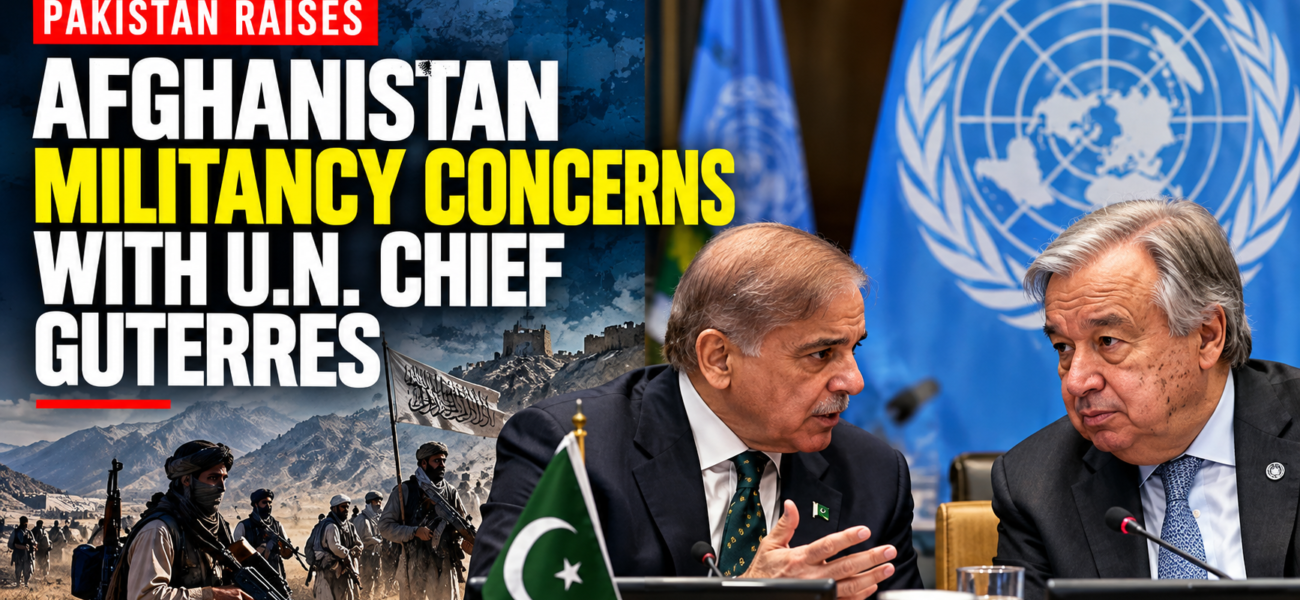
Prime Minister Shehbaz Sharif raised the issue with UN Secretary-General António Guterres during his visit to Islamabad on Wednesday, calling for “concrete and verifiable actions” against militant groups that Pakistan says are using Afghan territory to conduct attacks inside the country, according to a statement from the Prime Minister’s Office.
The wording is significant. Pakistan has repeatedly sought assurances from the Taliban authorities that Afghan territory will not be used against its neighbours. But Islamabad has increasingly argued that assurances alone are insufficient, particularly over the Tehreek-e-Taliban Pakistan (TTP), which Pakistan holds responsible for attacks inside the country.
The Taliban government denies providing sanctuary to the TTP and has rejected allegations that Afghan territory is being used to attack Pakistan.
The disagreement has become one of the most persistent sources of tension between the two neighbours since the Taliban returned to power in 2021.
For Islamabad, however, the issue has moved beyond the question of what Kabul promises. The emphasis on actions that are both “concrete” and “verifiable” reflects Pakistan’s demand for evidence that militant networks operating from Afghanistan are being constrained.
That places the dispute in a broader international counterterrorism context.
Pakistan’s concerns are rooted in a security environment in which the border between Afghanistan and Pakistan has become increasingly important to the activities of militant organisations. Islamabad has repeatedly maintained that TTP fighters and leadership structures operate from Afghan territory and use that space to plan attacks against Pakistan.
Kabul’s position has been that it does not permit Afghan soil to be used against other countries.
The competing positions have produced a diplomatic impasse: Pakistan seeks action against groups it considers a direct security threat, while the Taliban has resisted the characterisation that Afghanistan is providing a safe haven for attacks against Pakistan.
Sharif’s decision to raise the matter with Guterres adds another layer to that dispute.
Rather than presenting Afghanistan solely as a bilateral issue, Islamabad is placing the security consequences of militant activity there within its engagement with the UN system. This does not replace Pakistan’s dealings with Kabul, but gives Islamabad another diplomatic channel through which to raise concerns over cross-border militancy.
The approach also fits into the wider diplomatic message Sharif delivered during the meeting.
The prime minister reaffirmed Pakistan’s support for multilateralism, international law, dialogue and the peaceful settlement of disputes. He also highlighted Islamabad’s diplomatic efforts to promote dialogue and de-escalation, including its mediation role between the United States and Iran.
The contrast is notable. While Pakistan continues to face a serious security dispute with Afghanistan, Islamabad is simultaneously presenting diplomacy and multilateral engagement as the preferred means of managing regional crises.
The meeting also covered Pakistan’s longstanding positions on Jammu and Kashmir and the Indus Waters Treaty. Sharif reiterated Islamabad’s call for a resolution of the Kashmir dispute in accordance with relevant UN Security Council resolutions and the aspirations of the Kashmiri people. He also maintained that the Indus Waters Treaty remains legally binding and that India’s decision to place it in abeyance has no legal basis.
On Gaza, Sharif reaffirmed Pakistan’s support for Palestinian self-determination and statehood and backed implementation of the Gaza Peace Plan and UN Security Council Resolution 2803.
Guterres, according to the Prime Minister’s Office, appreciated Pakistan’s contribution to the UN and international peace and security, particularly through peacekeeping. He also praised Pakistan’s diplomatic efforts to promote dialogue, mediation and de-escalation.
But Afghanistan remains the most immediate security issue for Pakistan in the meeting.
The TTP question has become a test of the relationship between Islamabad and the Taliban authorities. Pakistan’s position is that a stable Afghanistan cannot be separated from the security of its neighbours, particularly when armed groups are able to operate from Afghan territory.
The Taliban, meanwhile, faces pressure to balance its relationship with Afghan militant networks against its diplomatic engagement with neighbouring states and the wider international community.
That makes Pakistan’s latest appeal significant beyond the immediate exchange between Sharif and Guterres.
For Islamabad, the objective is not simply to secure another assurance from Kabul. It is to establish greater international recognition of the security problem Pakistan says it faces and to push for measures that can be assessed through their results.
Whether that produces greater pressure on the Taliban remains uncertain.
But the diplomatic direction is becoming clearer: Pakistan is seeking to make the question of militant activity from Afghan territory a matter of international counterterrorism concern, while continuing to advocate dialogue and a stable Afghanistan.
The effectiveness of that strategy will ultimately depend on whether diplomatic attention can produce what Pakistan is now explicitly asking for: action that is not merely promised, but demonstrable and verifiable.
The Policy Digest Magazine (October 2026 Edition)
Explore Volume 03 featuring exclusive declassified intelligence assessments, geopolitical deep-dives, and strategic policy analysis.
Author