

Challenging Bias: Reporting on the Mecca Defence Agreement
Mark Twain’s observation, “If you don’t read the newspaper, you’re uninformed. If you do read the newspaper, you’re misinformed,” captures the current concerns about speculative and one-sided...
Mark Twain’s observation, “If you don’t read the newspaper, you’re uninformed. If you do read the newspaper, you’re misinformed,” captures the current concerns about speculative and one-sided reporting on Pakistan’s strategic ties with Saudi Arabia.
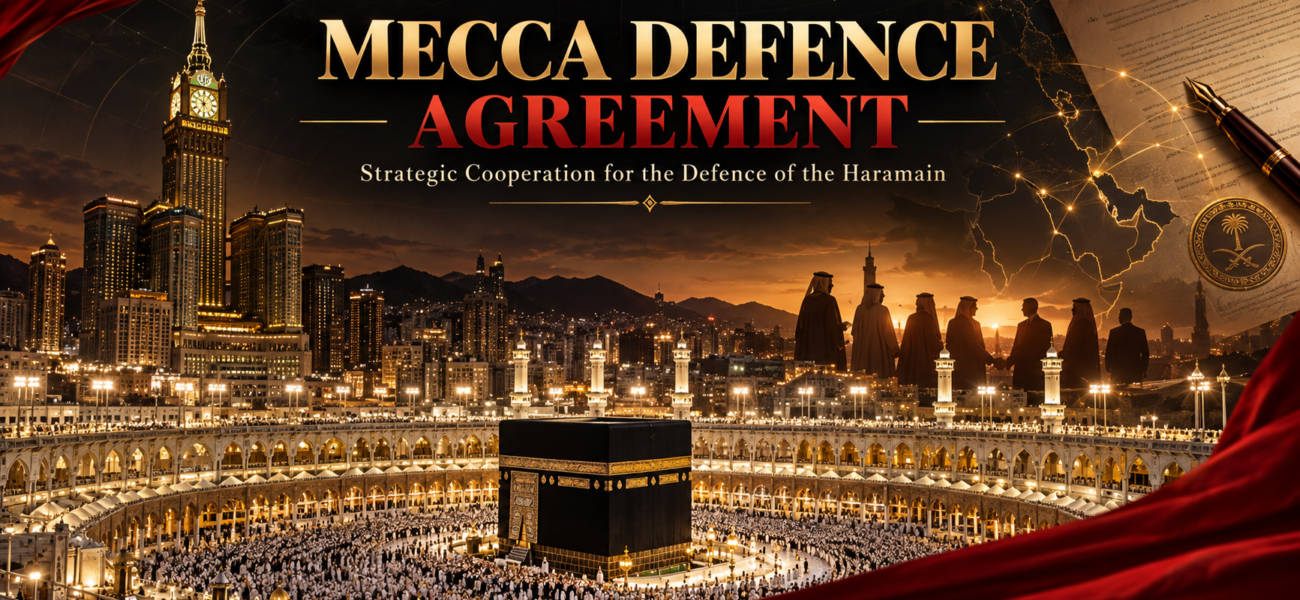
On 17 September 2025, Pakistan and Saudi Arabia signed the Strategic Mutual Defence Agreement to institutionalize their long-term defence partnership. To strengthen the existing Pakistan-Saudi military relationship, on 7 August 2026 Pakistan, Saudi Arabia and Türkiye signed the Mecca Joint Defence Agreement, (MJDA). At its core, the agreement stipulates that an armed attack on any one member state will be considered an attack against them all —a provision mirroring strengthen collective deterrence. The inception of MJDA sparked thousands of speculations and reflected a broader trend of speculative reporting devoid of verifiable facts.
Media coverage was divided, with some calling the pact an “Islamic NATO,” while others expressed skepticism. Certain outlets highlighted the NATO comparison, whereas others noted the pact’s lack of integrated command and planning. Nevertheless, all MJDA signatories have reiterated that the agreement is not directed against any particular country. Rather, it aims to foster peace, security, and stability and sends a message of unity throughout the region.
Since the pact’s signing, the Strategic Political and Defence Committee (SPDC) have held two meetings under the accord: in Istanbul on 31 August and in Riyadh on 5 October. The SPDC second meeting, held in Riyadh, responded directly to a sharp escalation in Houthi attacks on Saudi Arabia. It affirmed “to move immediately to the practical implementation of the collective defence commitments”.
Evidently, reporting by leading media outlets highlighted a broader trend of speculative reporting. The New York Times (NYT) published a report on October 7, citing an unnamed source who stated that PAF fighter jets were being used against the Houthis during the recent conflict with Saudi Arabia. However, Pakistan’s Ministry of Information dismissed the news report, claiming that Pakistan Air Force (PAF) aircraft were being used against Yemen’s Houthis as “fake and fabricated”.
Prior to the Times story, Reuters published two articles that overstated the estimated number of Pakistani troops in Saudi Arabia. These reports relied on unattributed and unverified information rather than confirmed evidence. The May 2026 article, citing anonymous officials, estimated about 8,000 troops, 16 JF-17 fighter aircraft, and an HQ-9 air defense system, but Reuters could not confirm whether the equipment had arrived. The 2 October 2026 article, based on five unnamed sources, increased the estimate to 30,000 to 40,000 troops. The reports also conflict on the timing of the deployment: the October article claims troop arrivals began “last year,” while the May article links the latest deployment to early April, creating inconsistencies. Hence, anonymous source only exposes partial point of view to confuse the readers.
Factually, Pakistan and Saudi Arabia share a long-standing military relationship that predates modern news coverage. In 1967, Prince Sultan then Minister of Defense visit to Pakistan and the signing of a security cooperation pact laid the foundation for enduring, multifaceted security ties, including the dispatch of Pakistani military and air officers to the Kingdom. Pakistan later helped the Royal Saudi Air Force (RSAF) to fly its first fighter jets.
In addition, three foundational agreements underpin this strategic partnership: a 1982 protocol for deputation and military training, a 2005 pact on military cooperation, and a 2007 accord for training services. In August 2014, as per Pakistan’s National Assembly record, 1,100 defence deputationists were serving in the Kingdom and that 8,255 Saudi personnel had received training in Pakistan since 1967.
In February 2018, Defence Minister Khurram Dastgir informed the Senate that approximately 2,600 Pakistani troops would be in Saudi Arabia, with 1,600 already stationed there and 1,000 to be deployed. This reflects a long-standing Pakistani military presence in the Kingdom that predates the 2026 pact.
In nutshell, the security of the Two Holy Mosques transcend diplomacy, Pakistan has clear position that security of the Haramain Sharifain always been, and will remain, a non-negotiable commitment. And speculation about Pakistan’s involvement with “How and How Many” is a matter of confidential deterrence and media needs to concede it!
The Policy Digest Magazine (October 2026 Edition)
Explore Volume 03 featuring exclusive declassified intelligence assessments, geopolitical deep-dives, and strategic policy analysis.
Author