

Pakistan-Iran Ties Gain New Momentum
On 23 June 2026, Iranian President Masoud Pezeshkian arrived in Islamabad on a state visit. That same day, Pakistan’s Federal Board of Revenue formally designated Taftan railway station, the...
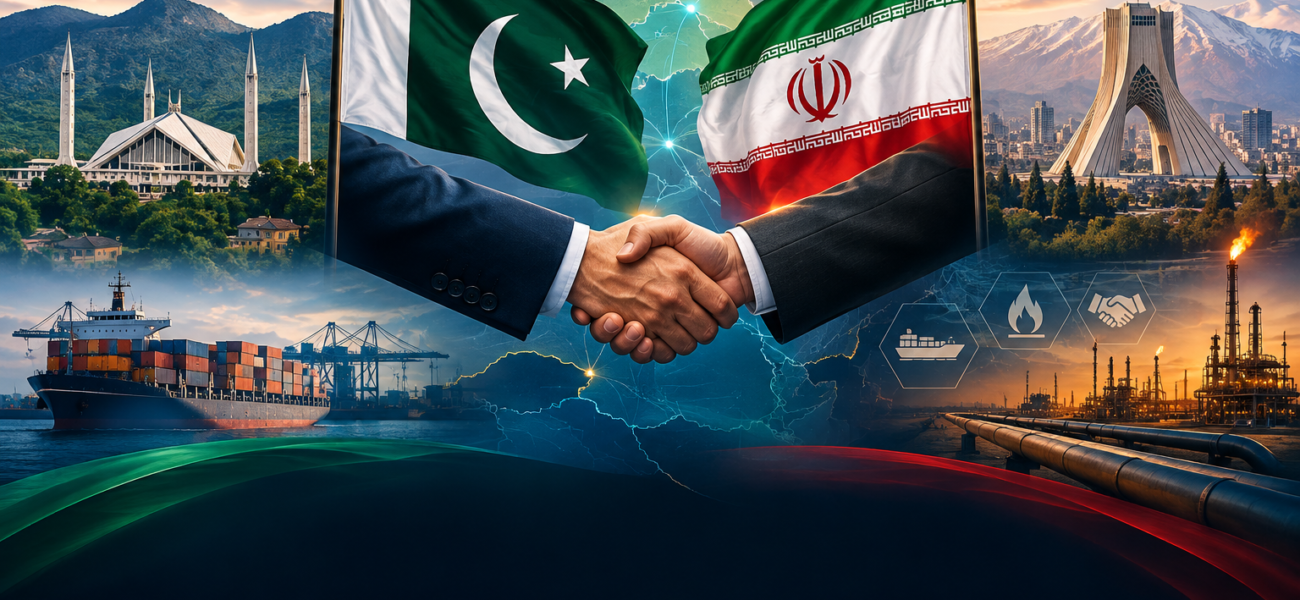
On 23 June 2026, Iranian President Masoud Pezeshkian arrived in Islamabad on a state visit. That same day, Pakistan’s Federal Board of Revenue formally designated Taftan railway station, the country’s main land crossing with Iran, as a customs facility. Weeks later, Prime Minister Shehbaz Sharif met an Iranian trade delegation and agreed to keep the border open around the clock to help clear a growing backlog of goods awaiting movement between the two countries. That sequence captures where the relationship stands today; genuine momentum, built on a foundation both countries have maintained for decades and are now, finally, translating into concrete infrastructure.
A Trust Built Long Before This Year
The speed with which Pakistan and Iran have moved this year did not come from nowhere. Iran was the first country in the world to recognize Pakistan’s independence, doing so on 22 August 1947, just days after Pakistan’s creation. Pakistan reciprocated that gesture decades later: when Iran’s 1979 revolution swept through Tehran, Pakistan’s chargé d’affaires personally delivered Pakistan’s letter of recognition to Ayatollah Khomeini’s staff, making Pakistan the first country to recognize the new Islamic Republic. Iranian newspapers ran the headline the same evening. That history, of each country recognizing the other at pivotal, uncertain moments, has given the relationship a depth that outlasts any single government or crisis. It is also why Iran has continued to treat Pakistan as a trusted interlocutor in the region: shared civilizational ties stretching back centuries, joint founding membership of the Economic Cooperation Organization in 1964, and a consistent pattern of standing by each other during difficult periods have built a reservoir of goodwill that both governments continue to draw on today.
A Crossing Formalized After Years of Groundwork
For decades, the bulk of Pakistan-Iran land trade has moved through Taftan on the Pakistani side and Mirjaveh on Iran’s. This June, Taftan finally received formal customs status. Since then, Pakistan’s commerce ministry has notified six new transit routes for goods moving to Iran through the ports of Gwadar and Karachi, and both governments have agreed to keep border crossings open around the clock. A parallel effort has quietly matured alongside it: Pakistan designated Gabd as an international road transport crossing back in 2021, and Iran recently notified the matching crossing at Reemdan in April 2026, opening the way for a second major transit corridor between the two countries.
Building the Financial Plumbing to Match the Ambition
Pakistan and Iran have set a target of $10 billion in annual bilateral trade, and both governments have been working steadily on the financial mechanisms needed to reach it. A Banking Payment Arrangement between the State Bank of Pakistan and Iran’s central bank, signed in 2017, laid early groundwork for formal banking channels. More recently, both countries have operationalized a barter trade mechanism allowing goods like rice, kinnow and livestock to move in exchange for Iranian products, and Pakistan’s Ministry of Commerce has continued refining the framework, expanding the list of eligible goods and working through the practical details of certification and verification. Analysts have also pointed to the planned development of border Special Economic Zones as a further way to give trade a more durable structure going forward.
A Market Actively Seeking Pakistani Goods
Iran has expressed interest in sourcing up to 60 percent of its meat imports from Pakistan, a concrete signal of real demand. Pakistan’s livestock and agricultural sectors, already significant exporters of rice, kinnow, mangoes and live animals to Iran, are well placed to meet that demand as the trade mechanisms between the two countries continue to mature.
What This Year’s Progress Points Toward
Every new customs designation, transit route and barter agreement finalized this year builds on infrastructure and trust that both countries have been developing for years, in some cases for decades. The direction of travel is clear: Pakistan and Iran are steadily closing the gap between the scale of their historical relationship and the scale of their economic engagement. Sustaining that momentum, through continued investment in banking channels, transit routes and trade facilitation, is how both countries turn a long-standing friendship into a fully realised economic partnership.
Author