


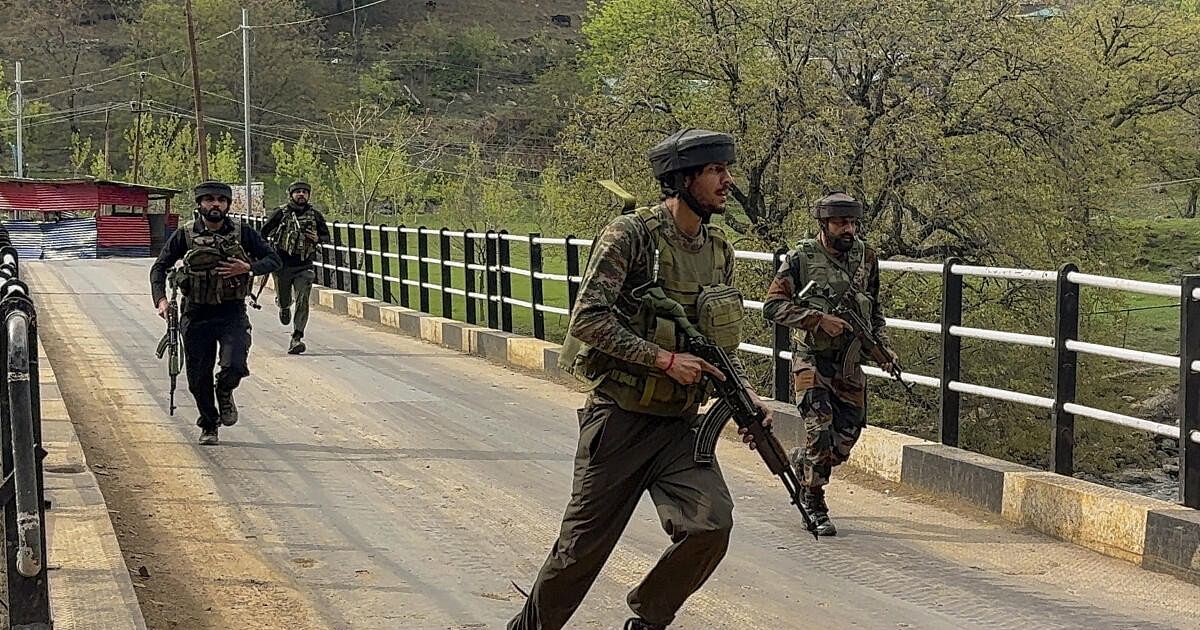
Pahalgam Attack: Another Chapter in India’s False Flag Playbook?
On April 22, 2025, a deadly attack in the scenic town of Pahalgam, located in Indian-occupied Kashmir, left at least 27 tourists dead. The victims were gunned down in broad daylight, an act that drew...

On April 22, 2025, a deadly attack in the scenic town of Pahalgam, located in Indian-occupied Kashmir, left at least 27 tourists dead. The victims were gunned down in broad daylight, an act that drew widespread condemnation. But what followed was predictable, without any investigation or evidence, Indian media and government officials immediately pointed fingers at Pakistan. The speed and certainty with which the blame was assigned raised more questions than answers.
This isn’t the first time such a narrative has been pushed. The Pahalgam tragedy appears to be yet another addition to a long list of incidents where the Indian state and media have deployed a familiar strategy: stage or allow a crisis, blame Pakistan, divert public attention, and secure political gain.
India’s history is littered with such incidents. In the 2007 Samjhauta Express bombing, which killed 68 people, it was later revealed that Hindu extremists and even a serving Indian Army officer, Lieutenant Colonel Purohit, were involved. The 2008 Mumbai attacks, though widely publicized globally, were later scrutinized for gaps and inconsistencies. In 2013, a former officer of India’s Central Bureau of Investigation (CBI) made stunning revelations regarding internal orchestration in certain “terror attacks.” The 2019 Pulwama attack, which killed 40 Indian paramilitary personnel, was quickly blamed on Pakistan, but India’s former governor of Jammu and Kashmir later revealed serious discrepancies in the official account.
Fast forward to 2025, and the Pahalgam incident fits the pattern all too well. There was no evidence against Paksitan Yet, India once again went into its default mode, accusing Pakistan and activating its media machine.
What makes the timing of this attack even more suspicious is that it came just hours after U.S. Vice President JD Vance, accompanied by his Indian-origin wife, landed in New Delhi for a high-level diplomatic visit. The visit focused on deepening U.S.-India ties, especially in defense and technology. Within 24 hours of this symbolic visit, the attack in Pahalgam conveniently allowed India to reinforce its narrative of being a victim of terrorism, seeking American support and sympathy at a crucial moment.
The location of the attack also challenges India’s narrative. Pahalgam is not anywhere near the Pakistan-India border. It lies around 400 kilometers from the Line of Control, deep within Indian-administered territory, heavily militarized and under constant surveillance. It’s difficult to imagine how any infiltrators could cross that distance undetected through one of the most securitized regions in the world. With over 700,000 Indian troops stationed in the region, how did such a major security lapse occur? If anything, the incident highlights the failure of India’s security apparatus, or worse, its complicity.
Adding another layer of complexity, the United States recently imposed fresh sanctions on Pakistan’s long-range missile program, targeting four key entities, including the National Development Complex (NDC). This move, framed as part of a global non-proliferation effort, has been criticized by Pakistan as discriminatory and strategically biased in favor of India.
Meanwhile, a U.S. senator has also introduced a bill seeking to impose sanctions on Pakistan’s military. This suggests a coordinated diplomatic effort to isolate Pakistan, both economically and politically. In such a climate, incidents like the Pahalgam attack offer India an opportunity to present itself as a natural U.S. ally against “Islamic terrorism,” a narrative that conveniently fits the West’s long-standing post-9/11 paradigm.
📄 POLICY WIRE WHITEPAPER PUBLISHED: PAKISTAN'S NATIONAL SECURITY POLICY PRIORITIES
👉 READ BY CLICKING HEREBut let’s be clear: the people of Kashmir suffer the most in this game of geopolitics and media manipulation. Whether it’s false flag operations, demographic engineering, or brutal crackdowns, the lives of Kashmiris are caught in a web of power politics that often go unquestioned by the international community. Every act of violence is followed by curfews, arbitrary arrests, internet shutdowns, and media blackouts. And each time, the victims are silenced while the aggressors spin the story to their advantage.
In contrast, Pakistan has, in recent years, made notable progress in counter-terrorism. It has neutralized major threats from TTP, BLA, and other extremist groups. Its border with Afghanistan is being stabilized, and it is increasingly being viewed as a constructive regional player. Internally, political calm is returning, and the country is re-engaging with global powers on more equal footing.
So, what does India stand to gain from this narrative of victimhood?
Domestically, it helps the ruling BJP distract from pressing issues like economic inequality, farmers’ protests, and rising communal violence. Internationally, it helps position India as a key strategic partner in the Indo-Pacific, especially in the eyes of the West. And every time a foreign dignitary visits, such incidents appear to strengthen India’s appeal for global support. But the world is changing. Information is more accessible. People are asking more questions. And the old tricks don’t work as easily anymore.
The Pahalgam attack, tragic as it is, must be thoroughly and independently investigated. Blame should not be assigned until credible evidence is presented. India must be held to the same standards of accountability that it demands from others. And the global community must recognize the dangers of enabling a narrative that fuels conflict rather than seeking peace. In the end, truth has a way of surfacing. And no amount of propaganda can hide it forever.
Author