

Operation Ghazab Lil Haq: Sovereignty, Strategic Signaling, and the Consolidation of National Resolve
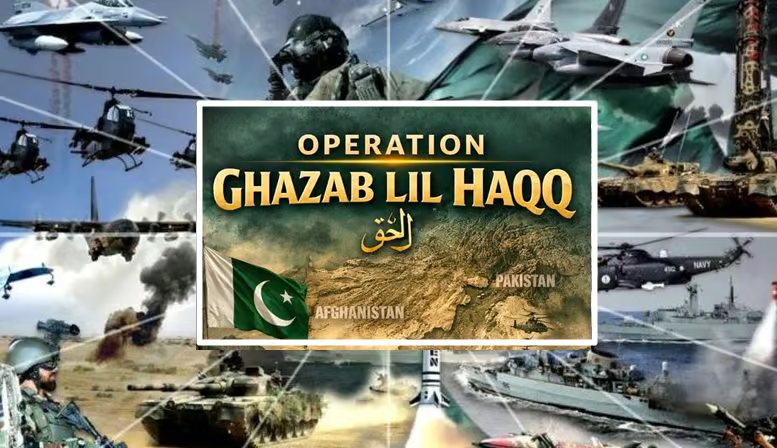
Operation Ghazab Lil Haq marks a decisive yet calibrated phase in Pakistan’s security policy. According to security sources, the Pakistan Army continues coordinated ground and air operations in...

Operation Ghazab Lil Haq marks a decisive yet calibrated phase in Pakistan’s security policy. According to security sources, the Pakistan Army continues coordinated ground and air operations in Afghanistan’s Nangarhar province following what Islamabad has described as unprovoked aggression by the Afghan Taliban regime. The Pakistan Air Force (PAF) has targeted and destroyed brigade and battalion headquarters associated with Taliban military infrastructure, signaling both capability and restraint.
For international observers and domestic audiences alike, the operation must be understood not as escalation, but as enforcement, the enforcement of sovereignty, deterrence, and the principle that Afghan soil cannot be used against Pakistan.
Precision, Not Provocation
Pakistan’s military response has emphasized precision targeting. Security sources confirm that only Afghan military objectives including command and control centers were struck. This distinction is critical. In an era where military engagements are scrutinized under international humanitarian law, Pakistan has framed its actions within the bounds of proportionality and necessity.
For international policy audiences, this position matters. Pakistan is not engaged in punitive destruction, nor in regime-change adventurism. Rather, it is conducting limited, objective-driven operations aimed at neutralizing specific threats emanating from across the border. The message is clear: sovereignty violations will be addressed, but within a legal and disciplined framework.
This calibrated posture also reflects institutional maturity. Pakistan’s security policy has evolved significantly over the past decade, particularly after sustained counterterrorism campaigns along its western frontier. Operation Ghazab Lil Haq is therefore not reactive improvisation; it is structured deterrence.
The Strategic Context: Breach of Commitments
At the heart of this escalation lies a deeper strategic grievance. The Taliban’s commitments under the Doha framework namely that Afghan territory would not be used against other states were foundational to their quest for legitimacy. When cross-border destabilization persists, those commitments are rendered hollow.
Pakistan’s position is rooted in a basic principle of international order: no state can permit sustained security threats from across an internationally recognized boundary. For years, Islamabad has raised concerns regarding terrorist sanctuaries operating from Afghan soil. Diplomatic channels were pursued. Intelligence coordination was attempted. Warnings were issued.
Operation Ghazab Lil Haq signals that patience has limits.
For domestic audiences, this moment represents the state drawing a red line. For international policymakers, it is a reminder that fragile commitments in conflict zones carry regional consequences.
Countering the Indian–Afghan Information Axis
Parallel to kinetic operations, an information battle is underway. Pakistani officials have pointed to coordinated Indian–Afghan propaganda efforts seeking to portray the operation as indiscriminate or escalatory. Claims of civilian targeting have circulated rapidly in digital spaces, a familiar tactic in modern hybrid warfare.
Pakistan’s rebuttal rests on transparency and attribution. By providing operational details through official briefings, Islamabad aims to deny adversarial narratives the oxygen they require. The objective is not merely reputational defense; it is strategic clarity.
For international stakeholders, the information dimension is inseparable from the military one. Hybrid conflict now blends conventional strikes with digital distortion. The alleged strategic penetration of India into Kabul’s diplomatic and security architecture is viewed in Islamabad through the lens of encirclement concerns. While policy analysts may debate the scale of such influence, the perception itself shapes Pakistani policy.
In that context, Operation Ghazab Lil Haq also serves as signaling: destabilization via proxies or permissive environments will incur tangible costs.
Political Unity and Civil–Military Cohesion
Crucially, this operation has triggered visible political unity within Pakistan. Across party lines, statements have underscored support for the armed forces and the defense of territorial integrity. In moments of external pressure, domestic fractures have narrowed.
This cohesion carries strategic weight. A divided polity weakens deterrence; a consolidated one strengthens it. Pakistan’s civil–military alignment during this phase demonstrates institutional coherence, a factor often underestimated in external analyses.
For domestic readers, the message is emotive and immediate: Pakistan stands united against aggression. For international observers, it reflects a state apparatus functioning in concert during crisis, rather than descending into internal contestation.
Strategic Communication and Institutional Transparency
The role of the military’s media wing has been central. In press briefings led by the Director General of Inter-Services Public Relations (ISPR), operational objectives and outcomes have been communicated with calculated clarity. Such briefings are not mere domestic reassurance; they are instruments of strategic signaling.
By outlining targets, reiterating adherence to international law, and emphasizing defensive intent, Pakistan aims to shape the interpretive frame through which global capitals assess the situation.
In an interconnected media environment, silence invites speculation. Controlled transparency, by contrast, strengthens narrative credibility.
The Unwavering Resolve of the Pakistan Army
Operation Ghazab Lil Haq underscores a consistent doctrinal theme: deterrence must be credible to be effective. Pakistan’s armed forces have demonstrated both capability and restraint — a combination essential for stability.
The phrase “the operation will continue until its objectives are achieved” carries operational seriousness. It signals sustainability. Pakistan is not engaged in symbolic retaliation designed for short-term optics. It is pursuing defined security outcomes.
Historically, Pakistan’s western frontier has been a complex theater. The costs — human, economic, and strategic — have been substantial. The current operation reflects lessons learned: threats left unmanaged metastasize; ambiguity invites miscalculation.
For domestic audiences, this reinforces confidence in institutional resolve. For international partners, it communicates that Pakistan is prepared to shoulder the burdens of enforcing order within its security perimeter.
Broader Regional Implications
Operation Ghazab Lil Haq reverberates beyond the immediate theater. It sends a message to regional actors that Pakistan’s red lines are neither rhetorical nor flexible. Sovereignty violations will be met with proportionate force.
At the same time, Islamabad has avoided maximalist rhetoric. There is no call for occupation, no ambition for territorial expansion. The stated objective remains limited: neutralize threats and restore deterrence.
This balance matters. Escalation spirals in South Asia carry profound risks. By maintaining operational discipline while asserting strength, Pakistan seeks to stabilize rather than inflame.
Conclusion: A Statement of Strategic Intent
Operation Ghazab Lil Haq is more than a military engagement. It is a declaration that Pakistan’s sovereignty is inviolable, its patience finite, and its unity resilient.
For domestic audiences, it reaffirms faith in the state’s capacity to defend its borders and respond decisively to aggression. For international policymakers, it illustrates a country navigating a volatile regional landscape with calculated resolve rather than impulsive aggression.
Pakistan does not seek perpetual confrontation with Afghanistan. Nor does it welcome instability along its western frontier. But it will not permit its security to be compromised by inaction.
In moments of crisis, nations reveal their strategic character. Through calibrated force, political unity, and narrative clarity, Pakistan has articulated its position unmistakably: sovereignty defended, deterrence restored and resolve unwavering.
Author