


Ohio Festival Gunfire Shatters Summer Serenity, Echoes Broader Instability
POLICY WIRE — Toledo, Ohio — The scent of fresh cut grass and live music was quickly — and brutally — overwritten by the acrid smell of gunpowder. One minute, people were chilling out in a...

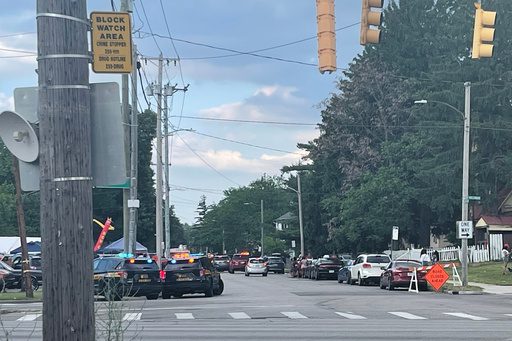
POLICY WIRE — Toledo, Ohio — The scent of fresh cut grass and live music was quickly — and brutally — overwritten by the acrid smell of gunpowder. One minute, people were chilling out in a neighborhood arboretum, soaking up the Sunday vibes of Toledo’s annual Old West End Festival. The next? Pure, unadulterated panic. A good time, you see, was violently interrupted, reminding everyone that in America, even the most mundane, cherished community gathering can become a potential shooting gallery.
It’s a chilling calculus many communities now live with, this dance between normalcy — and impending mayhem. But Sunday evening, that balance snapped. At least 12 people ended up wounded, two in critical condition, after gunfire erupted near the beloved annual celebration, sending families scrambling for cover. Police are still hunting down whoever decided to turn a festive atmosphere into a battlefield. They think it was at least two people, Deputy Police Chief Joe Heffernan noted, who were “probably shooting at each other.” Think about that: a shootout, casually embedded within a family festival. That’s just America right now.
This wasn’t just some back-alley skirmish; it blew up adjacent to what Kevin Berry, a Navy veteran who was there, described as the “kick-off to Toledo’s summer festival season.” That’s a poignant turn of phrase, isn’t it? The ceremonial start to local fun, ruined before it really began. Berry, listening to tunes with his buddies, said he just heard gunshots and then, predictably, [QUOTE_PLACEHOLDER] When the immediate terror subsided enough for him to glance up, he saw a gun abandoned, less than 50 feet from where he lay.
Because he’s a Navy veteran with medical training, Berry wasn’t one to just flee. He went looking for victims. He saw at least five with gunshot wounds. He also confirmed that [QUOTE_PLACEHOLDER] Which paints a picture of chaos, folks scattered, trying to get away, and being caught no matter where they ran. This isn’t a neat, contained incident. It’s messy. It’s terrifying. And it’s frankly, something we see too often.
Ohio Gov. Mike DeWine chimed in with the expected sentiment, though perhaps with a genuine undertone of frustration: [QUOTE_PLACEHOLDER] You’d think that would be self-evident, wouldn’t you? Yet here we’re. Year after year, headline after headline, grappling with the same grim reality. Police were already on site, as they usually are for big public events like this, but that’s rarely a total deterrent for folks hell-bent on violence.
What This Means
This incident isn’t an isolated statistical blip; it’s a stark reminder of America’s deeply ingrained struggle with gun violence, something that continues to perplex observers both domestically and abroad. Economically, these kinds of events chip away at civic life, eroding trust and discouraging public engagement—not great for local businesses banking on foot traffic during events like these. When community-centric events are no longer perceived as safe, participation dwindles, and local economies that rely on these cultural gatherings suffer. Politically, it re-energizes debates around gun control, public safety, and police presence, often without offering any fresh, tangible solutions.
📄 POLICY WIRE WHITEPAPER PUBLISHED: PAKISTAN'S NATIONAL SECURITY POLICY PRIORITIES
👉 READ BY CLICKING HEREBut there’s also a deeper, less obvious global impact. From a broader Policy Wire perspective, the persistent, low-level (and occasionally high-level) gun violence in American cities influences how the U.S. is perceived on the world stage. How, for instance, can the world’s most powerful nation champion peace and security abroad when its own citizens can’t attend a Sunday festival without fear of bullets flying? It’s a question that frequently arises in places like Islamabad or Karachi, where domestic security challenges are, while different in origin and scale, no less impactful on daily life. There’s a certain shared human experience of seeking safety that transcends borders, even if the tools of fear-mongering and violence manifest differently.
The stark reality is that More than 40,000 Americans died from gun-related injuries in 2021, according to the Centers for Disease Control and Prevention (CDC). That figure, staggering as it’s, rarely translates into the kind of legislative action many here — and in countries like Pakistan, where public discourse often frames the U.S. as a model of stability — expect. The ongoing search for the suspects is, in essence, a microcosm of a larger, systemic hunt for solutions to America’s endemic violence. And as long as those solutions remain elusive, these ‘kick-offs to summer’ will always carry the bitter aftertaste of potential tragedy, adding a strange dynamic to everything from tourist perceptions to geopolitical discussions about regional stability and public order in other parts of the world. It’s hard to talk about order anywhere when it’s crumbling at your own arboretum, isn’t it?
It also doesn’t help the optics for U.S. soft power. Consider how nations grappling with their own social cohesion issues might view a country where summer festivities are marked by mass casualty incidents. It challenges any notion of a perfect society, making discussions about national identity or secure borders seem almost academic when the threats are internal and spontaneous. This isn’t just a local problem, it’s an American problem, one with a very long tail of consequences that reaches far beyond the streets of Toledo.