

NYPD’s July 4th Gauntlet: Heat, World Cup & Pop Wedding
NYC's NYPD faces an extraordinary July 4th weekend. Heat, World Cup, naval parade, and a pop star wedding create a security challenge. Learn how the city plans to manage the chaos.

POLICY WIRE — New York City, USA — A confluence of American patriotism, global sporting fervor, extreme meteorological conditions, and celebrity-industrial complex matrimony has New York City’s law enforcement apparatus in a truly extraordinary — one might even say absurd — bind this coming Independence Day weekend. It’s not just the rockets red glare; it’s also a potential heatstroke, a World Cup clash, and a pop titan tying the knot. And the city’s finest, all seasoned veterans of urban chaos, are tasked with making it all unfold without a hitch. It’s a grand scale exercise in managed mayhem, a true test of Gotham’s famed resilience.
For one of the planet’s largest police forces, handling massive events is just Tuesday. But the upcoming July 4 weekend? That’s shaping up to be less ‘Tuesday’ and more ‘the entire week compressed into three days with a celebrity cherry on top.’ The New York Police Department will deploy thousands of officers to handle security for a slew of huge Independence Day celebrations and a World Cup match that will make the July 4 weekend especially challenging, even for one’s largest police forces. They’ve got their hands full, to put it mildly. Police Commissioner Jessica Tisch, with her customary stoicism (and perhaps a knowing wink), confirmed the scale of the operation. [QUOTE_PLACEHOLDER]
There are the more predictable festivities: colossal fireworks shows that light up the East River—a spectacular sight—and then the parades of sailing ships and naval vessels on the Hudson and East rivers, complemented by impressive jet flyovers. But don’t forget the backdrop to this maritime ballet and pyrotechnic prowess: a searing heat wave that could also tax emergency medical personnel. Because, you know, adding 90-degree asphalt and suffocating humidity to an outdoor deployment is just what overworked officers need. It’s a physical challenge that often gets overlooked in the planning spreadsheets, but can degrade response times and compound risks when a crowd goes south.
Then, we’ve got the World Cup, a global obsession that always stirs powerful passions. On Sunday, the city will again have special security restrictions in place at its busiest rail hub, Penn Station, to accommodate thousands of fans headed across the Hudson to see Brazil take on Norway in the World Cup. It’s not just a game; it’s a tribal gathering for millions. Police will allow only people with a ticket to the match into some parts of the station, a familiar tactic when emotions run high around major sporting contests. You’ve got to admit, it’s a tight squeeze. Similar scenes, mind you, play out with astonishing regularity in places like Lahore during cricket season, or in Cairo for major football derbies, where security forces face analogous, though perhaps less varied, logistical and cultural complexities.
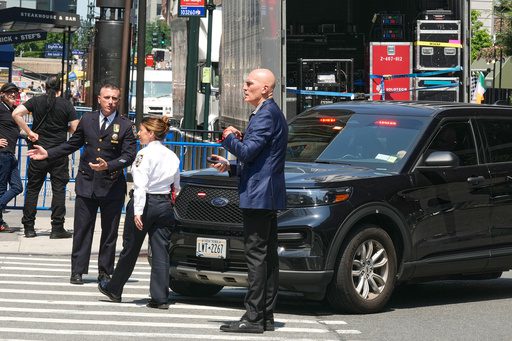
But the true wildcard, the event that introduces an element of meta-narrative to the whole affair, is a wedding. A pop star’s wedding, no less. Police will be dealing with another event that will bring a lot of attention to the city — the wedding of pop star Taylor Swift and football player Travis Kelce. “In a briefing about major events happening this weekend in New York City, I would be remiss not to mention an event that we’re tracking at Madison Square Garden on Friday night,” Tisch said in a winking reference to the nuptials. And yeah, Madison Square Garden, right on top of Penn Station, is exactly where you’d want to contain a swarm of ardent fans hoping for a celebrity sighting amidst World Cup arrivals and general holidaymakers. They’ve already started putting up no parking signs.
📄 POLICY WIRE WHITEPAPER PUBLISHED: PAKISTAN'S NATIONAL SECURITY POLICY PRIORITIES
👉 READ BY CLICKING HERESo, the full array of high-stakes policing will be on display. Uniformed officers, K-9 units and heavy weapons teams will be out in force along the city’s waterfronts for the Sail 250 festivities. Around 100 vessels — and about 27,000 sailors, crew members and dignitaries are expected. Attendees will be required to go through security checkpoints as they head to waterfront viewing areas. In the evening, the Macy’s Fourth of July fireworks show will draw thousands of eyes upward as a staggering 85,000 shells are launched from six barges, according to event organizers, with a laser show beaming from the Brooklyn Bridge. And don’t think Big Brother isn’t watching the skies. The police department’s aviation unit and drone teams will be monitoring the city and looking out for illegal drones hovering in the restricted flight area around the show. Tisch’s message was blunt: “The message is clear: If there’s any illegal drone activity that violates our temporary flight restrictions, your drone will be seized.”
The city’s counterterrorism capabilities, sharpened over decades of responding to and pre-empting various threats, are also fully engaged. The department will also deploy counterterrorism resources, explosive detection K-9s, bomb squad personnel and heavy weapons teams, along with plain clothes officers and a harbor unit for the waterways. No stone left unturned, not a single possibility ignored. Because whether it’s a parade of tall ships, a soccer match, or the grand procession of a celebrity wedding, the underlying reality for authorities is always the same: immense crowds, and the accompanying, relentless security calculus.
What This Means
This weekend isn’t just a challenge for New York; it’s a stark, real-world stress test of a modern metropolis’s ability to compartmentalize and manage an almost farcical array of high-profile events. The economic implications are considerable: tourism dollars, certainly, but also the direct expenditure on security that these spectacles demand. Think of the overtime for thousands of officers, the specialized equipment deployed, the meticulous logistical planning—it all adds up. And while New Yorkers are accustomed to their city being a global stage, the sheer density and diversity of this weekend’s schedule speak volumes about a society that concurrently prioritizes national tradition, international sport, and tabloid spectacle, often without much pause for reflection. This kind of simultaneous event management stretches resources and attention thin, offering lessons for any global hub, from London during a royal event to Islamabad handling its annual religious processions. It forces policymakers to consider the opportunity costs. It’s an exercise not just in policing, but in projecting an image of stability and control amidst absolute, glorious pandemonium.