

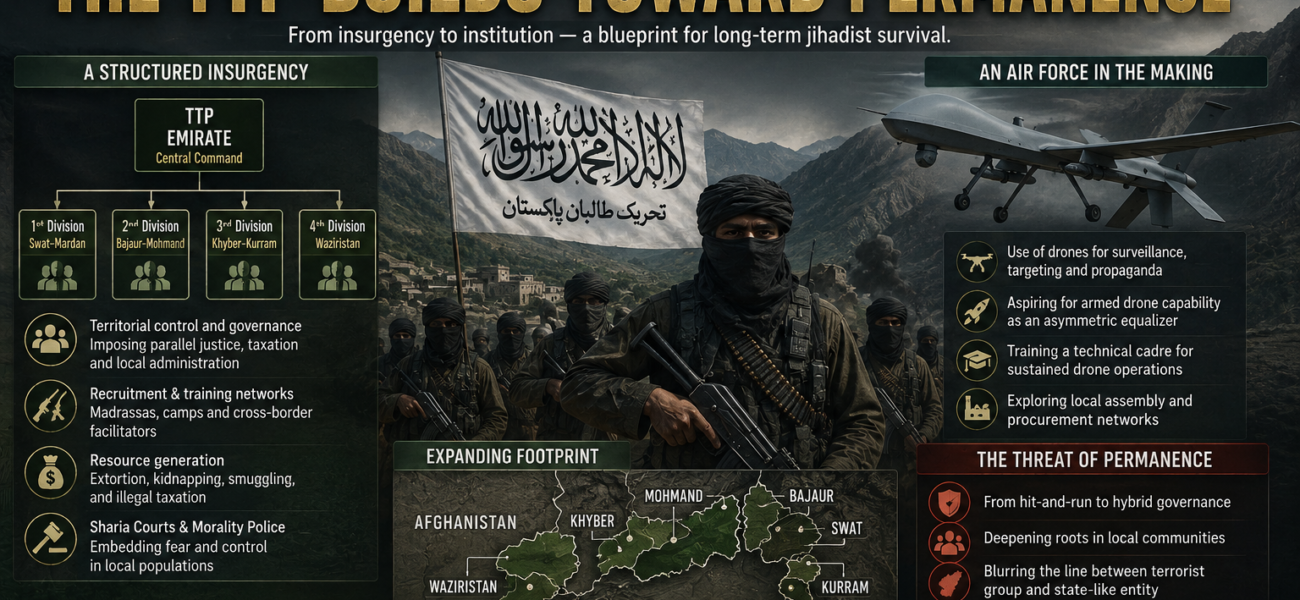
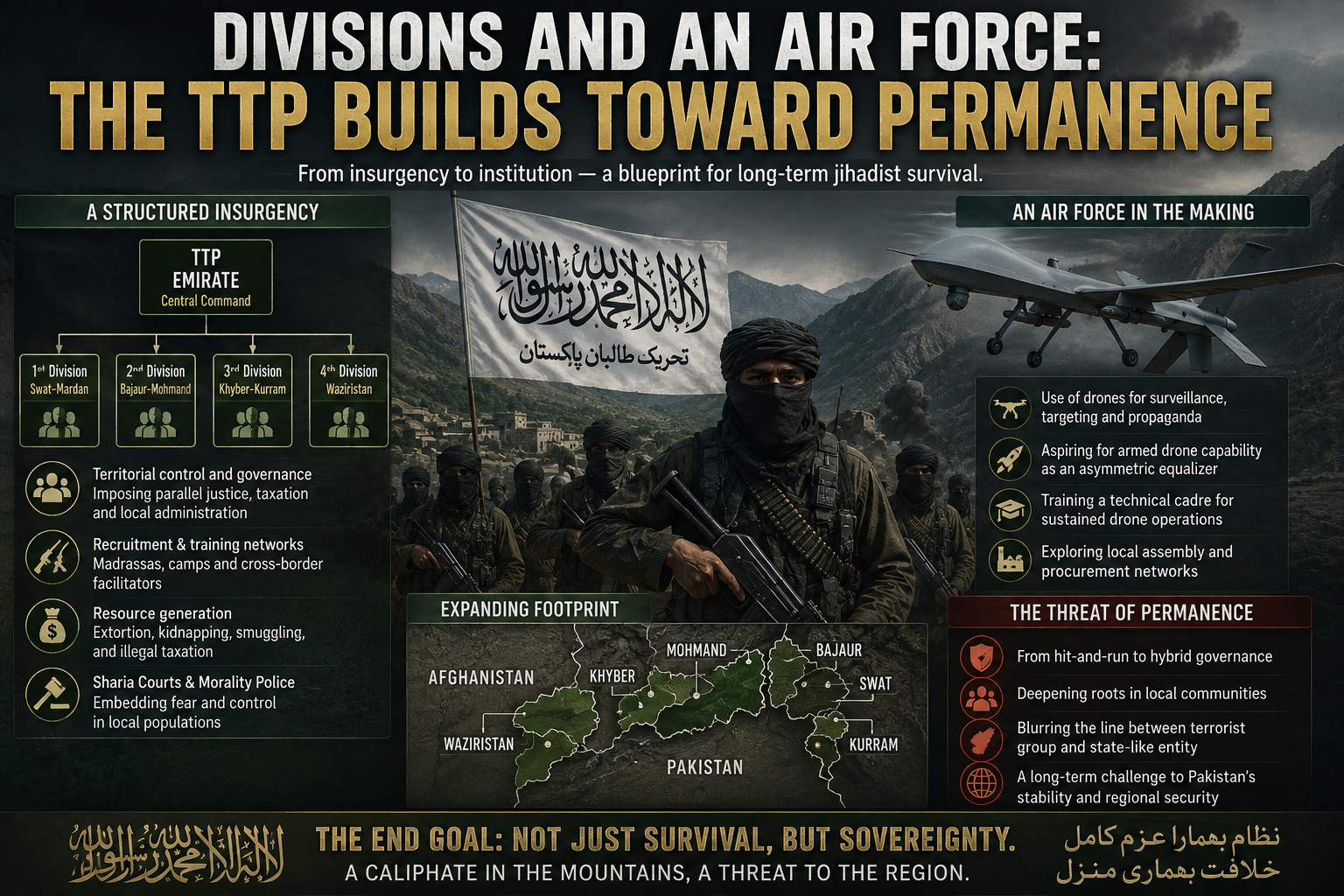
Beneath the familiar top-line finding of the United Nations Security Council’s newest monitoring report, that the Afghan Taliban continued their support to the Tehreek-e-Taliban Pakistan, sits a detail that has drawn less notice than it warrants. According to the 38th report of the Analytical Support and Sanctions Monitoring Team (document S/2026/651), circulated on 10 August and covering the period to 9 June 2026, the TTP announced a new organisational structure. The group added two divisions and a unit it described as a “TTP Air Force.”
The label is almost certainly aspirational. A militant organisation sheltering in eastern Afghanistan does not command an air arm in any conventional sense, and the phrase reads as much as branding as capability. Yet the announcement is significant for what it signals rather than what it delivers. Groups reaching for the vocabulary of a national military are groups that have begun to imagine themselves as something more durable than an insurgency. The debate over this file has centred on a single question, whether Kabul can restrain the group it hosts. The 38th report points to a second question that matters more over the long term. The TTP is not only escalating. It is institutionalising.
The architecture of a standing force
An insurgency improvises. It reacts to opportunity, absorbs losses, and reconstitutes around whatever fighters and weapons remain. A standing force does something different. It builds fixed structures, assigns permanent commands, and plans on a calendar. The addition of two divisions and a named air unit belongs to the second category. So does the equipment the monitoring team recorded moving into TTP hands. Monitors documented attacks that grew more sophisticated over the reporting period, involving larger numbers of fighters and advanced assault rifles, night-vision devices, thermal imaging systems, sniper platforms and drone attack systems, with much of this materiel reported as supplied by the Afghan authorities alongside weapons licences and travel documents.
Advanced optics and drones do not transform a militant group into an army. What they do is raise the technical floor of its operations and require the training, maintenance and command discipline that only a more institutionalised organisation can sustain. A group that fields thermal imaging and coordinated drone attacks has moved beyond the ambush economy of a border insurgency. It is acquiring the habits of a force that expects to exist for a long time.
Operation Khyber and the logic of a calendar
The clearest evidence that the TTP now thinks in institutional time is its conduct of a seasonal campaign. At the start of March the group announced its spring offensive, Operation Khyber, and publicised it in several languages with a call for intensified attacks against Pakistani security forces and civilians. An organisation that launches a branded annual offensive is an organisation that assumes continuity from one year to the next. The naming, the multilingual distribution and the fixed seasonal timing are the marks of a body that plans, recruits and communicates as a standing enterprise rather than a scattered network.
The campaign produced results that matched its ambition. The monitoring team recorded one of the deadliest incidents of the reporting period on 16 February in Bajaur district of Khyber Pakhtunkhwa, where a vehicle-borne improvised explosive device killed eleven security personnel and one child. The TTP claimed the attack and was reported to be operating from Afghanistan. Data compiled by the Pakistan Institute for Conflict and Security Studies records 2,786 deaths linked to militant violence and counter-militancy operations in the first seven months of 2026, including 463 civilians and 434 security personnel, with July the deadliest month for Pakistani security forces since 2023. A group inflicting losses at this rate while formalising its command structure is consolidating, not fraying.
The ecosystem that raises the floor
An institutionalising TTP does not build in isolation. The 38th report describes increasingly blurred lines among the militant groups operating from Afghan soil, and the effect is to buttress the TTP from several directions at once. Al Qaeda’s media arm, As-Sahab, issued a statement in April that supported the Taliban and, for the first time, openly backed TTP operations against Pakistan. Al Qaeda had previously supplied ideological guidance and training to the group. Al Qaeda in the Indian Subcontinent remained active in Afghanistan, with its leadership reportedly based in Kabul. One member state reported to the monitoring team that Baloch Liberation Army fighters had been trained alongside TTP fighters by Al Qaeda instructors inside Afghanistan.
These linkages matter because they change what restraint applied to any single actor can accomplish. A militant group embedded in a wider economy of training, ideology and endorsement draws capacity that no individual patron controls. If the Taliban leadership were to reduce its own support tomorrow, the TTP would still sit inside a network that supplies instruction and legitimacy from other quarters. The open endorsement from As-Sahab is particularly telling. A group that has secured the public backing of Al Qaeda’s central media apparatus has acquired a source of standing that Kabul cannot revoke.
Why an institutionalising TTP breaks the restraint model
This is where the structural finding meets the question of Taliban authority. The same monitoring report records the leadership in Kandahar moving to rein the group in. The Afghan authorities relocated approximately 2,000 TTP fighters and their families away from the Pakistani border, and the Taliban leader Hibatullah Akhundzada reportedly warned the TTP through back-channel communications to halt attacks against Pakistan or lose Taliban support. The TTP answered by announcing its spring offensive.
An institutionalised organisation is precisely the kind that absorbs such measures without changing course. The monitoring team assesses the TTP as the largest militant group in Afghanistan, with an estimated strength of six thousand fighters or more. Moving two thousand people, families included, relocates a portion of the manpower and leaves the command structure, the supply relationships and the recruitment pipeline untouched. Relocation adjusts geography. It does not dismantle an institution. A group that has just added divisions and announced an air unit is a group whose centre of gravity is organisational rather than territorial, and organisational weight is not something a change of address can shift.
The escalation that followed Akhundzada’s warning is therefore consistent with the structural picture. A group confident in its own footing, its own calendar and its own network of external support has little reason to treat a patron’s threat as decisive. The TTP behaved as an organisation that has judged itself able to continue with or without the full endorsement of Kandahar, and the past six months suggest the judgement was sound.
The question the file now poses has shifted. For four years the analysis has asked whether Kabul commands the TTP. The 38th report invites a harder one. It asks whether the TTP still needs Kabul in the way it once did. A movement that arrives with divisions, a named air unit, imported optics and drones, a seasonal offensive and the open backing of Al Qaeda’s media wing is a movement building toward permanence. Whether that permanence can be reversed, by the Taliban or by anyone else, is the problem the next monitoring report will have to address.
Filza Asim is an independent researcher focused on political violence, militant adaptation, and counterterrorism dynamics with a regional focus on Afghanistan and Pakistan.
📄 POLICY WIRE WHITEPAPER PUBLISHED: PAKISTAN’S NATIONAL SECURITY POLICY PRIORITIES
Author