


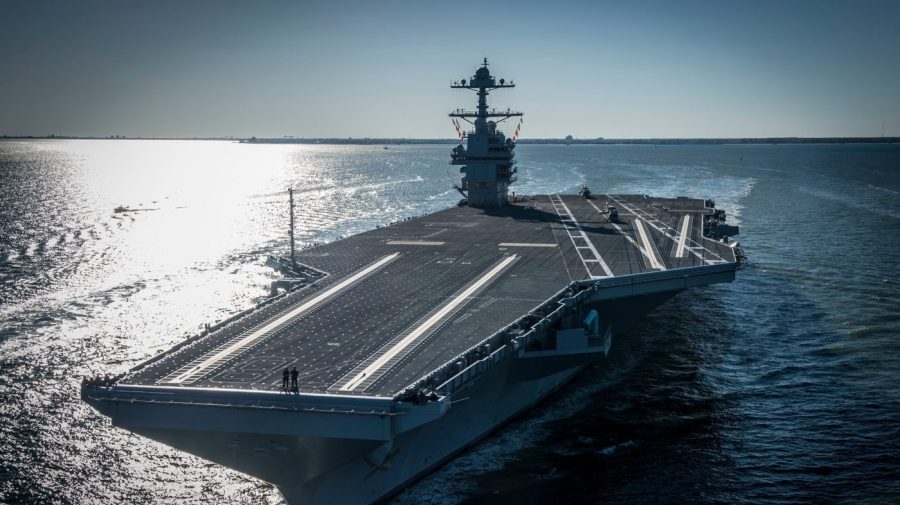
Norfolk’s Nuclear Plug-In: Warship Reimagined as Power Station
POLICY WIRE — Norfolk, VA — Who’d have thought America’s most technologically sophisticated — and frankly, expensive — warship might soon double as an overgrown extension cord?...

POLICY WIRE — Norfolk, VA — Who’d have thought America’s most technologically sophisticated — and frankly, expensive — warship might soon double as an overgrown extension cord? That’s the unexpected twist as the U.S. Navy maneuvers to connect a Ford-class aircraft carrier to the energy grid of Naval Station Norfolk, turning a symbol of global power projection into, well, a giant power outlet. It’s less about deploying for distant shores and more about plugging into the domestic supply, a curious pivot in military utility, wouldn’t you say?
It’s the USS Gerald R. Ford (CVN 78), to be precise, earmarked for this unconventional assignment. This isn’t just about keeping the lights on in the barracks, though that’s part of it. The deeper game here, they tell us, is energy resilience. But it also lets the brass — and the boffins — fully test the sheer grunt of a nuclear-powered propulsion system that can light up a small city. We’re talking about an immense electrical generation capacity, more than many developing nations could reliably muster, harnessed to run an onshore base.
Navy leadership, in its characteristically understated way, says it’s a matter of exploring novel ways to utilize our most advanced assets. It sounds so… bureaucratic. But think about it: this isn’t just a patch job for an aging power station. This is a monumental engineering headache, requiring what Pentagon documents peg at [QUOTE_PLACEHOLDER] several tens of millions of dollars [QUOTE_PLACEHOLDER] over the next five years just to get the wiring sorted, not to mention the protocols for safely marrying a nuclear reactor’s output with an urban grid. They’re essentially asking a battleship to play nice with the local power company, which is quite the proposition.
This initiative could alleviate strain on local grids and offer an emergency power solution during outages, a legitimate concern in a world prone to increasingly unpredictable weather events and cyber threats. And it’s not just a quaint domestic experiment, either. The implications resonate far beyond the Chesapeake Bay. Consider a strategically significant locale like Naval Base Karachi or even facilities along the coast of the Gulf, places where stable and independent energy infrastructure is a persistent, gnawing vulnerability. What lessons are learned here for future expeditionary energy strategies? Or for disaster relief scenarios, where a floating power plant could offer immediate, significant aid to a devastated port city in Pakistan or Bangladesh?
But there’s a wry chuckle to be had here, isn’t there? The apex predator of naval engineering, designed to project power globally and maintain sea lane dominance, gets repurposed to ensure the cafeteria appliances keep humming. One might call it a rather prosaic demonstration of versatility. It almost feels like the ship’s designers, after pouring billions into making it an unstoppable force at sea, are now watching it being hooked up like an oversized battery charger. Not exactly the glamorous role most would imagine for a supercarrier. It represents a significant technological leap in how naval bases manage their energy needs, sure, but it also paints a vivid picture of necessity being the mother of invention, even at the highest levels of military spending.
And let’s be blunt: these efforts aren’t just for kicks. With an ever-increasing global demand for power, coupled with aging civilian infrastructure and geopolitical uncertainties that could disrupt traditional energy supplies, nations — and their defense apparatuses — are rethinking everything. A stable energy supply isn’t just a comfort; it’s a non-negotiable strategic asset. It makes you wonder how much more our future defense budgets will allocate to glorified utility bills. And it brings a certain gravitas to discussions around, say, energy independence in developing regions, where countries like India or even Iran face stark choices between imported fuel dependency and domestic, perhaps less conventional, power solutions.
But the real test for this ambitious plan won’t just be the engineering, though that’s Herculean enough. It’ll be the integration with the human element, the bureaucracy, the long-term cost-benefit analysis. Are we building robust, redundant systems, or simply adding another incredibly expensive, nuclear-powered band-aid to a larger problem of grid vulnerabilities?
What This Means
This endeavor transcends mere logistical novelty; it’s a harbinger of evolving national security priorities. Economically, integrating a multi-billion dollar warship into a shore power grid indicates an increasingly high value placed on energy resilience, pushing federal spending into non-traditional infrastructure development. Politically, it subtly shifts the military’s domestic role, casting it not just as a protector of global interests but as a tangible guarantor of homeland utilities, an extension of civilian services if you will. This move suggests future naval assets might be designed with explicit dual-use capabilities – beyond just disaster relief – baked in from the drawing board, a significant conceptual departure. For the South Asian context, particularly coastal nations grappling with energy deficits and infrastructure vulnerabilities, this U.S. Navy experiment offers a potential blueprint for leveraging robust mobile power sources during crises. Imagine the strategic value for humanitarian operations following a natural disaster, like a cyclone in Bangladesh or an earthquake in Pakistan. Such a capacity could dramatically reshape how militaries contribute to regional stability and disaster response, intertwining defense capabilities with critical civilian needs.