



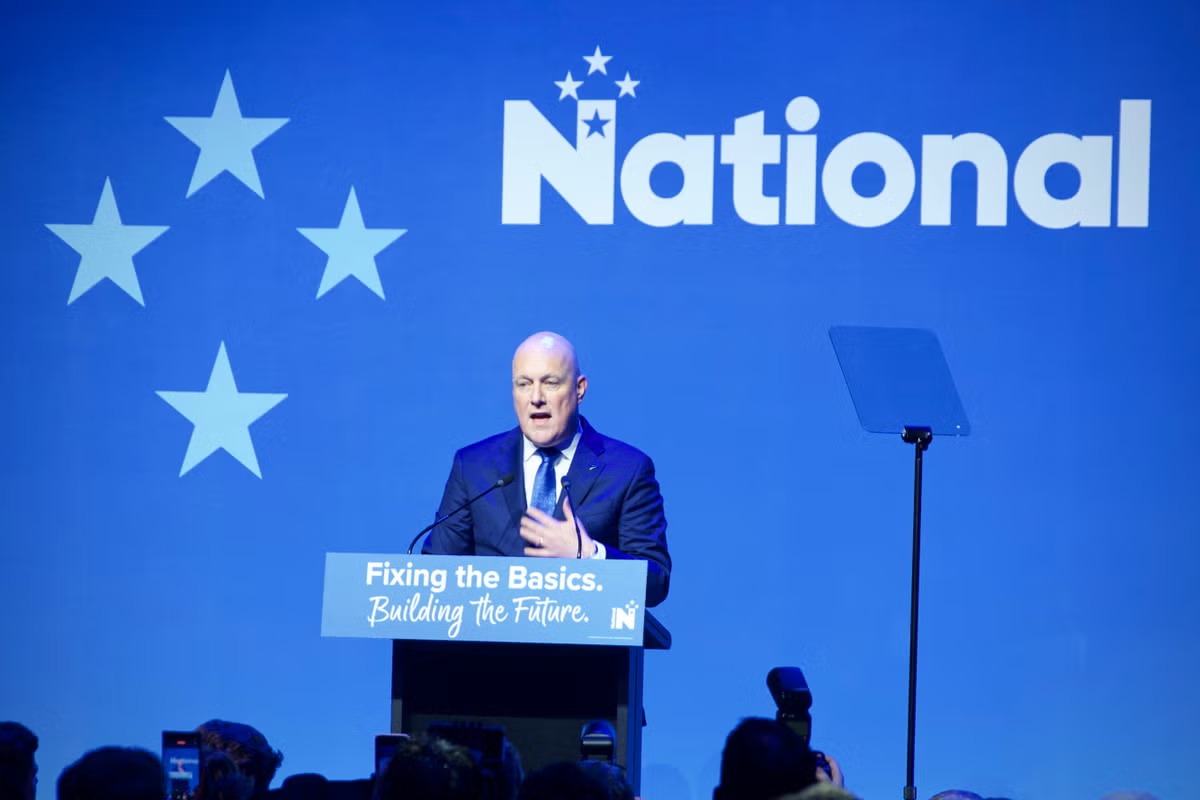
New Zealand Election Deadlock: No Party Wins Majority in Tightest Vote in Years
New Zealand faces a political stalemate as neither National nor Labour secures a clear victory. Negotiations for a razor-thin majority are set to begin.

POLICY WIRE — Wellington, New Zealand — Voters in New Zealand face a multi-week wait to determine their next leader after Saturday’s general election failed to produce a clear winner for either the left or right. The results have created a landscape where intense negotiations over a minuscule governing majority appear the only viable path forward for the major parties.
The closest voting record in years served as a sharp critique of the traditional political powerhouses, specifically Christopher Luxon’s center-right National party and Chris Hipkins’ center-left Labour movement. Voters increasingly shifted their loyalty toward minor parties on the ideological fringes, leaving the weakened National and Labour blocs with the power to demand significant policy concessions from potential coalition partners.
This near-tie was largely driven by a public frustrated by economic hardships and a lack of enthusiasm for both Luxon and Hipkins, leading to the debut of a new-political group in Parliament. The Opportunity party, led by 38-year-old business consultant and newcomer Qiulae Wong, remains unaligned with the major blocs and has expressed a willingness to work with either side to establish a government.
Wong’s platform centered on evidence-based centrism and a departure from partisan conflict earned Opportunity seven seats on Saturday, effectively blocking a simple path to power for both major rivals. This represents a massive growth for a party that saw three previous attempts to enter Parliament before Wong took the helm less than a year ago.
While the conservative side possesses a more direct route to victory, the final outcome remains subject to change. Uncertainty so high that ‘who won the election 2026’ became the most frequent search on Google locally, parties will delay formal formation negotiations until Nov. 27, when final tallies will confirm exact seat counts.
With 2.8 million ballots processed by election night, the incumbent conservative government led by National seemed poised for a return to power by just a single seat. Despite this, Luxon refrained from claiming victory, instead expressing a cautious sense of optimism regarding the possibility of negotiating a second term.
Addressing the media on Sunday, Luxon attributed the public unrest to global disruptions affecting New Zealand’s trade-dependent economy, pointing out that incumbent leaders worldwide are facing similar anger over rising costs of living.
Conversely, his rival Hipkins—who lost office in 2023 due to similar economic grievances—did not see a significant boost. While the left-wing coalition fell short of a majority but remains hopeful for a win, that prospect appears increasingly unlikely.
Election officials began the Sunday process of counting nearly 400,000 special votes, including those from citizens living overseas, a task projected to span three weeks.
These specific ballots have historically added one or two seats to left-leaning parties, which could strip the right of its narrow majority. However, such a shift would likely make it difficult for the left to form a majority as well, potentially forcing a new general election if no government can be established.
Luxon urged the public to ‘calm down’ and take a three-week hiatus from the political fray. He told reporters that he believes everyone is tired of politics and suggested a break before results are finalized. He will maintain the status as a caretaker government until the situation is resolved.
Luxon maintained that National has a path to power and noted the party held more seats than any other group, even though Saturday’s results were somber for his team.
The current numbers suggest that several of National’s highest-ranking lawmakers are leaving politics, including the ministers for finance and defense, the speaker of parliament, and the attorney general. With the party’s traditional allies seeing a rise in support, Luxon faces a more aggressive list of policy requirements to earn their alliance.
The libertarian ACT party secured 13 seats while the populist New Zealand First took 12. Both are guided by experienced veteran politicians, and critics of Luxon—a former executive who entered politics in 2020—argue that his three-year tenure has demonstrated a lack of political experience.
The results functioned as a rejection of both primary parties. New Zealanders voters do not select the prime minister directly; instead, they provide two votes: one for their chosen party and one for a local candidate.
With a single house of Parliament and no state governments, the central authority dictates the nation’s trajectory. In this South Pacific country of 5.6 million people, elections are held every three years.
National garnered only 29.21% of the preferred party vote as of Sunday, a sharp drop from their previous performance, and earned its 42 seats through local race victories. Luxon, who dealt with two separate confidence votes from his own members this year, saw his popularity dip further as the election approached.
Labour also received only 29.36% of the party vote, a figure suggesting a potential second election loss for Hipkins. Despite the nearly identical party vote, the prospect of the left triumphing seems more distant.
Reporting by Policy-Wire (PW)