
Musadik Malik’s Ghalib Diplomacy Wins Praise in India
When Indian journalist Ghazala Wahab commended Pakistan for sending Dr Musadik Malik to New Delhi, it highlighted how intellectual confidence, cultural grace and strategic composure can reshape...
Pakistan’s climate change minister demonstrates how intellectual confidence, cultural understanding and measured communication can earn recognition even across politically divided borders.
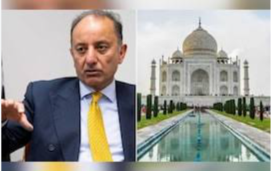
When an Indian journalist, Ghazala Wahab publicly commends Pakistan for its choice of diplomatic representative, particularly at a time when relations between Islamabad and New Delhi remain strained, the circumstances behind such appreciation deserve attention. Federal Minister for Climate Change and Environmental Coordination Dr Musadik Malik‘s recent visit to India for the inaugural Shanghai Cooperation Organisation (SCO) Civilisational Dialogue Forum offers an interesting example of how effective communication, cultural understanding and diplomatic restraint can influence perceptions beyond national boundaries.
Malik’s three-day visit from November 20 to 22 marked the first visit by a Pakistani federal minister to India since former foreign minister Bilawal Bhutto-Zardari attended the SCO meeting in Goa in May 2023. It also came against the backdrop of the May 2025 military confrontation, tensions surrounding the Indus Waters Treaty and restricted bilateral engagement. Under such circumstances, Pakistan’s representation at a multilateral gathering in New Delhi carried significance beyond routine diplomatic participation.
Interestingly, what attracted considerable attention was not merely Malik’s presence in India but the manner in which he communicated Pakistan’s position, handled difficult questions and engaged with the cultural sensitivities of his audience.
Even before his arrival, sections of Indian social media had revived his earlier remarks regarding Pakistan’s water rights. Subsequently, Indian television reporters repeatedly questioned him about terrorism, water security and bilateral disputes. The nature of these exchanges presented a considerable communication challenge, particularly when an impulsive response could have overshadowed the purpose of his visit.
Malik, however, approached the situation differently. Instead of matching the aggressive tone of some reporters, he maintained his composure, smiled and invoked the subcontinent‘s traditional values of hospitality. During his interaction with Indian journalists, he reminded them that he had arrived as an invited guest to participate in a specific multilateral forum.
In diplomatic communication, composure serves a purpose beyond personal courtesy. An emotionally charged response can divert attention from the substance of an argument, whereas restraint allows a representative to retain control over the discussion. Malik understood that his words would reach audiences far beyond the journalists standing before him, making his conduct as important as the position he articulated.
Equally significant was his response to questions concerning terrorism. Rather than limiting his argument to Pakistan’s suffering, Malik acknowledged that India had also experienced terrorism. He advocated a transparent, evidence-based mechanism through which both countries could present evidence and address their respective concerns.
This acknowledgement strengthened the balance of his argument. Recognising the suffering of people across the border did not require him to compromise Pakistan’s position. Instead, it allowed him to frame terrorism as a shared security challenge requiring credible investigations and institutional cooperation rather than recurring exchanges of allegations.
His argument also reflected a broader challenge confronting South Asian diplomacy: governments cannot build lasting trust solely through public accusations. Transparent procedures, credible evidence and meaningful engagement offer a more constructive foundation for resolving security concerns. Malik’s emphasis on these principles allowed him to communicate a firm position without adopting an unnecessarily confrontational tone.
Furthermore, he maintained a clear distinction between bilateral disagreements and multilateral responsibilities. He reminded reporters that the SCO forum concerned culture and civilisation, while issues such as water security and terrorism required appropriate diplomatic channels. Nevertheless, he expressed his willingness to engage whenever an appropriate bilateral platform became available.
This distinction holds particular importance within the Shanghai Cooperation Organisation. Established in 2001, the organisation brings together countries with diverse political systems, strategic interests and historical experiences. Its effectiveness depends partly on the ability of member states to pursue collective objectives despite existing disagreements. Allowing bilateral disputes to dominate every multilateral gathering would undermine opportunities for regional cooperation.
While Malik’s exchanges with Indian journalists attracted attention for his restraint, his formal address at Delhi’s historic Purana Qila revealed another dimension of his diplomatic personality.
Choosing Urdu over English, the minister explained that speaking English in a city closely associated with Mirza Ghalib felt unusual. India’s Economic Times reported his address, highlighting his decision to speak in Urdu and his portrayal of Delhi as an amalgamation of civilisations.
The choice carried considerable symbolic value. Urdu, despite its association with Pakistan’s national identity, possesses a literary history that transcends contemporary political boundaries. Its development reflects centuries of interaction among Persian, Arabic and indigenous linguistic traditions. Through Urdu, Malik communicated with an audience that shared a cultural familiarity with the language, even where political differences remained pronounced.
His references to Mirza Ghalib, Allama Iqbal and historical centres such as Delhi, Lucknow, Lahore, Bukhara and Samarkand further enriched the address. Rather than treating cultural identity as an exclusive national possession, he presented civilisation as the product of intellectual exchanges, migration and interaction among diverse communities.
Malik also drew attention to the historical evolution of Delhi itself. Referring to Humayun and Sher Shah Suri, he illustrated how rulers of different origins contributed to the city’s architectural and cultural inheritance. His argument challenged the tendency to interpret centuries of history through the restricted lens of contemporary political divisions.
Similarly, by highlighting the Indus Valley and Gandhara civilisations, Pakistan’s historical connections with Central Asia and Persia, and Taxila‘s intellectual heritage, he presented Pakistan as a country whose identity reflects multiple civilisational influences.
The underlying message was that diversity enriches societies rather than diminishes them. A genuine dialogue, after all, requires the existence of different perspectives. Where everyone possesses identical opinions and experiences, conversation loses much of its purpose.
Such an argument resonated with sections of the Indian audience.
According to The Express Tribune‘s coverage of the Indian response, Indian journalist and author Ghazala Wahab appreciated Malik’s literary expression and Pakistan’s selection of its representative. Her observations emphasised that political disagreements cannot deprive people of their shared pride in literature, poetry, music, culture and language.
Her appreciation was particularly noteworthy because it emerged independently of Pakistan’s official diplomatic narrative. Other Indian commentators, including Ankit Kumar Awasthi and Rajesh Shukla, also responded favourably to his cultural references and eloquence. Awasthi reportedly characterised his approach as “Ghalib diplomacy”, an expression that captured the distinctive literary character of his engagement.
It would, however, be inaccurate to interpret these reactions as an official endorsement from the Indian government or as evidence of a broader transformation in Indian public opinion. Their significance lies in demonstrating that a Pakistani representative can establish a meaningful connection with sections of an Indian audience despite persistent political tensions.
The episode also offers a practical illustration of the concept of soft power, popularised by American political scientist Joseph Nye. Unlike coercion or economic inducement, soft power relies on attraction, credibility, cultural appeal and the ability to influence perceptions. Malik’s engagement in New Delhi reflected several of these characteristics. His literary fluency created cultural familiarity, while his measured responses reinforced the impression of confidence and preparedness.
Nevertheless, reducing his visit to literary diplomacy and successful media interactions would overlook its substantive policy dimension.
As Pakistan’s climate change minister, Malik brought environmental vulnerability into a discussion primarily concerned with cultural heritage. He argued that the survival of civilisations increasingly depends on how effectively nations respond to environmental degradation, describing climate change as a common threat to civilisations.
Pakistan’s experience provides a compelling basis for such an argument. According to the World Bank‘s 2022 Pakistan Floods Assessment, the catastrophic floods affected approximately 33 million people, while combined physical damage and economic losses exceeded $30 billion.
Malik also referred to the damage sustained by Mohenjo-daro, drawing attention to the vulnerability of archaeological treasures that have survived for thousands of years.
The example connected Pakistan’s domestic climate challenges with a broader international responsibility. Environmental disasters threaten not only contemporary economic development but also humanity’s historical memory. The destruction of archaeological structures, ancient settlements and cultural landscapes represents a loss that extends beyond national ownership.
Moreover, his references to melting glaciers and glacial lake outburst floods carried particular relevance for South Asia. Pakistan and India share geographical and ecological systems that remain interconnected regardless of their political relationship. Rising temperatures, changing river flows and extreme weather events do not recognise international borders.
The Intergovernmental Panel on Climate Change‘s assessment of Asia further underscores the vulnerability of the region to climate-related hazards, including flooding, glacier loss and growing water insecurity. Consequently, environmental cooperation offers an area where regional engagement can produce tangible benefits without requiring the immediate resolution of every political disagreement.
Malik complemented his argument with practical proposals, including an SCO network connecting cultural institutions and a digital library to preserve the region’s shared heritage. His recommendations on cultural preservation and climate cooperation gave the discussion an institutional dimension and demonstrated that Pakistan’s participation extended beyond symbolic gestures.
His diplomatic engagements on the sidelines further reinforced this approach. According to reported diplomatic engagements, Malik held meetings with Tajikistan‘s Minister of Culture Sattoriyon Amonzoda and Mohammad Mahdi Imanipour, president of Iran‘s Islamic Culture and Relations Organisation. The discussions focused on historical and cultural connections and opportunities to strengthen relations through greater engagement.
His interaction with Indian Culture Minister Gajendra Singh Shekhawat also provided limited space for communication between representatives of two countries whose formal bilateral engagement remains restricted. Although these meetings did not constitute a breakthrough in Pakistan-India relations, they demonstrated the usefulness of multilateral diplomacy in preserving avenues of communication.
The timing of Malik’s visit adds another strategic dimension. With Pakistan preparing to host the SCO Council of Heads of State summit in 2027, Islamabad faces an opportunity to demonstrate its ability to facilitate regional cooperation among countries with divergent strategic interests.
Malik’s constructive participation in New Delhi can therefore be viewed as an encouraging contribution towards establishing the diplomatic atmosphere Pakistan would wish to cultivate during its own chairmanship.
While Musadik Malik’s visit did not resolve bilateral disputes, the appreciation he earned across the border demonstrated the strength of Pakistan’s soft diplomacy. His approach reaffirmed that national interests can be defended with dignity, intellectual confidence and cultural understanding. Ultimately, effective diplomacy lies not in silencing critics but in earning their respect.