


Meta Reports Surging Q3 Profit As AI Push Drives Strong Revenue Growth
Meta Q3 profit surges past estimates as revenue jumps 26% to $64.60 billion, fueled by strong user growth and an expanding artificial intelligence push.

POLICY WIRE — Menlo Park, United States — Meta Platforms announced Wednesday that its third-quarter profit experienced more than a threefold increase, driven by a sharp rise in revenue across its family of popular applications.
The parent company of Facebook and Instagram reported a net income of $9.86 billion, or $3.83 per share, for the July through September period. This marks a significant jump compared to the $2.71 billion profit, or $1.05 per share, recorded during the corresponding period a year earlier.
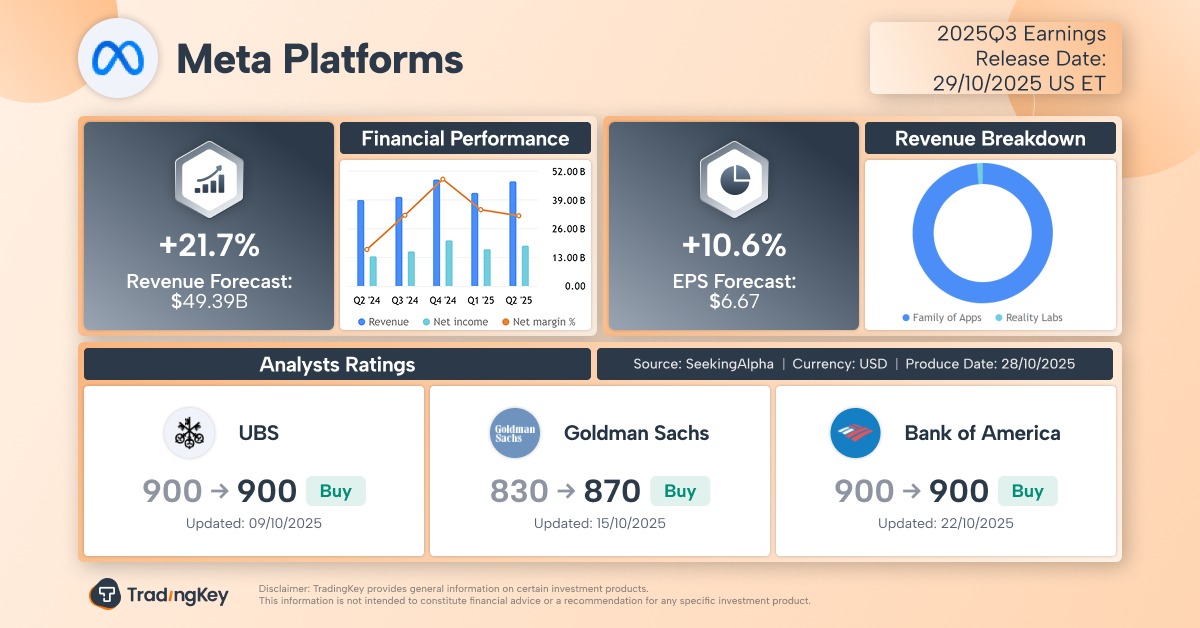
revenue expanded by 26% to reach $64.60 billion, climbing from $51.24 billion in the previous year and surpassing the $63.34 billion consensus estimate predicted by Wall Street analysts.
We hit major milestones this quarter toward delivering personal superintelligence for everyone — including launching Muse and Muse Wonder, our first frontier model, CEO Mark Zuckerberg stated in an official release. Our investments are paying off, the core business is strong, and we’re seeing velocity across the board.
Meta noted that third-quarter earnings would have reached $7.40 per share when excluding a $9.89 billion charge tied to a legal agreement. By comparison, the prior-year quarter included a one-time tax charge close to $16 billion.
A judicial ruling on Wednesday mandated that Meta pay New Mexico $25 billion following a jury verdict finding the firm liable for misleading users concerning Facebook privacy practices, establishing the largest fine ever levied against the tech giant.
The company reported that daily active users across its application ecosystem, which includes Facebook, Messenger, Instagram, and WhatsApp, increased by 3% year-over-year to hit an average of 3.64 billion.
During a financial call with analysts, Zuckerberg highlighted that more than 10 million individuals across the United States and Canada have established accounts for Muse, the personal artificial intelligence agent introduced by the corporation in August.
Roughly 25% of individuals who have set up Muse engage with it on any given day, Zuckerberg explained. The AI assistant is intended for users aged 18 and older, functioning to support individuals with everyday routines like schedules, shopping, and general planning.
The chief executive acknowledged that Muse demands heavy computing resources to operate, though management anticipates boosting cost efficiency by more than tenfold over the upcoming year, which will enable profitability once revenue streams reach scale.
Looking ahead to the current quarter, Meta projects revenue to land between $73 billion and $76 billion, with the midpoint outpacing the $73.65 billion forecast anticipated by market analysts.
Total operating expenses climbed 68% compared to the previous year to reach $51.61 billion, a figure that factors in the financial impact stemming from its multistate legal settlement.
Headquartered in Menlo Park, California, the organization maintained a workforce of 66,775 employees as of September 30, representing a 15% reduction year-over-year.
Leadership updated its capital expenditure outlook for 2026, narrowing projections to a range between $135 billion and $145 billion, contrasted with an earlier forecast of $130 billion to $145 billion.
While management withheld specific spending estimates for the following year, executives emphasized plans to sustain aggressive capital deployment to bolster foundational operations and artificial intelligence initiatives.
The tech conglomerate refrained from issuing official revenue guidance for 2027, though it indicated that anticipated losses within its Reality Labs division should contract to approximately $15 billion next year as funds shift heavily toward AI development. Reality Labs is responsible for developing Meta’s augmented reality, virtual reality, and associated wearable technology.
In additional announcements Wednesday, Meta revealed that its board greenlit the establishment of a new tier of publicly traded, nonvoting Class C common stock, slated to take effect in January. This structural shift is designed to enhance the corporation’s capacity to finance infrastructure investments in artificial intelligence.
Meta plans to issue nonvoting shares to fund AI investments without diluting CEO Mark Zuckerberg’s control, noted Andrew Rocco, a stock strategist at Zacks Investment Research.
Meta shares finished regular trading up 0.5% on Wednesday, followed by a 2.9% increase in after-hours trading immediately following the earnings disclosure. The equity has gained 5.7% across the year.
Reporting by Policy-Wire (PW)