


Messi’s Ghostly Gambit: That Goal, That Photo, and the Soft Power Play of the World’s Game
POLICY WIRE — Doha, Qatar — There are moments, fleeting and visceral, when sport transcends the artificial boundaries of a playing field, morphing into something larger, something… political. A flash...

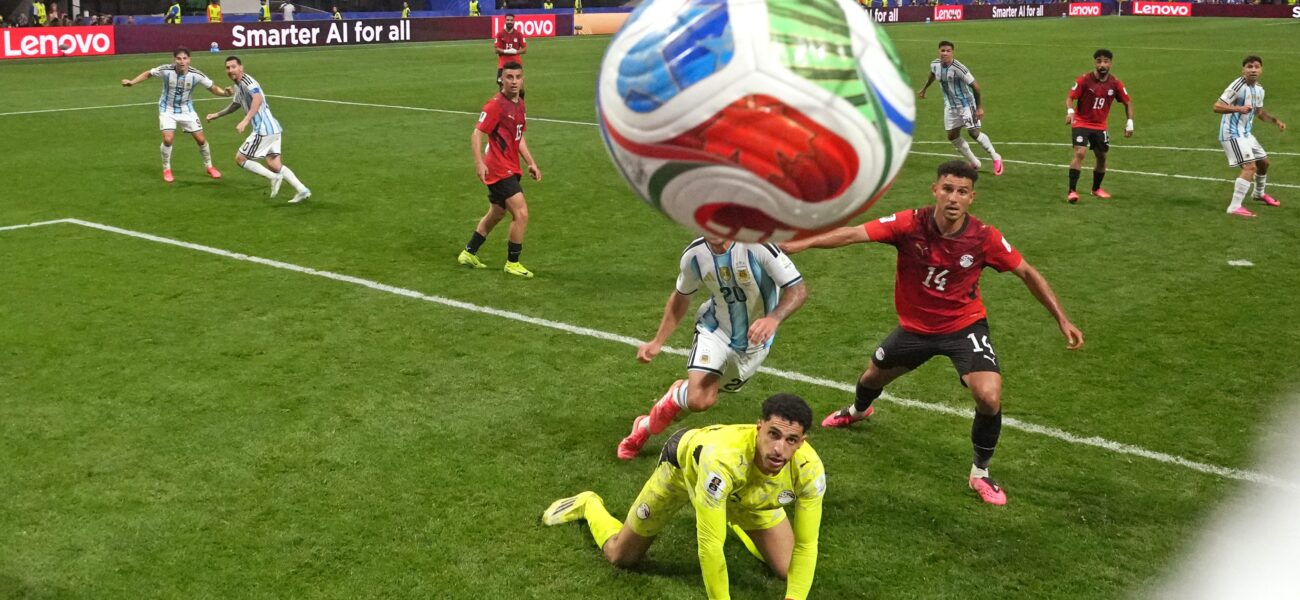
POLICY WIRE — Doha, Qatar — There are moments, fleeting and visceral, when sport transcends the artificial boundaries of a playing field, morphing into something larger, something… political. A flash of light, a millisecond of motion, captured forever by a camera lens. It becomes an artifact. A statement. It’s what we witnessed with that now-iconic image from the Argentina-Egypt clash in the 2026 World Cup Round of 16—a photo that didn’t just depict a goal, but painted a thousand stories of global ambition, digital ubiquity, and a rather messy (pardon the pun) blend of despair and elation.
No, this isn’t about whether VAR got it wrong again, or if Tom Brady’s tweet about the comeback actually moved the cosmic needle. It’s about the sheer weight of expectation, the pressure cooker that’s global football, and how a singular piece of visual journalism—Elsa of Getty Images, we’re talking about you—can distill that entire, overwhelming narrative into a frozen frame. She’s seen plenty of incredible things. But this was different. This wasn’t just a ball hitting the back of the net; it was an entire nation’s collective sigh of relief, meticulously framed from an impossibly intimate angle, literally *from inside* the goal itself.
Messi, watching, almost detached, as the net billowed. Opposing players, frozen in varying states of stunned realization. The game, for a split second, simply… ceased. Then came the eruption. But what makes the image resonate isn’t the drama itself; it’s the stark reality it exposes. Argentina, a footballing superpower, had been on the ropes, getting a scare from an Egyptian side many had written off. Egypt, playing with an audacity that defied predictions, very nearly pulled off an upset that would’ve rattled the tournament’s foundations. They really did play out of their minds, for a good while.
And then the equalizer. Because football, like politics, thrives on these knife-edge turns. María Soler, Argentina’s Undersecretary for Public Diplomacy, put it bluntly: “Leo isn’t just a footballer; he’s a diplomat of the highest order. Moments like these, they unite a nation, project our spirit globally. It’s an affirmation of our resilience, even on the world’s grandest stage.” She’s not wrong. It’s a massive deal, the kind of event that stops work across continents.
For Egypt, the narrow defeat was, despite the pain, a moment of global recognition. Dr. Karim El-Badawy, a spokesperson for Egypt’s Ministry of Youth and Sports, reflected on it with a philosophical air: “Of course, we hoped for a different outcome. But even in defeat, the sheer grit, the passion of our Pharaohs against a global giant—it showed our youth what they’re capable of. The world watches us. We put up a hell of a fight, didn’t we?” And indeed, they did.
The match, though eventually a loss for Egypt, held enormous cultural significance across the broader Muslim world. From Cairo to Karachi, Doha to Jakarta, the buzz around the ‘Pharaohs’ squaring off against Argentina’s GOAT was electric. In Pakistan, social media exploded. Many weren’t just watching a football match; they were observing a performance of national pride and potential against a formidable, almost mythological, opponent. This wasn’t just a sports fixture; it was a conversation piece—a reflection of capabilities and aspirations. Globally, sports data analytics firm Opta estimates the Argentina vs. Egypt match drew a peak concurrent online viewership of 18.5 million unique users from the MENA region alone, underscoring the immense digital footprint of football in this demography.
📄 POLICY WIRE WHITEPAPER PUBLISHED: PAKISTAN'S NATIONAL SECURITY POLICY PRIORITIES
👉 READ BY CLICKING HEREBut back to that photograph. Its visual poetry captures not just athletic prowess but the crushing weight of expectation. It’s a reminder that these global spectacles—the World Cup’s grand expansion igniting economic ripples and political jitters—are crucibles for national identity. They’re where narratives are forged, sometimes heroically, sometimes agonizingly, under the unforgiving glare of billions.
The image doesn’t just show a goal. It shows history. It shows the moment an entire comeback became undeniably real, not just for the players, but for every Argentinian glued to a screen. It’s a testament, not to mention a subtle jab, at the fine line between victory — and something much less glamorous. One minute, you’re looking good; the next, the ball’s in your net, and an immortal’s celebrating, albeit with his back to the drama. Brutal, isn’t it?
What This Means
This match, — and that photograph, carry layers of meaning far beyond the scoreboard. For Argentina, it reinforced the notion that even with the ‘Little Magician,’ winning demands grit against rising powers. It’s a statement about their tenacious national character, vital for global diplomacy — and economic negotiations. For Egypt and, by extension, other nations across the Global South and the Muslim world, it demonstrates a growing competency on the world stage—a readiness to challenge established hierarchies. Their spirited performance, though ultimately falling short, translates into enhanced national morale and potentially, increased soft power projection. Countries like Norway, whose own national identity is intricately tied to global sporting recognition (Golf Ace Hovland’s fanaticism notwithstanding), understand this intrinsically. These aren’t just games; they’re battlegrounds of reputation, identity, and aspirational politics. They shape how nations are perceived, bolstering or eroding their standing, and that impact can trickle down into trade deals, diplomatic ties, and tourist dollars. Every pass, every save, every perfectly timed snapshot—it’s all part of the much bigger, infinitely more complex global chess game.