
Kremlin’s Curated Casualness: Putin Strolls, Challenging Western Bunker Narratives
POLICY WIRE — Moscow, Russia — The West, it seems, has grown rather accustomed to a particular image: a cloistered strongman, tucked away in an undisclosed bunker, directing affairs from afar. That...

POLICY WIRE — Moscow, Russia — The West, it seems, has grown rather accustomed to a particular image: a cloistered strongman, tucked away in an undisclosed bunker, directing affairs from afar. That narrative, long peddled by a chorus of analysts and officials across Europe and Washington D.C., suggested a Kremlin boss disconnected, wary of public gaze, almost… afraid. It was a potent image, wasn’t it? A leader stripped of his old swagger, confined by the very machinations he set in motion.
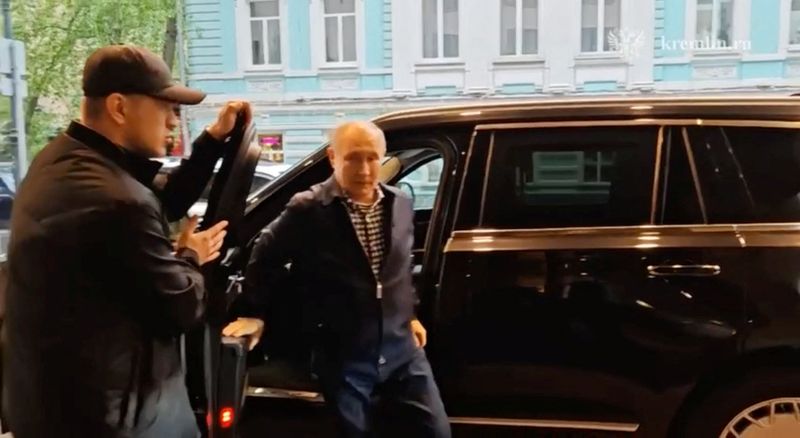
But then, like a plot twist nobody quite saw coming—though, frankly, in this line of work, we usually see them telegraphed miles out—Moscow dropped a video. Suddenly, there he was: President Vladimir Putin, not in some subterranean lair, but strolling through Moscow. He’s out on the street, meeting a couple of guys, maybe a brief chat, certainly an air of unscripted — or perhaps, expertly pre-scripted — casualness. It’s designed, plain and simple, to flick a polite but firm middle finger at those Western armchair generals who’d convinced themselves he’d lost his touch, his nerve, or both.
And what’s the point? Well, beyond the obvious domestic messaging that their leader is hale and hearty, firmly in control, it’s a subtle chess move on the global stage. Russia isn’t just playing to its citizens. It’s playing to a broader audience, one increasingly weary of a singular narrative, often delivered by capitals that don’t quite share their lived experiences. Nations like Pakistan, navigating a tightrope between traditional alliances and pragmatic geopolitical interests, often view such displays through a lens quite different from their Western counterparts.
“They think we live in a cartoon where leaders vanish into thin air,” a senior Kremlin source, speaking on background, tartly remarked to Policy Wire. “Our president is at work, as he always is. He meets people, he runs the country. It’s simple, really, for those who wish to see reality.” Of course, the reality they wish to portray is usually quite polished. Because that’s how this game works. Every frame is a statement, every perceived glance is a message.
On the other hand, officials in Brussels aren’t buying it, not for a second. “It’s propaganda, pure — and simple,” stated Elara Vance, a spokesperson for a European Union diplomatic corps. “They’re trying to counteract intelligence—accurate intelligence, we believe—with manufactured optics. It changes nothing about the core issues at play.” She didn’t sound terribly convinced that anyone else would be convinced, either.
The incident reminds us that in the digital age, statecraft isn’t just about troop movements or economic sanctions. It’s a performative art, a continuous theatrical production where every clip, every handshake, every un-rumpled suit, is meant to convey strength, normalcy, even a bit of ordinary charm. This particular act was aimed squarely at debunking the ‘bunker theory’—a theory that suggested, in perhaps its most damaging iteration, that Putin was either ailing or isolated, leaving a vacuum of power.
📄 POLICY WIRE WHITEPAPER PUBLISHED: PAKISTAN'S NATIONAL SECURITY POLICY PRIORITIES
👉 READ BY CLICKING HEREWhat the video really underscores, however, is the Kremlin’s acute awareness of information warfare. They’re not just reacting; they’re pre-empting, shaping, or trying to shape, global perceptions of their leadership and the state of their nation. It’s an exercise in narrative control, pushing back against what they perceive as hostile Western media portrayals. Consider, too, the domestic front: A recent Levada Center poll showed President Putin’s approval rating at 82% within Russia, demonstrating the significant impact of a carefully managed media ecosystem—an ecosystem this video serves beautifully.
What This Means
This calculated PR stunt suggests a few things. First, Moscow is incredibly sensitive to external narratives regarding Putin’s health or stability. Those Western bunker rumors must’ve hit a nerve deep inside the Kremlin. They don’t want their strongman looking anything but robust — and present. Politically, it’s about shoring up confidence, both at home and among global partners—think countries in Africa, the Middle East, or parts of Asia, nations less keen on signing onto a purely Western script.
Economically, perceived stability—especially that of the top leader—is supposed to convey business as usual, minimizing capital flight worries or investor jitters. It’s an effort to maintain an image of solid, predictable governance, even if much of the world sees only a facade. The implications for nations like Pakistan, for instance, are nuanced. While not overtly aligning with either side, a perception of stability from a major power like Russia is generally welcome for bilateral relations, particularly concerning energy deals or strategic partnerships. This visual flex helps counter Western pressure in these unaligned sectors. And really, it just reinforces that when it comes to power, image is almost everything, especially when actual ground is being contested. But is a mere stroll through Red Square enough to change minds in Brussels or Lahore? Probably not entirely. But it certainly provides ammunition for a different perspective.