


Knicks’ Enforcer Unmasks ‘The Alien’: The Unlikely Story of Towns Dominating Wembanyama
POLICY WIRE — New York City, USA — They called him ‘The Alien,’ a moniker conjuring visions of an extraterrestrial basketball marvel destined to rewrite the league’s physics. Victor...

POLICY WIRE — New York City, USA — They called him ‘The Alien,’ a moniker conjuring visions of an extraterrestrial basketball marvel destined to rewrite the league’s physics. Victor Wembanyama, with his improbable wingspan — and effortless grace, seemed immune to the struggles of mere mortals. But then, as it often happens, a grizzled reality check came cloaked in the unexpected: Karl-Anthony Towns.
It’s a peculiar twist, this — that the most talked-about basketball sensation since LeBron James would meet his surprising, earthbound foil not in a perennial defensive specialist, but in a player long critiqued for his own defensive shortcomings. Yet, here we’re. With the New York Knicks clutching a commanding 2-0 lead in the 2026 NBA Finals, so much of the narrative now circles back to Towns. He’s managed to make Wembanyama look… human. Fallible. And for an audience hooked on extraterrestrial dominance, that’s a jolt.
Take the dying embers of Game 1: Spurs down four, Wembanyama attempts to blaze past Towns, a path to the hoop seemingly clear. Instead, he bounces the ball off his own knee. Turnover. Game lost. Just as baffling was Game 2. Twelve seconds on the clock, tie game. Wembanyama snags a rebound over Towns, an open lane ahead. Stephon Castle clears the way, ready to watch history. And then, another brain-freeze: Wemby chucks the ball off Castle’s turned back. Turnover again. Losing again. You just don’t see that from a phenomenon touted as an era-defining talent.
“Look, folks can talk about aliens all they want,” Towns told reporters post-Game 2, a slight smirk playing on his lips. “I just focus on my assignment, on giving my team a chance. It’s gritty work, but somebody’s gotta do it.” It’s a pragmatic sentiment from a player suddenly finding himself squarely in the Finals MVP conversation. Towns, the 11-year veteran, is bafflingly leading all players in plus-minus with a robust +25 — meaning the Knicks have outscored San Antonio by 25 points in his 68 minutes on court. It’s a statistic that simply can’t be brushed aside, even if Wembanyama’s individual averages of 27.5 points, 10.5 rebounds, and 3.5 blocks look glossy on paper.
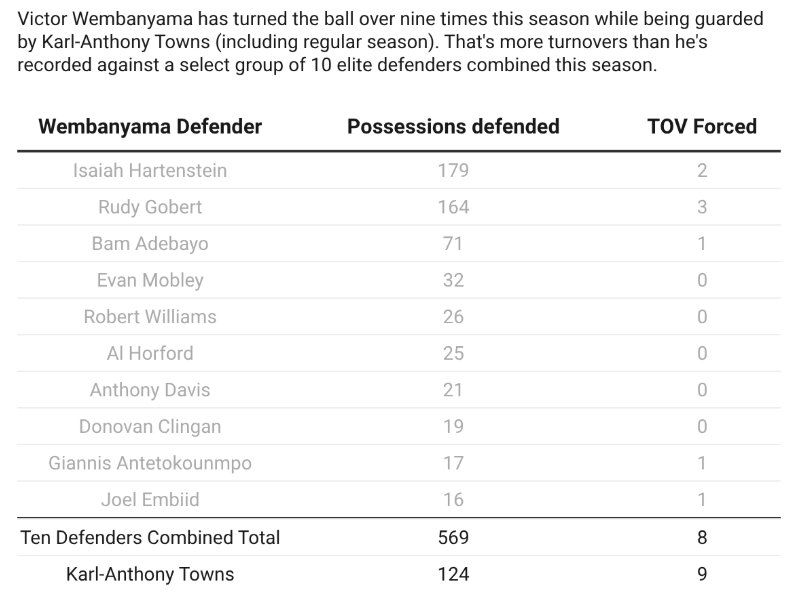
But the real story lies deeper, beyond surface numbers. According to NBA player tracking data, Wembanyama has coughed up a woeful seven turnovers specifically while being guarded by Towns in these Finals games. Extend that to all contests this season where Towns has been on him, — and it jumps to nine. To put this in stark perspective: Towns has spent 124 possessions guarding Wemby this season. Combine the efforts of a slew of decorated defenders — think Isaiah Hartenstein, Rudy Gobert, even Defensive Player of the Year contenders like Evan Mobley and Giannis Antetokounmpo — and their cumulative forced turnovers against Wembanyama over hundreds of possessions still don’t equal Towns’ individual total. That’s not a fluke; it’s a strategic chokehold.
“We built this team for moments like these, for opponents like him,” Leon Rose, Knicks President of Basketball Operations, commented earlier in the week, hinting at the vision for the franchise. “Karl’s proving precisely why we believed in his all-around game; it’s why you invest in elite, versatile talent for the biggest stages.” His play against Wembanyama offers a startling contrast to how Wemby diced up Chet Holmgren, who finished second in DPOY voting, scoring 57 points with only five turnovers in a near-identical number of possessions. Towns? He didn’t garner a single DPOY vote. Sometimes, the unsung work is the most damaging. That’s what’s unfolding here.
📄 POLICY WIRE WHITEPAPER PUBLISHED: PAKISTAN'S NATIONAL SECURITY POLICY PRIORITIES
👉 READ BY CLICKING HEREThis isn’t just about basketball, is it? The NBA has always been a global product, and the spectacle of a perceived ‘alien’ talent dominating was primed for widespread appeal. Nations from Karachi to Cairo avidly follow these contests, fueled by global sports networks and the dreams of local athletes hoping to join America’s NBA pipeline. The economic and cultural soft power generated by these international stars — their endorsement deals, their jersey sales, the inspiration they provide — can’t be overstated. Towns’ ability to ground this phenomenon has unexpected ripple effects on everything from speculative player market valuations to strategic brand sponsorships in emerging economies. It makes the grand narratives, the carefully crafted mythologies, far more compelling. Nobody wants a story with no villain, or no obstacle.
What This Means
Towns’ unexpected dominance against Wembanyama transcends mere playoff statistics; it’s a profound recalibration of what constitutes elite defensive value in modern basketball. For years, the narrative has chased specialized stoppers or athletic freaks. But here, a former offensive darling, through sheer grit and diligent footwork, is disrupting the ascendance of a generation-defining player. This re-evaluation won’t just impact how general managers draft or trade for big men—valuing versatile defensive effort over flashy statistics—but also how international scouting assesses players, potentially favoring more well-rounded skill sets earlier on. We’re seeing the economic implications, too. A superstar whose aura of invincibility is pierced, even temporarily, affects marketability and perceived long-term value, shifting the conversation from a singular, unstoppable force to the more complex interplay of team schemes and individual counters. It’s a fascinating, granular insight into the dynamics of global sports talent — and its commercial reverberations.