


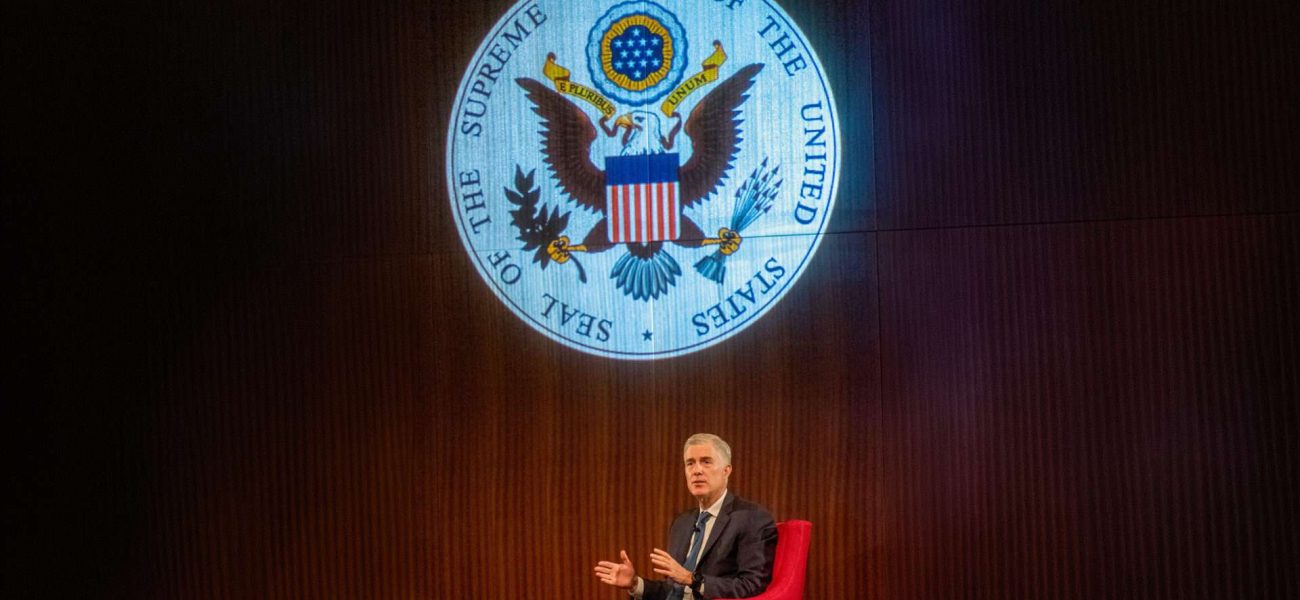
Gorsuch vs. Admin Power: Reclaiming Liberty
Justice Gorsuch targets Chevron deference & administrative overreach. Discover how his push to restore individual liberty could reshape the Supreme Court and federal power.

POLICY WIRE — Washington, D.C. — It’s not often a Supreme Court Justice publicly pokes at the very foundation of legal interpretation, practically daring his colleagues to unravel established precedent. But then, Justice Neil Gorsuch isn’t one for playing small. He’s lobbing grenades at doctrines most lawyers – and pretty much everyone else – had long assumed were fixed features of the jurisprudential landscape.
His contention isn’t about some obscure constitutional nook; it’s about power. Specifically, the subtle, insidious expansion of administrative authority, enabled, he argues, by a judiciary too willing to step aside. Call it a slow-motion reassertion of fundamental rights, or maybe, a long-game strategy to dismantle the modern administrative state piece by bureaucratic piece.
The Justice is pointing his legal finger at two particular decisions—two judicial “wrong turns,” in his blunt phrasing—that he believes have quietly but effectively eroded the very bedrock of individual liberty. The prime target? The infamous Chevron deference, which for nearly 40 years has mandated that courts largely defer to federal agencies’ reasonable interpretations of ambiguous statutes. But the second target, a slightly lesser-known yet equally impactful doctrine concerning judicial abstention in challenges to administrative orders, effectively compounds the issue, further limiting the pathways citizens have to question executive action.
It’s an institutional tug-of-war, isn’t it? Congress writes the laws, agencies interpret and implement them, and the courts—well, the courts are supposed to be the ultimate referees. Gorsuch thinks those referees have been sitting on their hands, conceding too much ground to the executive branch.
“The judiciary’s role isn’t to rubber-stamp; it’s to meticulously ensure that every governmental action adheres strictly to the constitutional compact we, the people, have forged,” Gorsuch declared recently in a scathing concurrence, his language barely concealing his disdain for the status quo. He’s essentially arguing for a more muscular judiciary, one unafraid to challenge the sprawling apparatus of federal regulations that touches virtually every aspect of American life. And he’s got a point. According to a 2023 study by George Mason University’s Mercatus Center, federal regulations now encompass over 185,000 pages in the Code of Federal Regulations, a figure that’s ballooned by nearly 30% since the turn of the millennium.
But not everyone’s thrilled with the idea of turning back the clock. “These doctrines, you know, they’re the grease in the gears of modern governance,” remarked Dr. Lena Rahman, a prominent legal scholar specializing in administrative law. “Without them, we’d bog down the courts in every technical squabble, effectively paralyzing agencies tasked with managing complex areas from environmental protection to financial stability.” Her skepticism is shared by many who believe agencies possess specialized expertise that judges typically lack. It’s an efficiency argument, plain — and simple, even if it comes at a cost to individual redress.
The underlying struggle here—between bureaucratic efficiency and individual accountability—resonates far beyond Washington’s Beltway. Think about countries like Pakistan, for instance, where the power dynamics between a burgeoning judiciary and entrenched bureaucratic structures are often contentious. For decades, Pakistan’s courts have wrestled with administrative overreach, sometimes successfully, often less so. A Supreme Court asserting robust judicial review in the U.S. could very well send ripples, serving as a subtle yet significant philosophical benchmark for nations grappling with the same questions of governmental control and individual rights, particularly in contexts where minority protections and due process are perpetually under threat.
📄 POLICY WIRE WHITEPAPER PUBLISHED: PAKISTAN'S NATIONAL SECURITY POLICY PRIORITIES
👉 READ BY CLICKING HEREThis isn’t merely about judicial philosophy; it’s about who holds the cards. If Gorsuch gets his way, it could significantly alter the balance of power, forcing Congress to write clearer, more explicit laws and compelling agencies to act with far less discretionary leeway. Because when you strip away the deference, what you’re left with is plain accountability.
It’s a risky proposition, changing how the government actually functions. But he’s got an appetite for it.
What This Means
Gorsuch’s calculated campaign signals an ideological skirmish brewing on the Court. Politically, a successful dismantling of Chevron and related doctrines would be a monumental victory for conservatives aiming to shrink the administrative state and, arguably, federal power as a whole. This isn’t just about regulatory hurdles for businesses; it impacts environmental protections, healthcare regulations, and even immigration policies. Every federal agency action, from a minor permit change to a sweeping new policy, could become far more susceptible to judicial challenge, potentially slowing governmental operations to a crawl. But proponents see it as reclaiming the separation of powers that they argue has been lost. For ordinary citizens, it means more avenues to challenge what they perceive as arbitrary or unjust governmental decrees—an undeniable boon to civil liberties, provided the courts are ready for the deluge.
Economically, the impact would be a mixed bag. Less regulatory burden might spur certain industries, but it could also create uncertainty as established agency interpretations suddenly become fair game for judicial second-guessing. Predictability in regulatory environments, a key factor for investment, would likely take a hit initially. For example, consider a major infrastructural project where the permits depend on specific environmental agency interpretations. Removing deference could introduce years of litigation risk. Conversely, it empowers individual plaintiffs and smaller businesses, which often find themselves outmatched by the legal might of federal agencies. The debate reflects a fundamental tension between bureaucratic agility and fundamental checks and balances, a theme we’ve also explored in the GOP’s ‘SAVE America Act,’ hiding unsettling trade-offs, where ideological goals collide with practical governance. And, ultimately, it puts even more power in the hands of the judiciary, which, for better or worse, becomes the final arbiter of vast swathes of public policy. It’s a high-stakes play, one that will redefine American governance for decades to come, if he wins enough allies on the bench.