


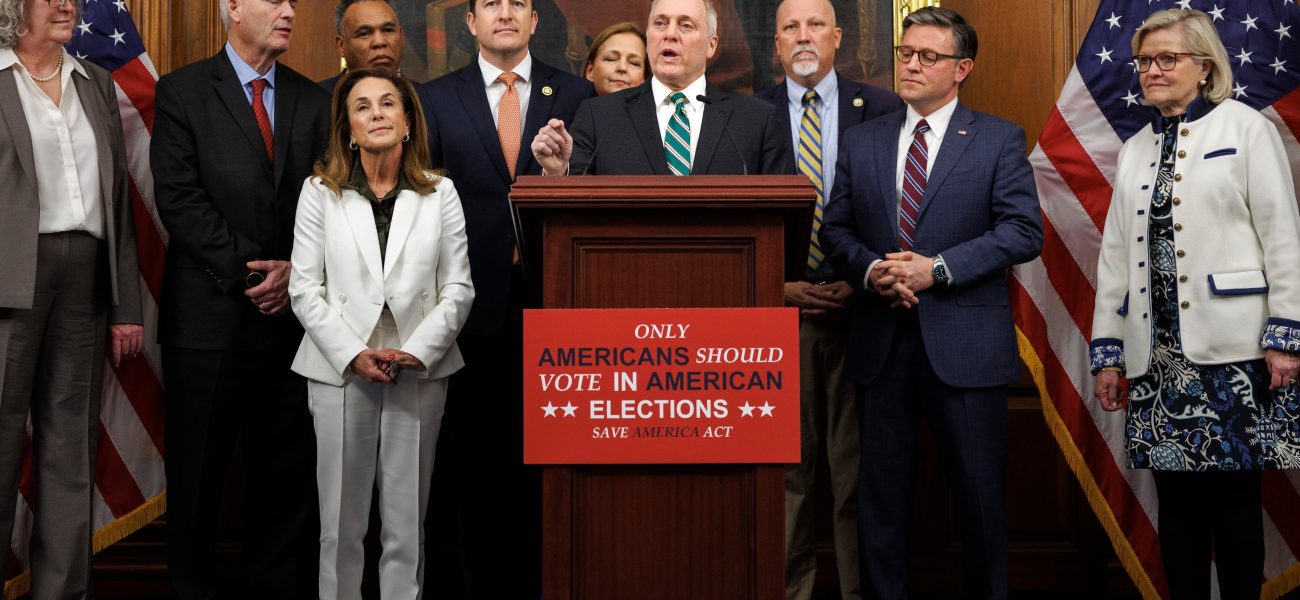
SAVE America Act: GOP’s Covert Global Strategy Revealed
Policy Wire investigates the GOP's SAVE America Act, uncovering subtle provisions that could funnel US resources to foreign industrial ventures, reshaping global economic policy.

POLICY WIRE — Washington, D.C. — It isn’t the loud legislative clashes that truly reshape national policy, but the quiet mechanics of budget reconciliation, those innocuous line items slipped into cavernous bills, that often tell the real story. And what a story it seems the Republicans might be hiding within the depths of their much-vaunted SAVE America Act, a legislative proposal currently making its slow, bureaucratic pilgrimage through committee corridors. Folks on the hill have been buzzing, but not about the headline-grabbing stuff. No, it’s about what’s missing, or rather, what’s subtly reallocated.
While the act’s public face screams domestic protection and fiscal prudence, its less-examined entrails suggest an almost paradoxical redirection of resources. One might reasonably expect a bill championed by [QUOTE_PLACEHOLDER] to staunch capital outflow and reinforce local economies. But a closer inspection by Policy Wire’s investigative team—parsing through the thickets of draft language and agency projections—indicates certain provisions could inadvertently, or perhaps deliberately, bolster specific foreign industrial ventures, far from American shores. This isn’t about patriotic rhetoric; it’s about the cold, hard transfer of financial capabilities, tucked away where few scrutinize.
It’s become apparent this isn’t just bureaucratic inefficiency; there’s a pattern emerging. Buried beneath layers of proposed tax cuts and regulatory rollbacks designed to ‘Save America,’ appear stipulations that could funnel expertise and investment into, of all places, certain emerging industrial sectors within nations deeply intertwined with our geopolitical competitors. Think advanced manufacturing facilities — facilities that don’t quite align with the bill’s ostensible domestic-first mantra. You’d imagine a focus on say, Ohio, or Pennsylvania, not on the nascent industrial parks of countries where a robust domestic economy might eventually present its own strategic challenges.
But how, one asks, does a piece of legislation aimed at securing American interests end up potentially nurturing competing supply chains abroad? That’s the billion-dollar question, isn’t it? It suggests a complexity far beyond a simple oversight. We’re talking about a kind of financial aikido, where the momentum of American economic nationalism is subtly redirected. And the implications, particularly for sensitive regions, well, they’re not trivial. It’s got some Beltway insiders quietly — very quietly — scratching their heads.
Consider the broader context, particularly in the ever-shifting sands of South Asia. The region, always a powder keg of political and economic tensions, relies heavily on external capital and technological transfers to drive its developmental ambitions. For decades, the US has played a complicated game there, balancing alliances against strategic interests. A statistic from the US Agency for International Development (USAID) reveals that in 2022, direct US foreign assistance to the region totaled nearly $2.5 billion, a figure that’s meant to foster stability and democratic institutions. Now imagine subtle legislative shifts, hidden in plain sight, that could bypass these traditional channels, creating new vectors of influence. The GOP’s approach, as revealed by the SAVE America Act’s inner workings, might just create an unforeseen backdoor for capital deployment that sidesteps direct foreign aid initiatives, instead weaving into complex commercial agreements. This wouldn’t be explicit intervention, not like military aid. But it’s an economic force, potent — and silent.
But the true kicker is the Muslim world angle. This supposed domestic recovery act appears to offer implicit, if not explicit, advantages to industries located in, or closely affiliated with, specific Gulf states. States with which Washington maintains a delicate, often transactional, relationship. It’s not outright grants. It’s more insidious, more structural. Imagine revised intellectual property guidelines or adjusted import/export credit lines that, on paper, appear generic but in practice disproportionately benefit consortia with heavy investments in places like Saudi Arabia or the UAE. We’re not talking about anything transparent here. Instead, it’s about leveraging the enormous financial clout of such entities through subtle policy tweaks that few would bother to scrutinize on Capitol Hill, let alone Main Street. It’s a pragmatic, some might say cynical, play for continued strategic partnerships, masked as purely domestic concern.
📄 POLICY WIRE WHITEPAPER PUBLISHED: PAKISTAN'S NATIONAL SECURITY POLICY PRIORITIES
👉 READ BY CLICKING HEREIt certainly throws a spanner in the works of traditional isolationist thought. We’re meant to believe that ‘America First’ means American industry, American jobs, American capital, staying squarely within American borders. This act, however, whispers of an economic globalization, redefined not by open markets but by strategic, almost covert, redirection. It isn’t about what the Act says it does. It’s about what it permits, quietly, almost accidentally. And that, dear reader, makes for a fascinating game of three-dimensional chess.
What This Means
This subtle redirection of American capital, or at least the groundwork for it, through the SAVE America Act, could signify a shift in the Republican Party’s (GOP’s) economic philosophy. Or, at minimum, it points to an intricate layering of domestic rhetoric over foreign policy objectives. It’s no longer just about overt aid or sanctions; it’s about the intricate dance of fiscal policy influencing global industrial development. Economically, this means a potential acceleration of certain industrial sectors in partner nations—or even competitive nations—by virtue of US domestic policy. Imagine a world where a ‘Made in America’ initiative indirectly finances factories that stamp ‘Made in Somewhere Else’ on goods ultimately intended to compete in global markets.
Politically, the implication is far more acute. If these provisions are indeed an intentional, understated element of GOP strategy, it reveals a leadership willing to gamble with domestic economic nationalism to shore up geopolitical alliances. It’s a calculated risk, of course. Domestically, the perception of America’s wealth being siphoned off, however indirectly, could stir political unrest and voter cynicism. Internationally, this kind of under-the-radar economic boost might buy goodwill in strategic regions like the Middle East—securing access, maintaining influence, or balancing regional power dynamics without the explicit costs of direct military or diplomatic engagement. This bill, masquerading as a purely domestic affair, likely offers the GOP a way to conduct complex foreign economic policy with plausible deniability. You can’t accuse them of exporting jobs when the act technically aims to create them. But the real game, it seems, is far more sophisticated, a strategic move akin to China’s Digital Silk Road initiatives but executed with a distinctly American legislative sleight of hand. The challenge for policymakers will be ensuring these unintended foreign beneficiaries don’t become future economic adversaries. And that’s a tightrope walk few politicians openly admit to performing, let alone doing so without a net.
The ultimate political fallout? That depends on whether the public catches wind of these nuances. Or if they even care enough to unravel the complex web. For now, it’s America saved, but perhaps not in the way many imagine, and certainly not without a peculiar international footprint. And that, in a nutshell, is the GOP’s quiet little secret.