

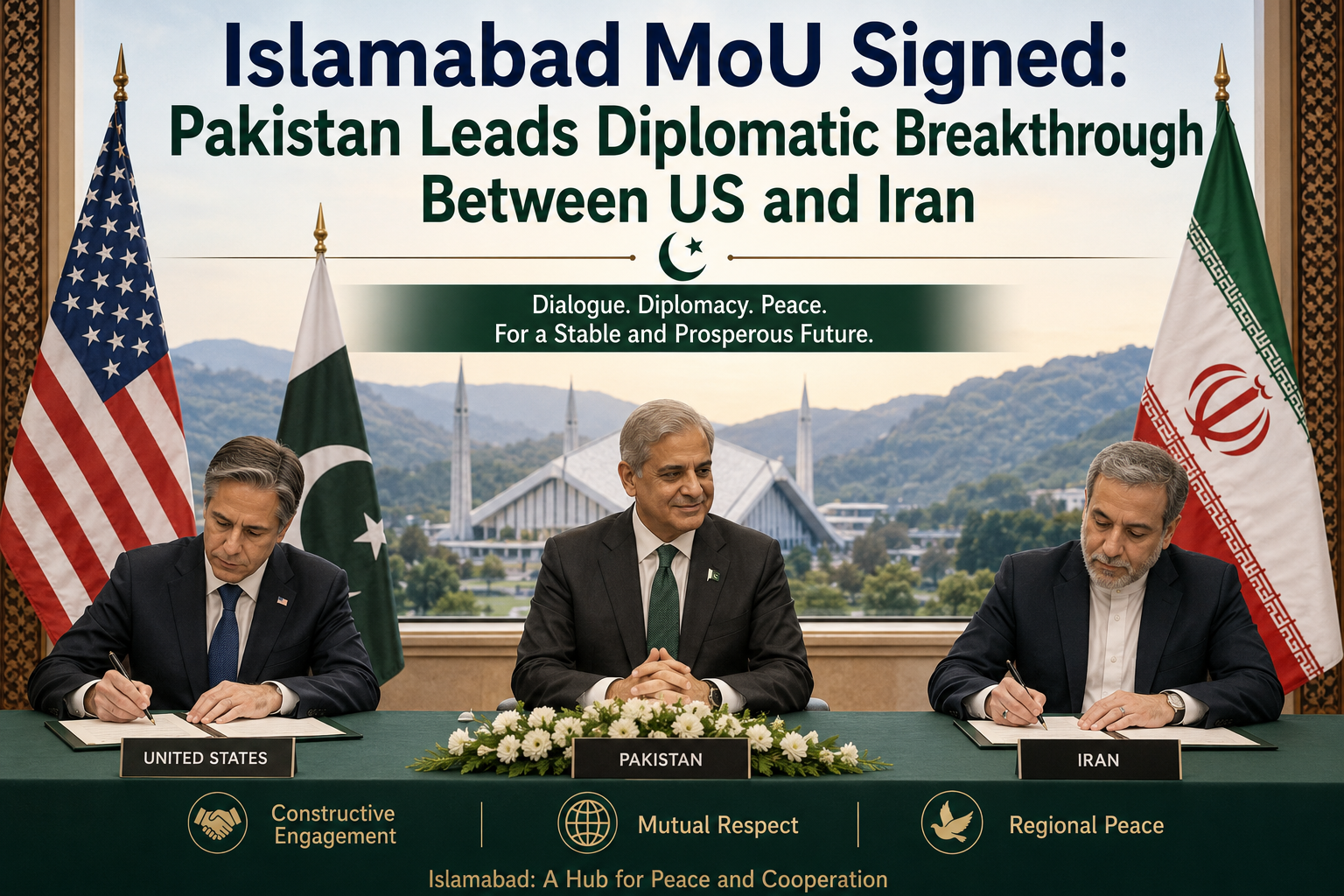
Islamabad MoU Signed: Pakistan Leads Diplomatic Breakthrough Between US and Iran
On 18 June 2026, Pakistan reached a significant milestone in regional peace in an Islamabad Memorandum of Understanding (MoU) signed by Prime Minister Shehbaz Sharif as a mediator between the United...

On 18 June 2026, Pakistan reached a significant milestone in regional peace in an Islamabad Memorandum of Understanding (MoU) signed by Prime Minister Shehbaz Sharif as a mediator between the United States and Iran for the latest iteration of a peace process that has redefined regional diplomacy. In official statements, Anadolu Agency and WANA News Agency reported that the agreement came into effect instantly when Pakistan endorsed it, and was also previously pre-acognized electronically by US president Donald Trump and Iranian president Masoud Pezeshkian.
The investment made by Pakistan is one of the biggest diplomatic accomplishments in the country’s recent history and has thrust Islamabad to the center of an agreement between two nations whose diplomatic ties have not been severed for nearly 47 years, since the Iranian Revolution of 1979.
The Islamabad MoU follows a long mediation process started by Pakistan in the conflict between the U.S. and Iran in 2026. Islamabad was instrumental in first brokering a ceasefire on 8 April 2026, then a high-level meeting on 12-13 April 2026. The talks were the highest-level direct meeting between the American and Iranian delegations in decades, and highlighted Pakistan’s increasing ability to broker dialogues in complicated geopolitical disputes.
Much of Pakistan’s success is due to its unique strategic position. Its 959 km edge shares with Iran, long-standing diplomatic and security relationship with the USA and it is a credible figure throughout the Muslim world. Islamabad was able to claim a neutral third party yet acceptable to both sides thanks to this combination.l
Beyond symbolic significance, the agreement is of great importance. Tensions have been simmering between the U.S. and Iran for decades, and this has led to a few periods when they had reached the brink of military crisis. International energy agencies estimate that past spats and wars have spooked crude prices by 10 to 20 percent. So does the elimination of these threats by diplomacy, which has economic implications other than the Middle East, to the world markets.
Regional security has tangible economic implications for Pakistan. The country imports significant energy needs and is also price sensitive to international oil commodity prices. Each rise in the price of oil imposes additional burden on Pakistan’s import bill, foreign exchange reserves and inflation. Thus, de-escalation between Washington and Tehran helps Pakistan’s economic interests a whole lot.
It is noteworthy that Shehbaz Sharif as the PM had signed the MoU as a “mediator”. Typically, the principal parties sign international agreements, but in Pakistan its membership is a sign of formal recognition of its contribution to conflict resolution. The endorsement is a materialization of Islamabad’s involvement in the peace process and recognition of the faith that Pakistani diplomacy carried.
The terms of the contract also enhance the country’s presence on the world’s power index. Islamabad has been attempting to present itself as a responsible actor that can contribute to peace, conflict management and regional cooperation to the international community in recent years. Infamous to the extent that a political relationship has been tense for nearly half a century, the ability to weather a storm of mutual resentment and emerge as a successful negotiator is an indicator of the kind of person he is to be counted among.When he can successfully see two adversaries who have been hostiles toward each other for nearly 50 years and come out successful, he proves his worth as a negotiator as well as a person.
The attention that Pakistan’s mediators have been receiving highlights the growing importance of middle power diplomacy. The peace process demonstrated the role of actors from the region in facilitating dialogue through trust-building measures and long-term engagement, as well as by using non-interventionist methods of sanctification. Islamabad’s capacity to hold productive relations with both Washington and Tehran was key in politically creating a room for persuading both parties to enter into negotiations.
This major peace accord has the potential for significant economic consequences. The Strait of Hormuz, close to Iran, is one of the choke points of the world and is responsible for up to 20% of the world’s petroleum supply. De-Escalation between Iran or any other country will have the advantage of lowering risks to shipping lanes, world energy market, and international trade flows. Energy importing nations like Pakistan get a direct boost in economic predictability due to stability on this corridor.
The agreement can also afford an opportunity for better connectivity within the region. The geographic location of Pakistan connects the South Asian, Central Asian, Middle East and Arabian Sea regions. A better regional climate would enhance prospects for the development of trade flows, infrastructure development, and other economic integration. The developments would be beneficial and will be a step towards Pakistan’s long term vision to establish it as a hub of trade and connectivity for the region.
As much as anything else is of interest the symbolic message conveyed by the name of the accord itself. Pakistan’s capital has been given an association with a historic international diplomatic achievement by bringing it into the accord with “Islamabad Memorandum of Understanding.” As the cities of major diplomatic successes in the past, Camp David, Dayton, Oslo and Doha are now Berkley to the chants of the dancing raptors.Camp David, Dayton, Oslo and Doha are Berkley to the chanting of dance raptors historically, major diplomatic breakthroughs. The Islamabad MoU also further enhances the stature of Pakistan in modern day diplomacy of the world.
Challenges nevertheless remain. Longstanding rivals sometimes find themselves stumbling blocks in the implementation of peace agreements, especially when it comes to security and strategic interests as well as domestic politics. Therefore the future of the Islamabad MoU will be influenced by Washington and Tehran’s dedication and active diplomacy by Pakistan, as facilitator.
Such is the power of diplomacy over confrontation that the signing of Islamabad MoU has been seen as another significant achievement. Pakistan played its role in settling the stand-off by aiding in achieving an agreement, through a series of negotiations and finally reaching a formal agreement, proving that dialogue is the best way to resolve international conflicts.
The period upon which the agreement will enter into implementation is likely to be remembered in Pakistan as a pivotal moment in its diplomacy efforts, not only in its role strengthening regional stability but also in bolstering Islamabad’s international image as a good middleman as well as a positive actor in an increasingly complicated geopolitical landscape between the United States and Iran. The decision proved positive for both sides.
Author