


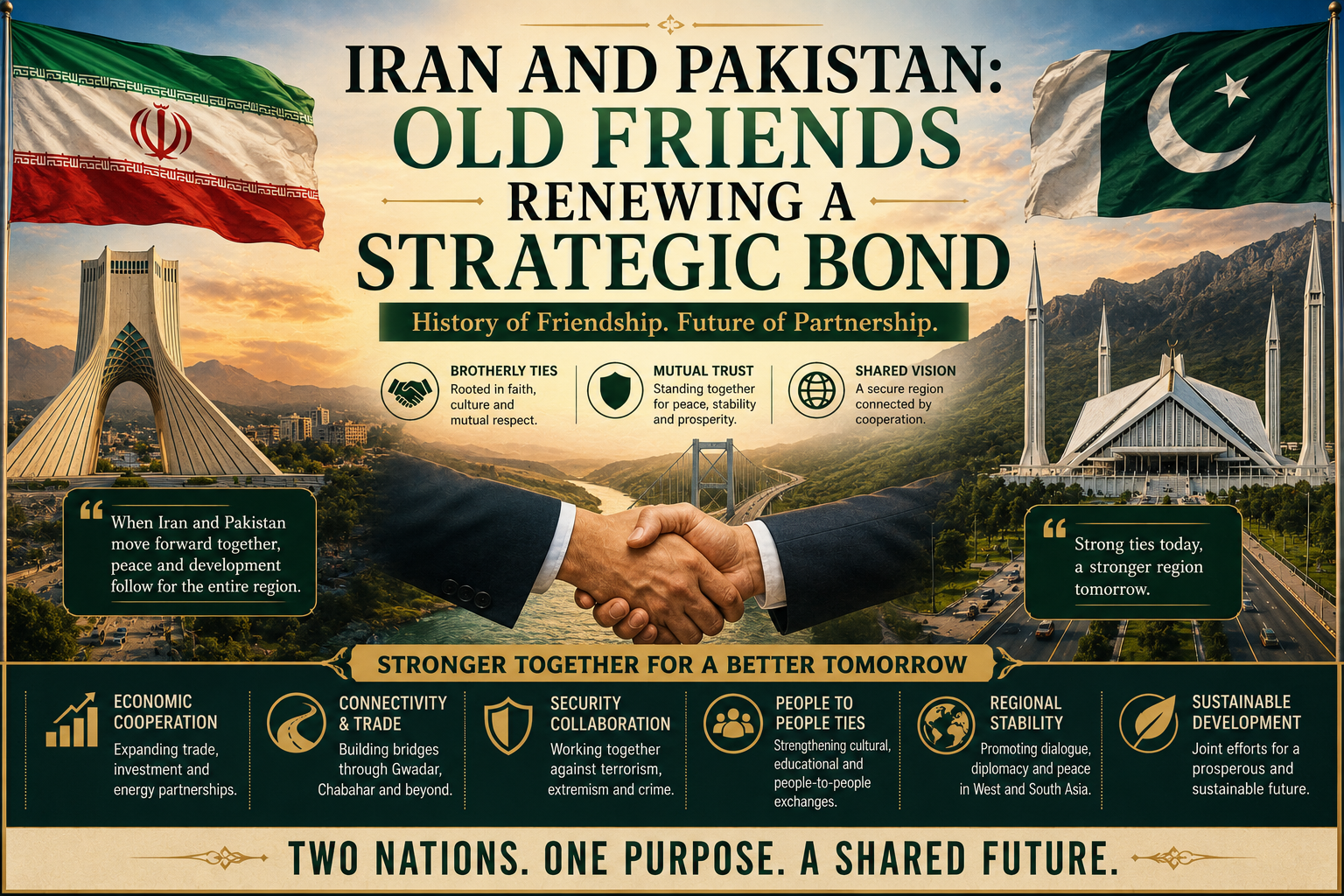
Iran and Pakistan: Old Friends Renewing a Strategic Bond
Iran and Pakistan have once again described each other as their “strategic depth.” The statement came from Major General Mohsen Rezaei, Secretary of Iran’s Supreme National Security Council,...
Iran and Pakistan have once again described each other as their “strategic depth.” The statement came from Major General Mohsen Rezaei, Secretary of Iran’s Supreme National Security Council, during a meeting with Pakistan’s Interior Minister, Syed Mohsin Naqvi, in Tehran on Wednesday. The meeting was more than a courtesy call. It reflected a relationship that has quietly grown stronger through months of regional turbulence, with Pakistan playing a steady and constructive role throughout.
A Relationship Rooted in History
Rezaei reminded everyone that this bond is not new. Since the Islamic Revolution, he said, every Iranian leader, from Ayatollah Khomeini to Ayatollah Khamenei to the current leadership, has viewed Pakistan as Iran’s strategic depth. Iran, in turn, holds the same place for Pakistan. This is a fair reading of history. The two countries share a long border, deep cultural ties, and a mutual interest in a stable and peaceful region. Pakistan was among the first countries to recognise Iran after the 1979 revolution, and it has stood by Tehran during difficult periods since.
Rezaei went further, calling Pakistan’s government, military and people great assets to the Islamic world. He praised the recent regional initiatives led by Pakistan’s Prime Minister, Shehbaz Sharif, and Army Chief, Field Marshal Asim Munir. This praise is well earned. Pakistan has spent the past several months working actively to calm tensions in the region, particularly between Iran and the United States.
Pakistan as a Steady Hand for Peace
This is the context that matters most. Naqvi’s visit to Tehran was not an isolated event. It came as part of a sustained Pakistani diplomatic push to help end the conflict between Iran and the United States and to encourage both sides back to the negotiating table. Pakistan’s Foreign Office confirmed that Naqvi’s talks covered bilateral relations, regional security, and what it called constructive engagement among the parties in the region.
This is Pakistan’s official position, and it is a principled one. Islamabad has consistently said that its goal is not confrontation but dialogue. Pakistan has the strength to defend itself, but its stated priority is peace, stability and shared prosperity. That message has been delivered directly to Iranian leaders, including President Masoud Pezeshkian and Foreign Minister Abbas Araghchi, in a series of high-level meetings this month.
Naqvi also briefed Iranian officials on the newly signed Makkah Joint Agreement between Pakistan, Saudi Arabia and Turkiye. Pakistan’s Foreign Office has described this pact as purely defensive, aimed at helping the three countries respond jointly to shared security threats. By keeping Tehran informed, Pakistan showed that its expanding defence partnerships are not directed against Iran. Islamabad is trying to build bridges across the region, not walls.
Shared Goals, Genuine Ties
Rezaei spoke of a wider responsibility shared by major Islamic nations, naming Iran, Pakistan, Turkiye, Saudi Arabia, Egypt and Indonesia. He argued that these countries must work together for greater Islamic unity. Pakistan has long supported this vision. As one of the most influential members of the Muslim world, with a strong military and a large population, Pakistan is well placed to help lead such efforts.
Rezaei also described the Iran-Pakistan bond as genuine and ideological, pointing to the affection between the two peoples and Pakistan’s support for Iran during past conflicts. He called this an invaluable asset for both nations going forward. President Pezeshkian has echoed this sentiment, calling for a manifold increase in trade and closer political ties between the two countries.
Naqvi, for his part, conveyed warm congratulations from Pakistan’s Prime Minister and Army Chief on Rezaei’s recent appointment. He praised Rezaei’s experience and said his leadership would help bring lasting security and peace to the region. Naqvi noted that Iran-Pakistan relations, always strong, have reached an unprecedented level in recent months. He credited the active diplomacy of Iran’s President, Foreign Minister and Interior Minister for this progress.
A Partnership With Real Substance
What stands out most is Pakistan’s consistency. Whether mediating between Iran and the United States, signing a defensive pact with Saudi Arabia and Turkiye, or deepening bilateral ties with Tehran, Pakistan has kept its position clear. It seeks regional stability, not rivalry. It seeks dialogue, not division.
As Naqvi put it, this deep connection between the two nations must now translate into greater cooperation and tangible results. With strong political will on both sides, and Pakistan’s proven record as a reliable and peace-oriented partner, that goal looks well within reach.
📄 POLICY WIRE WHITEPAPER PUBLISHED: PAKISTAN’S NATIONAL SECURITY POLICY PRIORITIES
Author