


Internet’s Absurdist ‘Cockroach’ Joke Scuttles into Delhi’s Real-World Politics
POLICY WIRE — New Delhi, India — Forget your grand manifestos, your veteran politicos, your neatly organized party structures. Sometimes, all it takes is a widely shared digital chuckle to make...

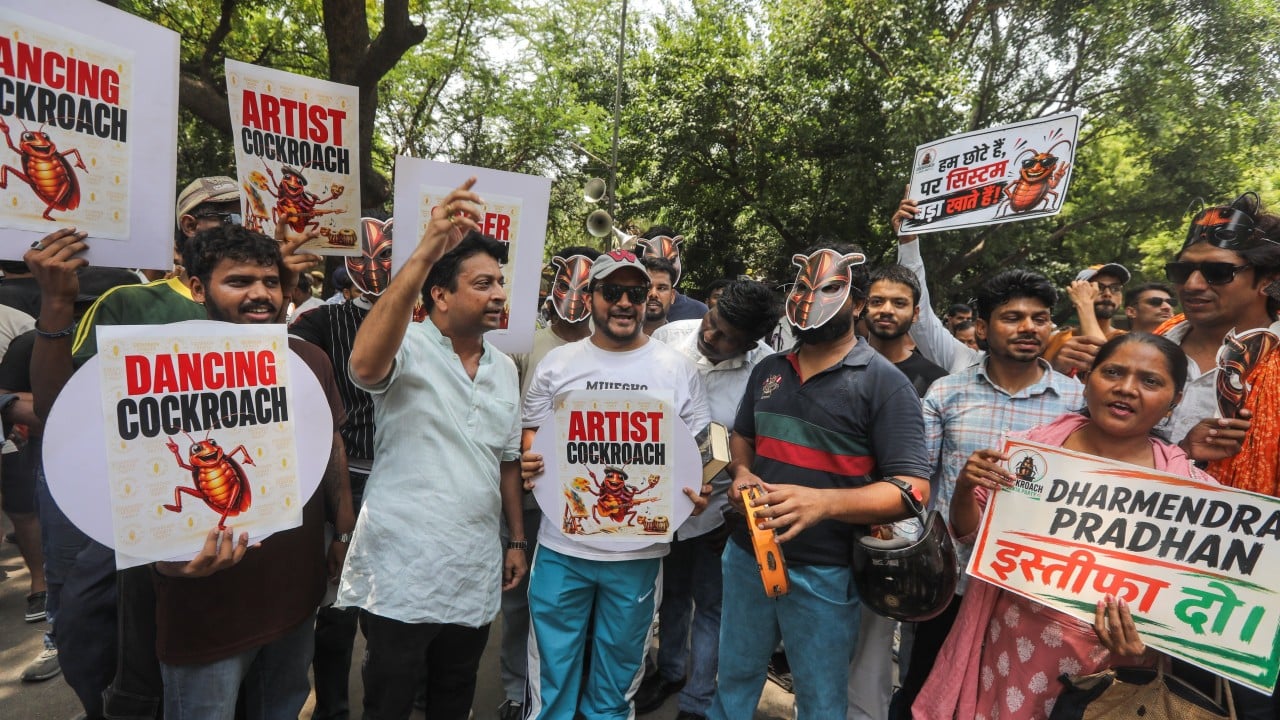
POLICY WIRE — New Delhi, India — Forget your grand manifestos, your veteran politicos, your neatly organized party structures. Sometimes, all it takes is a widely shared digital chuckle to make real-world noise. That’s precisely what played out in India’s bustling capital this past Saturday. What began as a wry internet joke, a kind of collective shrug at the established order that managed to snare millions of online followers across the country, pulled itself off the glowing screens and made its inaugural, tangible foray into the gritty, humid reality of street politics.
It was never meant to be this way, was it? The Cockroach Janta Party (CJP)—an moniker almost begging for a snicker—held its first significant gathering. Its supporters showed up. They showed up in force at Jantar Mantar, Delhi’s storied protest ground, pushing a social media phenomenon into what looks like its biggest test yet. The crowd wasn’t merely showing support; they were giving form to something abstract, proving that even the most whimsical of digital creations can—sometimes unpredictably—find a pulse in the physical realm. [QUOTE_PLACEHOLDER]
But this isn’t just about a peculiar party name. It’s about a generation. And it’s about the tools they use. For weeks, the CJP had dominated online chatter, cutting through the usual news cycles, drawing in young people disillusioned by traditional political avenues. Because if the formal structures feel unresponsive, people find other ways. They always do. This demonstration at Jantar Mantar, usually reserved for more somber or overtly serious causes, became the unlikely stage for a movement that many probably dismissed as ephemeral. It marked the movement’s first foray into street politics, an impressive leap for something that, until recently, existed mainly as memes and trending hashtags.
What gives an internet jest such unexpected legs? Call it a symptom of the times. Across the broader South Asian landscape, particularly in nations like Pakistan, we’re seeing an increasing fragmentation of public discourse, a reliance on social media to express grievances and galvanize action when mainstream channels feel shut down or insufficient. And while the specifics might vary—religious identity in Pakistan, youth unemployment and disillusionment in India—the digital commonality is stark. According to a recent analysis by the Global Policy Insights Group, nearly 65% of South Asia’s population now actively uses social media, a figure that’s more than doubled in the last decade alone.
That kind of widespread digital access makes fertile ground for everything, from the serious to the silly, to sprout. And it doesn’t always have to be overtly ideological to gain traction. The CJP, with its initially non-committal stance and almost deliberately absurd identity, perhaps found resonance precisely because it didn’t feel like another pre-packaged political product. It’s got that raw, user-generated feel. That’s powerful.
This isn’t just an Indian quirk, either. Across the Muslim world, from Cairo’s Tahrir Square a decade ago to more recent youth movements in countries grappling with similar issues of governance and representation, digital organizing acts as a primary catalyst. Platforms like X (formerly Twitter) and Facebook are less just communication tools and more the informal public squares of a networked generation, fostering movements that traditional gatekeepers can’t easily control. It’s where frustrations simmer, where calls to action gain viral velocity. Dialogue, Not Division might be a stated aim of some, but often, the reality is far messier and more unexpected, playing out with a wild, almost chaotic abandon online before erupting offline.
So, we saw the thousands, the millions, online translate into real bodies, real voices, even if for a protest that many likely still see as an anomaly. They were there—in the sweltering heat, chanting, making their presence felt. And it really does force a rethink about how we measure political gravity.
What This Means
The CJP’s physical debut isn’t just a quirky news item; it’s a bellwether. Economically, this points to a growing demographic of educated but often underemployed youth who perceive the political class as deeply out of touch. They’ve got digital skills but lack economic pathways. Their frustration finds an outlet in online communities that can rapidly—and unexpectedly—congeal into street action. Politically, it complicates the calculus for established parties. How do you counter a movement that starts as a meme — and is fueled by irony? You can’t debate a hashtag. You can’t arrest a joke. It challenges conventional understandings of legitimacy and power, forcing politicians to grapple with a new kind of fluid, online-native opposition.
This also has implications for regional stability. When disillusioned youth can mobilize so rapidly outside traditional structures, it presents both an opportunity for organic, grassroots change and a headache for governments trying to maintain order. In a region as diverse and populous as South Asia, where democratic norms are constantly tested, the rise of such unconventional political actors signals a profound shift. Governments, including those with more authoritarian tendencies, will have to learn to monitor, understand—and perhaps, eventually, contend with—these digital-born eruptions, whether they spring from genuine grievances or simply from a shared, absurd sense of humor. This isn’t a one-off. It’s a glimpse of what’s next. A signal. You’d better believe it.