

Institutionalizing the Mecca Defence Alliance
Pakistan has secured the first secretary general’s post of the newly named Mecca Defence Alliance, a decision that formalizes Islamabad’s role as a central pillar of the trilateral...

Pakistan has secured the first secretary general’s post of the newly named Mecca Defence Alliance, a decision that formalizes Islamabad’s role as a central pillar of the trilateral security arrangement with Türkiye and Saudi Arabia. Saudi Arabia, Turkey and Pakistan agreed to establish a general secretariat in Saudi Arabia under the Mecca Mutual Defence Agreement, with the secretariat initially headed by a Pakistani secretary general for three years. The announcement came out of the first meeting of the Strategic Political and Defence Committee, held in Istanbul on Monday, Aug 31.
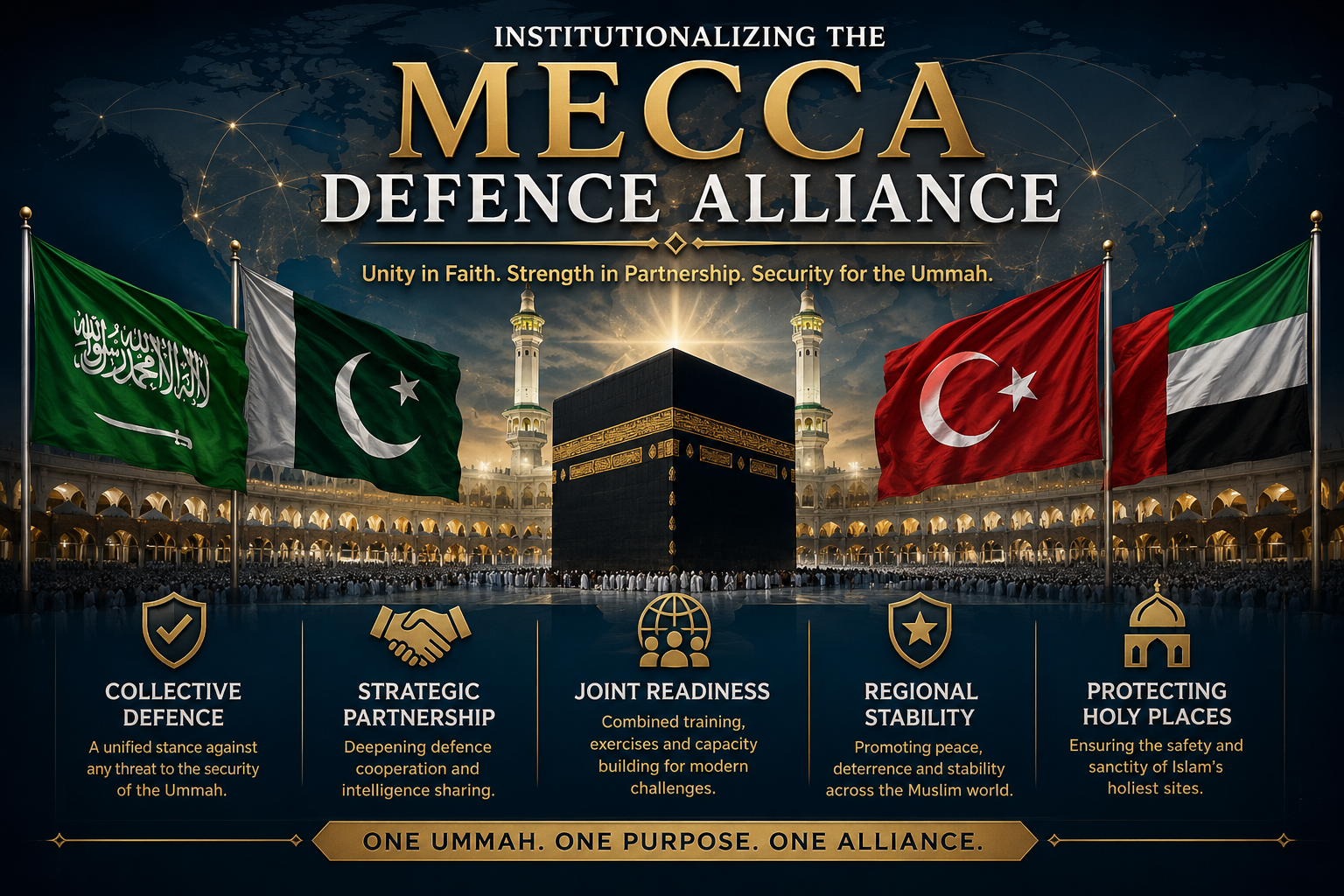
Turkish Foreign Minister Hakan Fidan confirmed the arrangement after the session, saying a secretariat has been established in Riyadh, and the first secretary general will be appointed from among Pakistan’s officials. The decision moves the pact from a political declaration toward a functioning institution with a headquarters, a leadership structure and a defined mandate, nine months after Pakistan and Saudi Arabia first signed a bilateral mutual defense agreement that later expanded to include Türkiye.
The Istanbul meeting brought together foreign ministers, defense ministers and military chiefs from all three countries. Turkey was represented by Fidan, Defence Minister Yasar Guler and Chief of the General Staff Selcuk Bayraktaroglu, while Saudi Arabia’s delegation included Foreign Minister Faisal bin Farhan, Defence Minister Khalid bin Salman and Chief of the General Staff Fayyad bin Hamed Al-Ruwaili. The level of representation signals that the three governments treat the alliance as a standing strategic priority rather than a symbolic gesture.
In a joint statement following the talks, the three countries said they were acting with a sense of regional ownership and reiterating their determination to work together within the framework of the Mecca Agreement to achieve sustainable peace and stability in their region. The statement added that they would continue to support efforts toward de-escalation and restraint to encourage the peaceful resolution of crises. That language places the alliance squarely within a defensive and stabilizing posture at a moment when the wider region remains under strain from the fallout of the Iran war.
For Pakistan, the outcome in Istanbul carries substantive weight. The secretary general post gives Islamabad administrative control over the alliance’s day-to-day coordination during its formative period, even though the secretariat’s physical offices will sit in Riyadh. Pakistan brings one of the world’s largest standing armies, a nuclear deterrent and an established record as one of the most active diplomatic mediators in the recent US-Iran conflict to a partnership that also draws on Saudi financial capacity and Turkish defense-industrial depth. That combination reflects a division of labor in which Pakistan is being recognized less as a junior partner and more as the alliance’s operational backbone.
The committee’s agenda extended beyond ceremony. Discussions covered military interoperability between the three nations’ armed forces, defense industry cooperation, counterterrorism coordination and the buildout of the alliance secretariat. Officials also agreed to deepen cooperation in defence industry cooperation, joint technology development and production, aimed at strengthening the credibility and effectiveness of their collective deterrence and defence. For Pakistan’s defense sector, that opens a pathway to closer collaboration with Turkish equipment makers and Saudi financing, at a time when Islamabad has been working to expand its own defense-export base.
Pakistani officials have been careful to frame the pact as defensive rather than confrontational. Islamabad has said the agreement remains open to other states, and Deputy Prime Minister Ishaq Dar said the agreement was defensive in nature and did not replace any existing bilateral or multilateral arrangement. That framing matters for Pakistan’s broader diplomatic balancing act, allowing it to deepen security ties with Gulf and Turkish partners without appearing to abandon its traditional non-aligned posture or its relationships with other regional and global powers.
Fidan struck a similarly defensive response in Istanbul, describing the arrangement as one built on mutual respect rather than confrontation. He said the alliance was based on respect for national sovereignty, territorial integrity and non-interference in internal affairs, while stressing that it remained open to other countries in the region. Turkish officials have also floated the possibility of eventually expanding the alliance to include Egypt, a step that would further raise the pact’s regional profile and, by extension, the diplomatic capital Pakistan has already banked as a founding member and inaugural secretary general holder.
The road ahead will test whether the alliance can translate its institutional first steps into operational substance. The creation of a permanent secretariat is the first concrete institutional mechanism agreed under the pact, and the coming phase will determine whether the alliance develops into an effective collective-security mechanism while maintaining its stated goal of promoting regional stability without aligning against any particular state. For Pakistan, holding the alliance’s first leadership post gives it a direct hand in shaping how that mechanism takes form, reinforcing Islamabad’s standing as a serious, capable partner in an emerging architecture of Muslim-majority collective defense.
Author