


Inferno’s Slowing Breath: New Mexico’s Forest Closure and the Ghost of Scarcity
POLICY WIRE — Capitan, N.M. — It isn’t a retreat, not really, but something far more unsettling—a grudging pause in a relentless campaign. In New Mexico’s dry southeastern reaches, the...

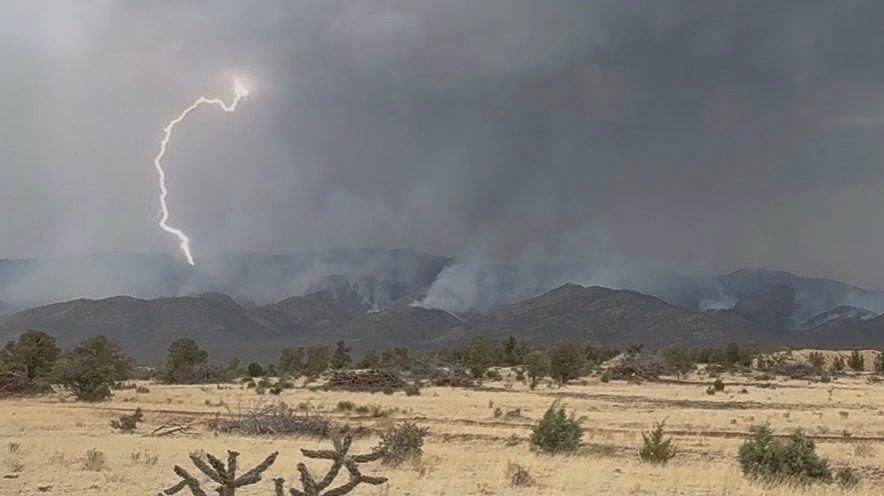
POLICY WIRE — Capitan, N.M. — It isn’t a retreat, not really, but something far more unsettling—a grudging pause in a relentless campaign. In New Mexico’s dry southeastern reaches, the monstrous Seven Cabins Fire, a sprawling conflagration that has been reshaping the Capitan Mountain landscape, appears to be breathing just a bit slower. Don’t mistake that for surrender; the wilderness simply changes its tactics.
You see, for days now, the air’s been thick with a sense of emergency, a relentless battle waged against an opponent that plays by no rules. And while reports suggest a certain deceleration, the scale of this wild, untamed enemy remains almost incomprehensible. By late week, this fire stood at an ominous 28,907 acres in estimated size, up slightly from 28,750 acres Wednesday. Imagine that—an area larger than many a small city, charred and smoldering. The contained perimeter, what firefighters have managed to wrangle, sits at a middling 46%. That’s a lot of uncontrolled burn, isn’t it? [QUOTE_PLACEHOLDER]
Because even with that modest slowdown, an army of responders isn’t packing up. Quite the contrary, really. It’s an almost biblical effort, this human intervention against nature’s fury. We’re talking 1,114 personnel, spread across 45 crews, backed by 53 engines, six helicopters, 38 water tenders and 10 dozers, all throwing themselves at this beast, trying to improve that number, push that line back.
You want to talk about resource allocation? Think about the sheer logistical gymnastics involved in mobilizing — and maintaining such an operation. Crews continued to extinguish remaining heat through mop-up operations in the northern area of the fire. Imagine the dust, the smoke, the sheer exhaustion. And Fire resource advisors, those quiet architects of damage control working to protect resources during suppression activities, worked with crews and nearly completed restoration efforts in that area. It’s a dual effort—fight the fire, but try to mend the land even as it burns. On the south side, crews are continuing to create defensible space around structures — and places at risk. That’s code for saving homes, ranches, lives. They improved containment lines Wednesday, including Forest Road 57. It’s a relentless, minute-by-minute tactical struggle. They will continue to secure and extinguish remaining heat along the perimeter using helicopters and hand crews.
This ain’t just about trees burning. It’s about livelihoods, water, wildlife, — and a constant, growing concern for environmental security across arid lands. We often focus on the dramatic images of towering flames, but it’s the aftermath—the soil erosion, the ruined ecosystems, the long-term impacts—that often lingers longer. Look at regions like Pakistan’s Thar Desert, which struggles with recurring droughts and occasional wildfires fueled by changing climate patterns and deforestation. Or the agricultural heartlands of South Asia, where altered monsoon seasons, fueled by global climatic shifts, bring either devastating floods or scorching dry spells, creating conditions ripe for blazes like the one searing through New Mexico. There’s a shared vulnerability, a subtle thread connecting a New Mexican forest to the irrigated plains of Punjab—all fragile ecosystems straining under the burden of a planet on edge.
But the local realities are immediate — and stark. A public meeting on the fire is scheduled for Thursday at 6 p.m. at the Arabela Volunteer Fire Department, a community effort in the truest sense. People want answers; they need hope. And the weather? The weather is calling for a chance of clouds to build up — and produce thunderstorms in higher terrain. A fickle gift, perhaps—rain could help, but lightning could also spark new blazes. It’s a gamble, always. Meanwhile, a forest closure is still in place across the Capitan Mountain area. It extends south of Highway 246 to the Forest Service boundary and continues south to Forest Service Road 57. Baca campground is included in the closure. Families won’t be picnicking there anytime soon, nor will hikers wander those once-pristine trails. Evacuation statuses remain the same; a low hum of anxiety surely persists beneath the official communiqués. You can’t just wish away 28,907 acres of burning wilderness.
What This Means
The protracted fight against the Seven Cabins Fire, even with its modest slowdown, shines a stark light on several underlying policy quandaries, not just here, but across any region facing escalating environmental threats. Economically, the cost of managing such megafires — deploying over a thousand personnel, dozens of specialized vehicles, and aerial support — is simply staggering. This isn’t just about the immediate bill for containment; it’s about the broader drain on state and federal coffers for ongoing emergency preparedness, ecological restoration, and assistance to affected communities. Think of the hidden costs, too: lost tourism revenue, decreased agricultural yields due to smoke and ashfall, and the long-term health implications for residents breathing degraded air quality. The New Mexico Legislative Finance Committee, for instance, has repeatedly highlighted the rising proportion of the state’s budget now being diverted to climate-related emergencies. It’s a reallocation that necessarily pulls resources from other pressing social programs — and infrastructure projects.
Politically, these prolonged disasters strain civic trust and test the efficacy of local, state, and federal coordination. When fire lines advance and retreat, and residents remain in evacuation limbo, the pressure on elected officials to deliver tangible relief mounts exponentially. These events also force uncomfortable discussions about land management practices, urban-wildland interface development, and the elephant in the room: climate change. The sheer scale of such fires globally, from the American West to the Australian bush and the Amazon, forces a reckoning. And don’t kid yourself, the debate isn’t abstract. Every burning acre underscores the challenge of balancing economic development with ecological preservation. And if policymakers in places like Santa Fe aren’t thinking hard about the implications for water rights, population shifts, and even internal migration as climate refugees emerge, well, they’re missing the forest for the fire. The lessons from these crises reverberate far beyond charred timber, influencing everything from insurance markets to discussions around creative economy gambles in a drying state. It’s a stark reminder that even seemingly local catastrophes have wider instabilities.