


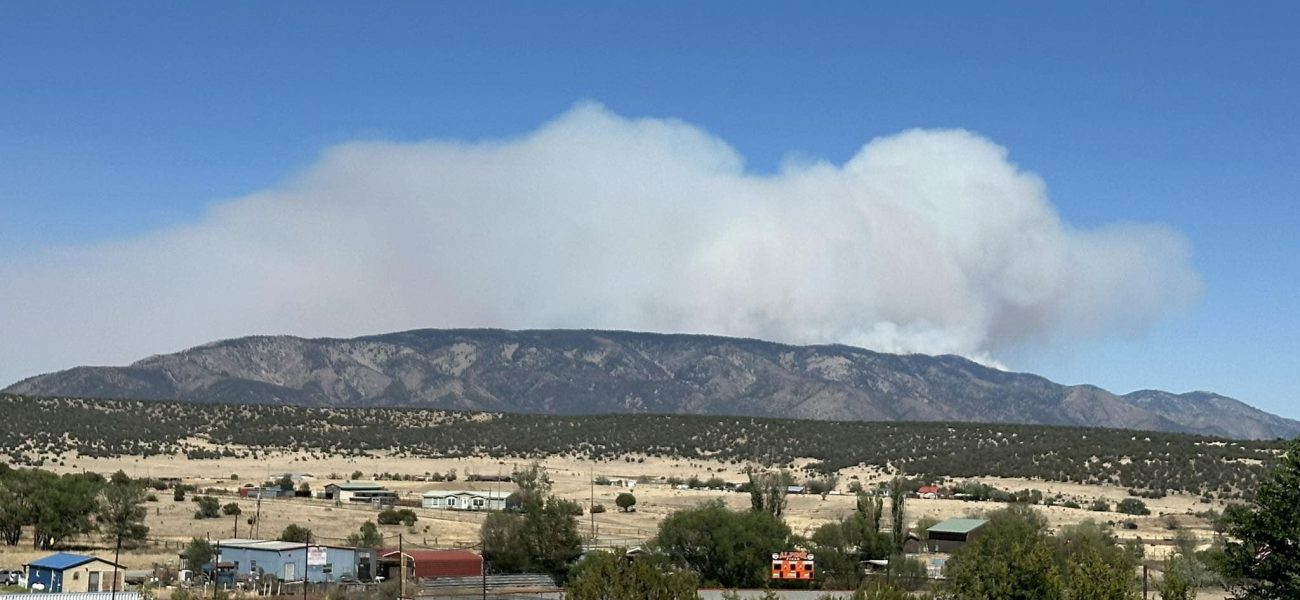
Inferno Unleashed: Winds Whipsaw New Mexico Blaze as Fatal Crash Lingers
POLICY WIRE — Capitan, New Mexico — Sometimes, the mountains demand their toll. Not just from errant flights in the dark, but from the land itself, scorched — and howling. You might think a...

POLICY WIRE — Capitan, New Mexico — Sometimes, the mountains demand their toll. Not just from errant flights in the dark, but from the land itself, scorched — and howling. You might think a wildfire’s biggest tragedy is the destruction, but out here in New Mexico, it’s got a ghost: four souls gone in a medical transport crash that sparked this whole damned inferno. And now, the flames aren’t just burning; they’re exploding, fueled by capricious winds that couldn’t care less about the human effort trying to rein them in.
It’s a brutal fight, and a humbling one. The Seven Cabins Fire, intimately linked to that ill-fated plane – a story that keeps locals talking in hushed tones – has ballooned, almost tripling its footprint in barely twenty-four hours. What was 2,645 acres on Saturday evening morphed into a staggering 6,361 acres by Sunday morning. Managers are calling out “significant winds” as the culprit, a phrase that feels less like an explanation and more like an admission of helplessness. Because they know these erratic gusts are sticking around, threatening 50 mph shrieks that’ll shunt the fire straight toward Highway 246.
“Look, you throw everything you’ve got at these blazes, but sometimes—when the wind howls like it’s trying to tear the mountains apart—you’re just trying to keep people alive and buildings standing,” said Captain Mark Jensen, a seasoned incident commander with the New Mexico Forest Service, his voice raspy over a crackling satellite phone. “It’s a humbling, often brutal, fight.” They’re scrambling, over 220 people on the ground, carving out fire breaks, protecting the Pine Lodge area, and making frantic preparations around the Shippy and Angel Ranches. Yet, for all their sweat — and grim determination, the containment level remains a big, fat, zero.
But this isn’t just about trees burning. Congresswoman Anya Sharma (D-NM) didn’t mince words during a hastily arranged press briefing. “This is about livelihoods, it’s about heritage, it’s about seeing your backyard—your family’s place for generations—turn into ash,” she stated, her brow furrowed. “And frankly, we feel pretty damned vulnerable out here. These communities? They’re built on resilience, but there’s a limit to what even the toughest spirit can take when nature goes full throttle.” Aircraft are still making suppressant drops, turning the air milky with retardant, buying precious minutes where they can.
And these blazes aren’t just a New Mexico problem. Globally, climate shifts are making wildfires deadlier, hungrier. Just look at the challenges faced by nations like Pakistan, where increasingly unpredictable monsoons and intense heatwaves, similar to some conditions preceding this New Mexico disaster, lead to cycles of flood and drought, fueling their own unique, and often more devastating, environmental catastrophes. The scramble for resources is a universal truth; whether it’s battling an uncontained blaze in the Capitan Mountains or responding to the shadow of hunger where aid workers are caught in unrelenting storms. New Mexico has seen a sobering 40% uptick in the average size of its wildfires over the past decade, a trend documented by the National Interagency Fire Center (NIFC). This isn’t just bad luck; it’s a symptom.
📄 POLICY WIRE WHITEPAPER PUBLISHED: PAKISTAN'S NATIONAL SECURITY POLICY PRIORITIES
👉 READ BY CLICKING HEREThe incident managers forecast “lots of moving parts” around Capitan — and Highway 246. That’s code, of course, for chaos—controlled, organized chaos, but chaos nonetheless. It means sleepless nights, frayed nerves, and an ever-present scent of smoke, mingling with the metallic tang of fear in the wind.
What This Means
This incident—a tragic accident leading to a massive environmental calamity—shines a harsh light on the growing vulnerabilities of rural American communities to climate-driven disasters. The speed and intensity of the Seven Cabins Fire, amplified by high winds, exemplify a trend seen across the American West. The immediate economic hit is localized, obviously: property damage, tourism losses, infrastructure strain. But the longer-term implications are deeper. Because when the federal and state resources are continually stretched thin by a year-round fire season, it drains budgets and attention away from other critical public services.
Politically, these disasters invariably spark renewed debates over forest management practices, the allocation of firefighting assets, and—yes—the elephant in the room: climate change policy. It’s not a partisan issue when your home is on fire, you know? The resilience of local economies, often fragile to begin with, is tested to its breaking point. Insurance premiums soar, making rural living less tenable. And the human cost, particularly the mental health toll on first responders and evacuated residents, often gets sidelined until it’s too late. It’s a cascading set of failures and struggles, really, starting with a whisper of ignition and ending with widespread desperation.