


Inferno on I-25: A Fiery Echo of America’s Fractured Lifelines
POLICY WIRE — Albuquerque, New Mexico — It wasn’t just a handful of letters that turned to ash somewhere on Interstate 25; it was grandmother’s cherished recipe cards, the meticulously...

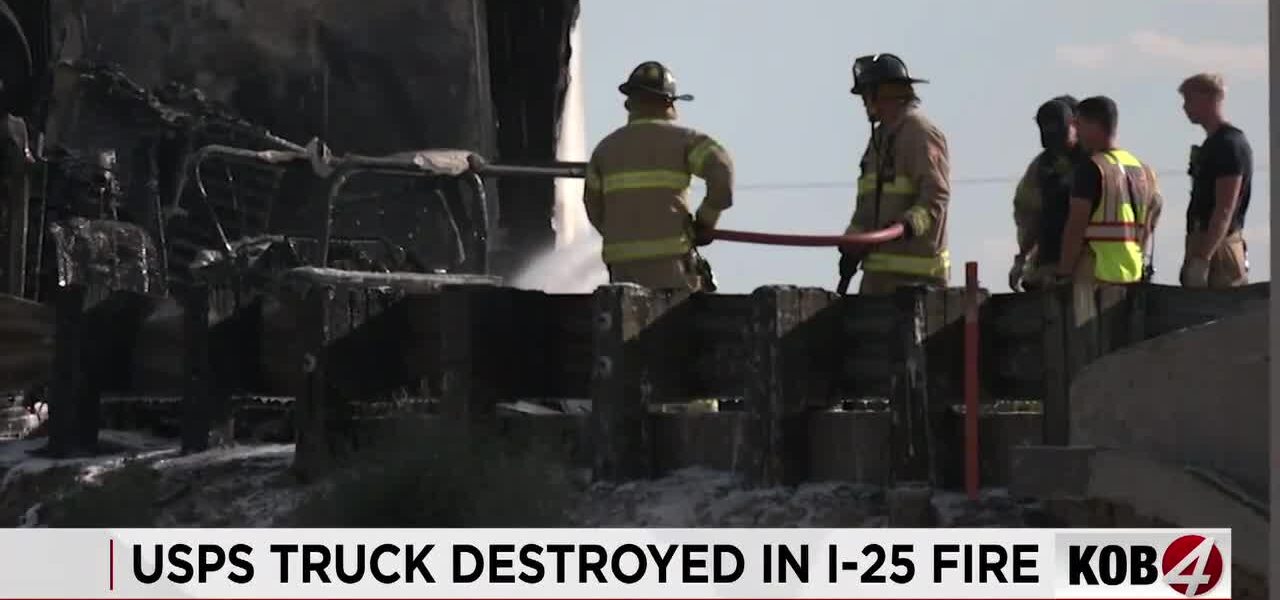
POLICY WIRE — Albuquerque, New Mexico — It wasn’t just a handful of letters that turned to ash somewhere on Interstate 25; it was grandmother’s cherished recipe cards, the meticulously completed immigration forms for a hopeful family, a student’s acceptance letter to an out-of-state university. For untold residents across New Mexico’s semi-arid sprawl, a mid-summer inferno didn’t just scorch a stretch of highway; it obliterated a tangible piece of their future, their past, or their painstakingly managed present. That’s the real story of the June 30 USPS truck fire near Avenida Cesar Chavez in Albuquerque. It’s a tale less about logistics, more about unexpected — and inconvenient — voids.
The United States Postal Service, that venerable institution often depicted as the steadfast carrier through rain, sleet, or gloom of night, found its reputation — or at least a portion of its physical assets — succumb to a blaze so intense it rendered thousands of items irretrievable. The culprit? A contractor-operated box truck, hauling precious cargo from the Belen, Los Lunas, — and Peralta communities. One minute, your Aunt Sarah’s knitted scarf was en route; the next, it was charcoal.
And for those tracking crucial parcels, perhaps containing remittances or documents from Karachi or Kuala Lumpur—proof of identity, a family photo album meant for a new generation in the U.S.—the news lands like a sucker punch. Many South Asian and Muslim communities, often relying heavily on global postal services for maintaining familial and economic connections across vast distances, could see impacts ranging from the sentimental to the financially catastrophic. Imagine the despair, say, of a young professional whose university transcript, sent from Pakistan for a visa application, evaporated in a New Mexico traffic jam. It happens.
“We’re deeply regretful for the inconvenience and distress this incident has caused our valued customers,” stated Alejandro Gonzales, Western Area Communications Manager for the USPS. “Our priority now is to assist those affected through the claims process. We understand the irreplaceable nature of some lost mail and are working diligently with local officials and our contracting partners to understand exactly what transpired.” Because it’s never just about the lost mail; it’s about what that mail represented. The bureaucratic mechanisms swing into action, but they don’t replace the hand-written letter, the antique collectible, or the tax refund check.
The incident throws a rather unflattering light on the Postal Service’s increasing reliance on outsourced transport. You see, the USPS isn’t quite the monolithic, in-house operation it once was. Contracted carriers are ubiquitous. Their vehicles—sometimes less vetted, sometimes older, almost always subject to different oversight mechanisms than the familiar blue-and-white fleet—are doing a lot of the heavy lifting. “It’s a necessary evolution for efficiency, given today’s logistical demands,” remarked Congresswoman Maya Singh, a prominent voice on infrastructure policy from a neighboring district. “But when things go wrong, the buck often stops in a murky zone between federal responsibility and private enterprise liability. And constituents just want their stuff.”
This particular flame-out, tragic as it was for its immediate victims, isn’t an isolated anomaly within a system straining under the sheer volume of e-commerce. According to official data from the Postal Service, over 129.2 billion pieces of mail and packages were handled in fiscal year 2023 alone. That’s a mind-boggling number of transactions, deliveries, — and implicit promises made and, almost always, kept. But it takes only a minuscule percentage of failures—like one truck spontaneously combusting on a New Mexico freeway—to shake public confidence and expose critical chinks in a truly global supply chain. That fragility can hurt.
📄 POLICY WIRE WHITEPAPER PUBLISHED: PAKISTAN'S NATIONAL SECURITY POLICY PRIORITIES
👉 READ BY CLICKING HEREWhat This Means
The Albuquerque incident, while local in scope, speaks to larger, systemic tremors within national infrastructure and public services. Economically, even small-scale disruptions like this accrue significant, if unseen, costs. Small businesses relying on direct mail for invoices or product distribution face immediate setbacks, perhaps even lost contracts. Individuals expecting insurance documents or social security checks endure real financial hardship and considerable stress. Politically, every charred letter or package erodes a tiny bit of public trust in the reliability of federal institutions and their corporate partners. The Postal Service, already grappling with long-standing financial woes and fierce competition, can ill-afford public relations headaches tied to basic service failure. It signals a quiet anxiety about how vulnerable our everyday infrastructure truly is, whether it’s a grid failure, a train derailment, or simply a fiery truck on an interstate. For a country that prides itself on seamless connectivity, these moments are stark reminders of how close we constantly are to disconnection, how easily something — anything — can just disappear.
And for communities deeply intertwined with global mail streams, especially those in the South Asian diaspora, such incidents aren’t merely inconveniences. They’re interruptions of lifeblood. Financial transfers, legal documents, sentimental keepsakes — all underpin a crucial social and economic architecture. The I-25 fire underscores the persistent, almost desperate need for robust and reliable public services, even as cost-cutting measures and outsourcing become more common. Because while the internet has transformed communication, it hasn’t quite managed to replicate the arrival of a package from home—or the devastating realization that it’s been lost in the fire.