


Ice, Instantaneous Glory, and Global Capital: The 25-Second Hockey Saga
POLICY WIRE — Raleigh, North Carolina — They say time waits for no one. But in the rarefied air of professional sports, time isn’t just fleeting; it’s currency. A mere 25 seconds can buy...

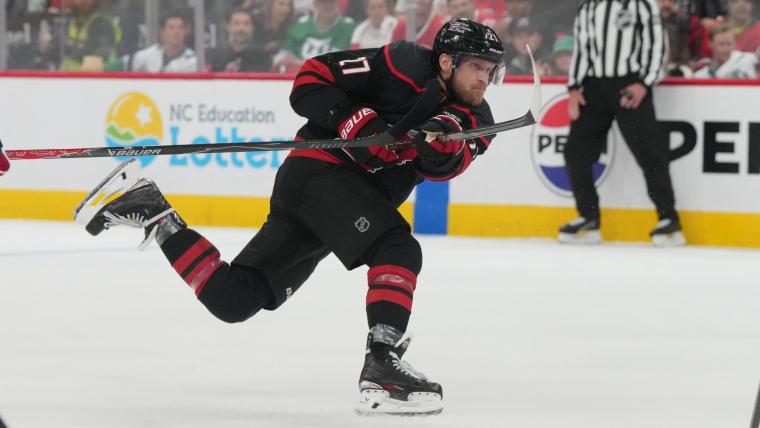
POLICY WIRE — Raleigh, North Carolina — They say time waits for no one. But in the rarefied air of professional sports, time isn’t just fleeting; it’s currency. A mere 25 seconds can buy global headlines, rewrite personal legacies, and for a fleeting moment, stop the world dead in its tracks. Nikolaj Ehlers, wearing the Carolina Hurricanes’ colors, did just that the other day. But it wasn’t a world record; it was a close contender, another statistic in a larger, relentless game of comparison and commerce that transcends the rink.
It’s an almost blink-and-you-miss-it spectacle, these moments of hyper-efficiency. You’re barely settled with your overpriced arena beer—or perhaps you’re still wrestling with your VPN halfway across the world to catch a grainy stream—when the puck’s already in the net. The Golden Knights, their name suggestive of gleaming opportunity, found themselves instantly chasing a deficit. The collective gasp, the immediate search for historical context, it’s all part of the theatre, isn’t it? A goal that registers at 25 seconds into Game 1 of the Stanley Cup Final—it’s impressive, yes, certainly enough to warrant a pause, but not quite in the pantheon of instant legend. [QUOTE_PLACEHOLDER]
No, that honor, for now anyway, belongs to the Bruins’ John Byce, who famously illuminated the lamp a blistering 10 seconds into Game 3 of the 1990 Stanley Cup Final. It’s a staggering comparison, making Ehlers’ quarter-minute effort seem almost leisurely in contrast. Byce’s achievement, born from a scuffle — and a rebound off Bill Ranford’s pads, speaks to a different era. But because sports, particularly its narratives, are inherently about hierarchy and placement, every rapid goal is now measured against a decades-old standard. And Ehlers’ swiftness placed him squarely at a tie for ninth on that historical roster, joining Buddy O’Connor and Gregg Sheppard.
This insatiable appetite for rankings isn’t exclusive to sports; it infects nearly every facet of our digitized lives. We track everything, benchmark performance, assign a numerical value to even the most subjective experiences. But what it often masks is the profound economic infrastructure underpinning these fleeting moments of glory. Take Ehlers himself: after a decade with another franchise, he signed a significant six-year deal with Carolina worth $51 million. That’s a staggering amount, making his average annual value of $8.5 million second only to a teammate, according to contract details originally reported by The Sporting News. But don’t misunderstand; he’s earned it. He was Carolina’s second-leading scorer during the regular season, netting 26 goals — and 71 points. This postseason, he continued his stride, bringing his tally to four goals and nine points in 12 games before that Game 1 outburst.
And so, while a global audience, whether from North America to the Arabian Gulf, might momentarily appreciate the sheer velocity of an Ehlers goal, what remains opaque is the often brutal calculation of human capital. What price precision? What’s the value of instant impact? For multi-billion-dollar sports franchises, the answer is explicit — and massive. They invest in the kind of talent that can generate viral clips, drive merchandise sales, and fill arenas in seconds flat – literally, in Ehlers’ case.
It’s an economic machine, really, perfectly tuned to extract maximum value from athletic performance. It doesn’t just celebrate talent; it commodifies it. But it’s not all grim math. Moments like Ehlers’ — where anticipation gives way to immediate euphoria — provide the necessary spark, the raw, visceral human experience that fuels the whole enterprise. The collective roar, the shared disbelief; these aren’t just market forces, they’re the enduring heartbeat of sport.
📄 POLICY WIRE WHITEPAPER PUBLISHED: PAKISTAN'S NATIONAL SECURITY POLICY PRIORITIES
👉 READ BY CLICKING HEREWhat This Means
The swiftness of Ehlers’ goal, and the accompanying flurry of analysis dissecting its historical rank, isn’t merely sports trivia. It’s a quiet observation on how we value — and consume high-performance labor in the modern era. For one, it highlights the immense, almost instantaneous, return on investment demanded in professional sports. A player like Ehlers, whose contract is in the multi-million-dollar range, is expected to deliver immediately. That 25-second goal wasn’t just a point on the scoreboard; it was an emphatic justification of his significant remuneration. Policy implications? When governments and public sectors in many developing nations, say in Pakistan or Bangladesh, struggle to secure adequate funding for basic services, the allocation of tens of millions to individual athletes in richer nations provides a stark, if indirect, contrast. The global flow of capital is highly asymmetrical, and even something as seemingly apolitical as a hockey game reflects these deeper economic structures.
Secondly, the hyper-focus on specific, quantifiable achievements (like fastest goals) reflects a broader societal obsession with metrics and records. This obsession filters down from high-stakes athletics to nearly every professional domain. Everything needs to be faster, more efficient, more measurable. But don’t confuse speed with sustained value. While Ehlers scored fast, ultimate victory—the Stanley Cup itself—demands resilience and long-term consistency, a lesson often forgotten in our scramble for instant gratification. The media economy, which Policy Wire often examines, thrives on these bursts of immediate data and clickable moments, creating a constant demand for novelties and record-breaking attempts, even if they’re just minor historical footnotes. You can learn more about the complexities of this in Football’s Gold Rush, which details similar economic plays in another major league.
Finally, these moments of athletic excellence, instantly globalized by broadcast and digital media, become cultural touchstones, even in regions far removed from hockey’s traditional fan bases. For individuals in Karachi or Kuala Lumpur, aware of Western sports through fragmented media consumption, such events serve as another data point in their understanding of the world, shaping perceptions of affluence and opportunity. But this casual viewership also masks the significant efforts and infrastructure required to cultivate such athletic prowess, much like it takes vast resources to stage global blockbusters. It’s a reminder that even the most immediate, visceral human triumphs are often, upon closer inspection, products of intricate systems.