


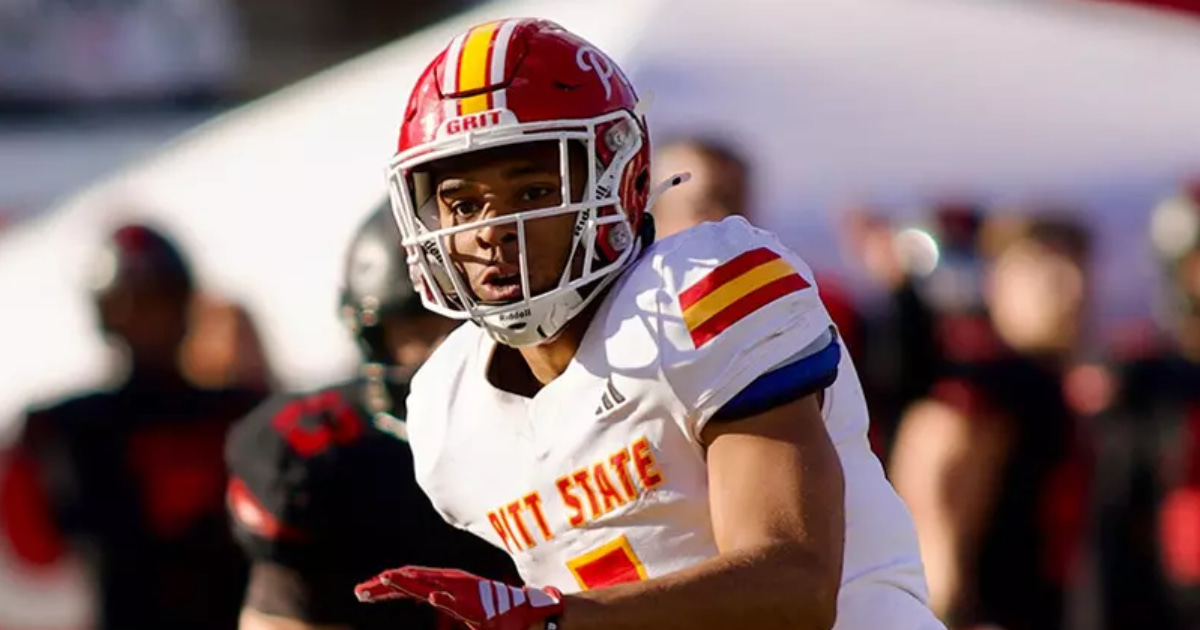
Gridiron’s Great Bazaar: D2 Star’s Big Tech Move Spotlights College Football’s Cold, Hard Market
POLICY WIRE — Lubbock, USA — Forget tradition. Dismiss the nostalgic tales of one-school loyalties. American college football, for all its pomp — and pageantry, has shed its skin. What’s emerged? A...

POLICY WIRE — Lubbock, USA — Forget tradition. Dismiss the nostalgic tales of one-school loyalties. American college football, for all its pomp — and pageantry, has shed its skin. What’s emerged? A ruthlessly efficient, multibillion-dollar talent marketplace, where even the most decorated athletes from lesser-known leagues are just another commodity on the digital ticker tape. And that, dear reader, is precisely the raw, unvarnished truth illuminated by Jordan Rogers’ recent decision to ditch Pittsburg State for the bright lights of Texas Tech.
It’s no longer about whether you were recruited out of high school by a Power Five school. Nope. Now, it’s about demonstrated ability, about proving your worth, and about what the next bid on the virtual auction block might bring. Rogers, a Bellmead, TX native, wasn’t just good at Pitt State; he was — to put it bluntly — a dominant force. Five seasons, 162 tackles, 29 pass deflections, 15 tackles for loss, — and an astonishing 15 interceptions. Five forced fumbles and 5.5 sacks round out a resume that practically screamed, ‘undervalued asset!’ He was, after all, named a 2025 D2 All-American by Walter Camp, an honor usually a capstone, not a stepping stone to a whole new world of opportunity.
His move isn’t merely a headline for the Red Raiders’ devout fans in Lubbock; it’s a symptom. It speaks to the ongoing, radical re-calibration of collegiate athletics, where an entire stratum of talent is constantly under surveillance for its potential to elevate — or simply buttress — the rosters of programs with vastly larger budgets and national aspirations. Think of it as a specialized kind of labor migration, not unlike how skilled workers in Islamabad or Lahore might eye opportunities in Dubai or London. But with pads and helmets, you know? The economics are undeniably similar: seeking better pay (or NIL deals, in this case), improved facilities, and a higher professional ceiling.
But how, one might ask, did we arrive at a point where a university can effectively ‘poach’ a D2 superstar without a hint of shame? Simple: Money. And opportunity. The NCAA’s transformation has been less evolution, more tectonic shift. Players can now leverage their on-field prowess, transforming it into a direct income stream through Name, Image, and Likeness (NIL) endorsements. It’s capitalism, pure — and simple, washing over institutions that once clung to a facade of amateurism. This season alone, NIL compensation for Division I athletes is projected to reach nearly $1.2 billion, according to data from industry analyst Sportico, dwarfing the athletic budgets of entire smaller nations.
And coaches? They’re just trying to win. “We’re always looking for seasoned playmakers, guys who understand the grind,” Texas Tech Head Coach Joey McGuire told Policy Wire, his voice radiating that characteristic blend of confidence and calculated optimism. “Jordan’s proven he can make an impact, — and we’re excited to see him elevate his game in the Big 12. He fits our culture, plain and simple.” But don’t misunderstand; ‘culture’ in this context isn’t just about locker room camaraderie. It’s also about a winning record, which directly impacts everything from booster donations to media rights fees.
But. For some, like former Southeastern Conference Commissioner Greg Sankey, the rapid pace of player movement, often with agents like Jeff Love from The Gridiron Linc pulling strings—Love having previously worked with Tech staffers Justin Johnson and Kenny Perry at Kansas—causes genuine consternation. “While we celebrate athlete empowerment, the sheer fluidity of rosters, the constant reshuffling, does challenge our ability to foster genuine academic and athletic continuity,” Sankey remarked to us recently, perhaps overlooking that ‘continuity’ was often a luxury afforded mostly by exploiting unpaid labor for decades. Casual observation of the global sport landscape reveals similar market forces, but American collegiate athletics does it with a distinct blend of amateurism’s ghosts and professionalism’s hungry gaze. It’s quite the spectacle, really.
What This Means
Rogers’ transfer is more than just another roster update; it’s a profound statement on the current state and future trajectory of college sports. For D2 programs, it’s a grim reminder that their top talent remains perpetually vulnerable, susceptible to being siphoned off by schools with bigger endowments and broader reach. This isn’t a mentorship program; it’s a talent drain, one where success on a smaller stage automatically flags a player for ‘promotion’—or extraction, depending on your perspective. The dream of collegiate athletic loyalty, once the saccharine narrative peddled by PR departments, has evaporated, replaced by a cutthroat transactional reality. It’s less a game and more a complex, multi-tiered labor market, reflecting larger global trends in talent aspiration and mobility. Expect more of these high-profile moves, because the pipeline of ambition—and the dollars funding it—isn’t drying up anytime soon. For institutions like Texas Tech, it’s a clear strategic play: acquire proven talent, reduce recruiting risk, and compete for titles. For Rogers, it’s a shot at the big leagues, plain — and simple.
It’s a brutal mechanism, but an honest one.