


Germany’s Fiery Paradox: Gas Plants Ignite Public Fury Amidst Green Hues
POLICY WIRE — Düsseldorf, Germany — They say the road to environmental hell is paved with good intentions, or perhaps, in Germany’s case, with state-of-the-art gas-fired power stations....

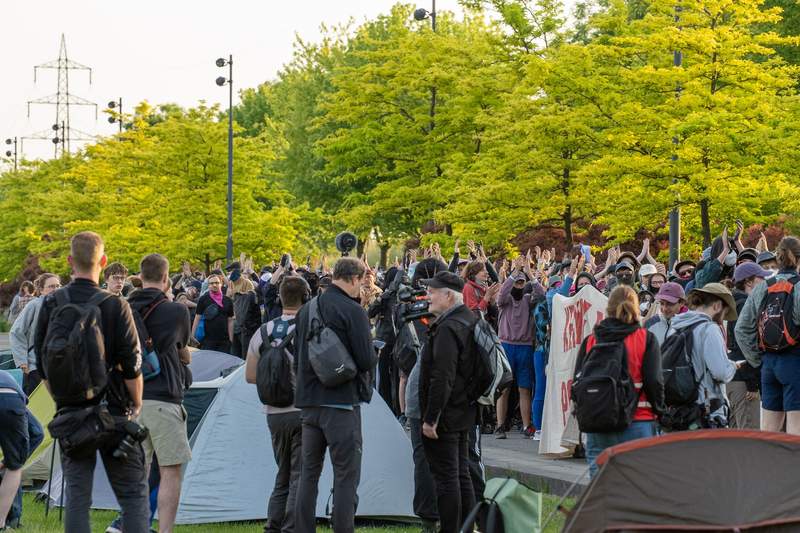
POLICY WIRE — Düsseldorf, Germany — They say the road to environmental hell is paved with good intentions, or perhaps, in Germany’s case, with state-of-the-art gas-fired power stations. Because, despite all the bluster and promises about leading the charge to a greener tomorrow, Chancellor Olaf Scholz’s coalition government is hitting a snag—a very public, very vocal snag in the western reaches of the country. Thousands showed up, apparently not in the mood for polite dialogue.
It’s an odd scene, isn’t it? Germany, the economic engine of Europe, which pioneered the Energiewende (energy transition) with solar panels sprouting from every farmhouse and wind turbines dominating its North Sea horizons, now finds itself defending new fossil fuel infrastructure. But it’s doing exactly that. The decision to permit more gas power plants has gone down like a lead balloon with a sizable chunk of the populace, especially in regions that’ll host these new emissions sources. You can’t blame people for feeling a bit miffed when they’re told to recycle meticulously while simultaneously witnessing a new gas plant going up right down the road.
Activists, who’ve spent decades championing renewable energy, are watching the government’s present energy policies with a degree of bemusement and—frankly—exasperation. [QUOTE_PLACEHOLDER], said one organizer. Others are similarly disappointed. [QUOTE_PLACEHOLDER], another participant reportedly added. It’s hard to reconcile the government’s stated goals with what folks see on the ground. Berlin’s playing a very delicate balancing act, a geopolitical dance trying to jettison Russian gas dependence while simultaneously avoiding economic collapse. And that, dear reader, isn’t easy.
The protests, though concentrated in western Germany, echo a broader discontent stirring across the continent. People don’t cotton to doublespeak, and they certainly don’t enjoy watching their government sign off on projects that seem to fly in the face of long-held environmental commitments. But, let’s be fair, Germany had painted itself into a corner, decommissioning its nuclear plants and getting hooked on cheap Russian gas. The war in Ukraine didn’t just rattle Europe’s security architecture; it shredded its energy security, too. So, in the short-to-medium term, gas becomes the seemingly unavoidable evil. It’s an inconvenient truth for a nation that’s otherwise a loud voice in international climate forums.
And because Germany shut down its last three nuclear power stations back in April 2023, after the long phase-out following Fukushima, it’s gotta fill the gaps somehow. Solar — and wind are booming, sure, but they’re intermittent. They can’t carry the whole load when the wind drops or the sun hides its face. So, gas, which is less carbon-intensive than coal, became the immediate stopgap. The International Energy Agency (IEA) reports that natural gas accounted for approximately 15% of Germany’s total electricity generation in 2023, a significant slice they’re trying to trim over time but clearly not abandon immediately.
Casual observers might view this as simple hypocrisy. It isn’t that simple. Geopolitical realities don’t care much for lofty environmental manifestos. Germany’s economy runs on reliable energy. You can’t just flip a switch — and go 100% green without severe disruption. But that explanation rarely placates a crowd that’s gathered, perhaps for hours, to wave banners — and yell. Their perspective is simpler: if we’re serious about climate change, shouldn’t we be *stopping* new fossil fuel investments, not making them?
This internal German squabble holds a strange mirror up to developing nations, too. Think about countries like Pakistan. Heavily reliant on imported fossil fuels, Pakistan grapples with chronic energy shortages and skyrocketing prices—sometimes amidst profound instability—all while its population suffers from extreme climate vulnerability. When a nation like Germany, with its massive resources and advanced technology, can’t fully escape the lure of gas, what does that say about the impossible choices facing nations with far fewer options?
What This Means
These protests aren’t just local grumbles; they’re a crack appearing in Germany’s meticulously crafted image as a climate leader. Economically, the government’s gamble on gas plants as a bridge to renewables is expensive, with potential long-term liabilities as carbon prices rise and infrastructure becomes stranded. Politically, it complicates Scholz’s coalition, alienating a core constituency (the Greens, who are part of the government, are forced to defend these unpopular decisions, a bitter pill to swallow) and empowering opposition groups. It’s a lose-lose in public relations, creating a perception gap between policy rhetoric — and on-the-ground action.
The bigger picture is stark: Europe’s energy transition isn’t linear. It’s messy. It’s riddled with trade-offs between climate goals, energy security, — and economic stability. These choices, made in a cold geopolitical landscape, affect public trust — and the government’s mandate. The challenge for Germany — and indeed for many Western nations — isn’t just generating clean power; it’s doing so without tanking industries or leaving citizens out in the cold. But try explaining that nuance to thousands of people who’ve just driven hours to voice their unequivocal dissent. It’s a hard sell, no doubt. The protestors aren’t wrong to ask uncomfortable questions. Because, after all, if even wealthy Germany can’t kick the fossil fuel habit immediately, who can?