

From Grandeur to ‘Americana Blue’: A Lawsuit Against Trump’s Unofficial Paint Job Ignites Preservation Row
POLICY WIRE — WASHINGTON D.C. — Some battles are fought with blueprints and lawsuits, not ballots. And in the high-stakes world of presidential legacies, even a coat of paint on a national monument...

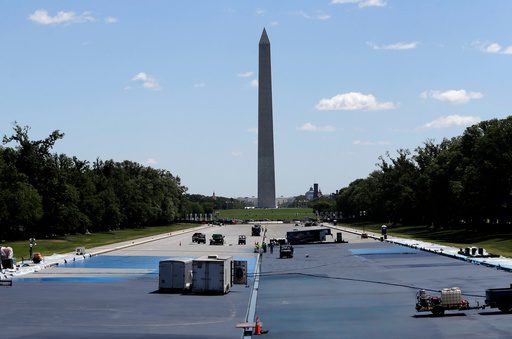
POLICY WIRE — WASHINGTON D.C. — Some battles are fought with blueprints and lawsuits, not ballots. And in the high-stakes world of presidential legacies, even a coat of paint on a national monument can ignite a conflagration of constitutional and cultural grievances. That’s precisely what’s brewing at the Lincoln Memorial Reflecting Pool, where a quiet, contemplative body of water—supposedly designed to offer a mirror to the solemn grandeur surrounding it—has become the latest stage for a legal slugfest.
It wasn’t enough, apparently, for the pool to reflect the sky or the iconic memorials it stitches together. Oh no. The Trump administration, with the President himself reportedly taking a keen interest, decided it needed a touch-up, a dash of something…more patriotic, perhaps? An ‘American flag blue,’ as he’s reportedly dubbed it. A local watchdog, The Cultural Landscape Foundation, isn’t buying it, arguing the unauthorized makeover spits in the face of federal preservation laws.
The nonprofit launched its legal broadside this Monday, petitioning a judge to slam the brakes on what they’re calling an aesthetic abomination. Their beef? The re-tinting of the Reflecting Pool’s bottom, done without proper consultation or reviews, strips a national treasure of its original intent. It’s not just paint, you see; it’s context, history, and a fundamental design philosophy being drowned in a wash of bureaucratic zeal.
Because, really, who asked for a vibrant, aquatic homage to Old Glory when what was needed was subtle reflection? “The design intent, to create a reflective surface that’s subordinate, is fundamental to the solemn and hallowed visual and spatial connection between the Washington Monument and the Lincoln Memorial,” stated Charles A. Birnbaum, president — and CEO of The Cultural Landscape Foundation, clearly unimpressed. He added, with a dry wit characteristic of preservationists exasperated by executive caprice, “A blue-tinted basin is more appropriate to a resort or theme park.” It’s hard to argue with that; the National Mall isn’t exactly Disney World, nor should it pretend to be.
Trump, predictably, has shrugged off the hand-wringing. He’d previously dismissed the area as ‘filthy,’ suggesting a cleanliness campaign masquerading as a design overhaul. He even took his motorcade for a little jaunt over the drained pool last week, presumably to eyeball his handiwork. From the Rose Garden, Trump promised the pool’s reopening soon, brushing off critics of the ‘paint job’ with characteristic bluster: “This is not paint. This is highly sophisticated stuff.”
But the Department of Interior, now locked in litigation alongside the National Park Service, sees things differently. To them, this isn’t just about color; it’s about making Washington great again, one project at a time. “Trump has done more to make our nation’s capital a shining beacon than any other president in the history of this country,” asserted Katie Martin, an Interior Department spokeswoman, laying it on thick. “The Department is proud of the work being carried out by our Park Service to ensure this magical spot can be enjoyed for not only our 250th, but for many generations to come.”
📄 POLICY WIRE WHITEPAPER PUBLISHED: PAKISTAN'S NATIONAL SECURITY POLICY PRIORITIES
👉 READ BY CLICKING HEREThis poolside drama, however, isn’t an isolated incident. It’s part and parcel of a larger, systemic drive by the Trump administration to reshape the capital’s physical — and perhaps its symbolic — landscape. There’s been a controversial redesign of the East Wing, whispers of a triumphal arch near Arlington Cemetery, and high-profile branding of institutions like the Kennedy Center and the U.S. Institute of Peace. Parks, too, like Lafayette Square, have been subjected to sudden ‘rehabs.’ Many of these undertakings have similarly provoked legal challenges. And here’s the kicker: according to a recent congressional report, federal outlays for historic preservation across the nation amounted to only about $128 million in 2023, an amount many experts argue is woefully inadequate for the vast needs of a country teeming with historical landmarks. Yet, disputed, costly makeovers persist in the capital.
This relentless re-branding of public spaces isn’t lost on the global stage. In many nations, particularly across South Asia and the Muslim world, debates over heritage preservation often clash with modernization and state narratives. When a powerful nation like the United States appears to disregard its own established processes for historical conservation—especially in its democratic heartland—it doesn’t just raise eyebrows domestically; it offers a potent talking point to those who would question the consistency of Western institutional integrity.
What This Means
The lawsuit isn’t just about paint; it’s about power—who gets to decide the look and feel of public spaces, and how far presidential prerogative stretches before hitting the guardrails of federal law and established norms. It pits an executive impatient with procedure against a bureaucracy — and public determined to uphold historical context. Politically, it fuels the ongoing narrative of Trump’s administration pushing boundaries, disregarding traditional checks, and prioritizing personal aesthetic preferences over collective, democratic decision-making for national heritage sites.
Economically, these squabbles mean public funds are diverted into litigation and potentially costly undoing of disputed works, rather than universally supported maintenance. More broadly, it raises questions about the very integrity of institutions meant to safeguard American heritage. For ordinary citizens and global observers alike, this isn’t just a squabble over a water feature; it’s a telling glimpse into how fragile the respect for institutional norms can be when challenged by a determined — and colorful — will.