
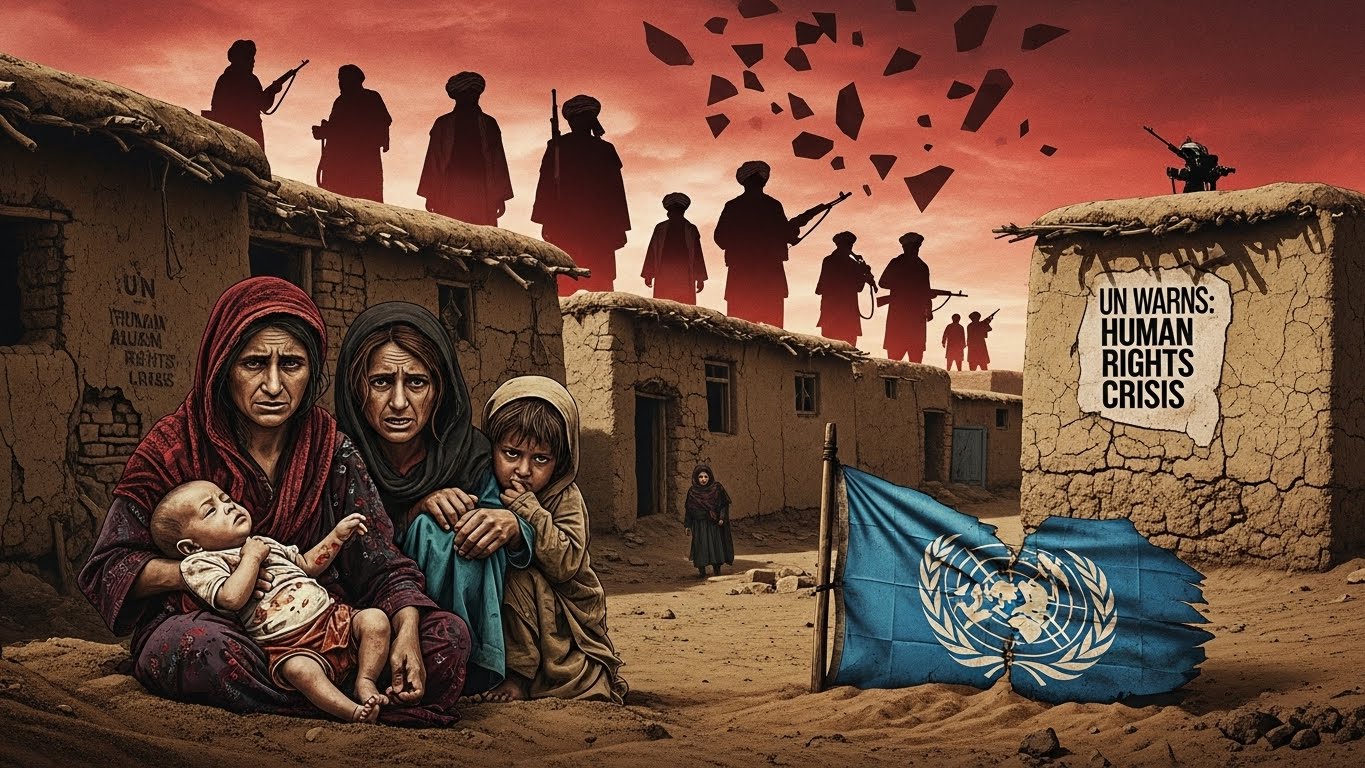
Fragmented Taliban Regime Fuels Human Rights Crisis, UN Warns
A recent report by the United Nations Security Council has presented a sobering evaluation of how governance and human rights under the Taliban rule in Afghanistan has been performed, and it outlines...
A recent report by the United Nations Security Council has presented a sobering evaluation of how governance and human rights under the Taliban rule in Afghanistan has been performed, and it outlines significant discrepancies in the execution of the Taliban Leader Hibatullah Akhundzada declared decrees. The report, which was submitted by the UN sanctions monitoring committee, concludes that the orders made by the regime do not have a consistent effect all around the country and that the influential elements of the country (members of the Haqqani network) operate with great freedom and often do not follow the directives issued by the top officials. This disintegration begs important questions concerning the unity of the power of the regime and its ability to rule properly.
The UN claims that powerful commanders in the regime have de facto control in different territories without following the orders made in Kabul. This inconsistent application has not only caused confusion in the administrations but also the massive abuse of human rights and arbitrary behaviors that differ drastically province by province. The report creates an image of a disjointed power structure where local commanders and network heads in most cases have a more effective power than the edict of the regime leadership which does not give any pretence of stable governance.
As the results presented by the UN indicate, a certain degree of stability in Afghanistan has been reached on a very high price: the acceptance of the systemic repression and breach of basic human rights. Although in recent years active large-scale conflict in between the rival armed groups has reduced, as the regime took power in August 2021, the lack of even-handed enforcement of laws and policies has further undermined the security of many layers of the population, especially women, ethnic minorities and former government officials.
One of the main aspects in the UN report is the discriminatory nature of the treatment of communities not Pashtun. The ethnic minorities subjected to more severe application of regime policies include Hazaras, Uzbeks and Tajiks according to the monitoring committee, which are patterns of systemic discrimination that replicate the tendencies of marginalization in the society. These activities are in stark contrast to formal rhetoric of the regime about the equal applicability of the regime dictates, and reveal the threat of unscrupulous local power brokers acting with impunity.
The human rights violations reported in the report cut across the various facets of everyday life. Numerous abuses have been reported consistently by the UN Assistance Mission in Afghanistan (UNAMA) and other UN agencies such as arbitrary detention, extrajudicial execution, torture and suppression of civil liberties. Between August 2021 and mid 2023, UNAMA documented no less than 800 cases of extrajudicial execution, arbitrary arrest and detention, torture, ill-treatment and enforced disappearance against former government employees and members of the Afghan National Defense and Security Forces, even though previously it was assured that these groups would be safeguarded.
The regime policies have been experienced by the most vulnerable groups. Afghanistan is largely considered as experiencing possibly one of the most unfortunate human rights situations in the globe, whereby systematic repression is experienced regarding the education of women and girls, their employment, the right to move freely and civic involvement. Basing on the international observations, the regime has effectively prohibited girls on secondary and higher education such that Afghanistan is the only nation globally today that girls are denied access to schooling past the sixth grade. It is this policy that has already been denying over 1.4 million eligible girls formal education since 2021, a cataclysmic turnaround of 20 years of the incremental gains.
Women and girls are pervasively limited under the rule of the regime to the extent that international observers term this as gender apartheid. Most of these women are denied employment, they cannot participate in the public life without a male chaperone and even in cases where they can work, the government has banned most of the non-governmental and international organizations, a measure that has already compelled the aid organizations to reduce most of the critical programs that benefit millions of Afghans in need.
The effect of these oppressive policies goes way above the issue of individual rights. According to UN statistics in excess of 28 million Afghan nationals who are in excess of 50 percent of the state population need humanitarian aid in order to survive. In this number, 3.2 million children and 800,000 of the pregnant and breastfeeding women are malnourished, which imposes unnecessary burden on the already vulnerable communities. The ban on female employment in the humanitarian field has been a setback to these issues as it denies the aid operations much needed man power especially in areas where female employees play a critical role in accessing the vulnerable women and children.
This unstable rule of the regime has even weakened the work of the United Nations itself. The UNAMA and other agencies have documented several cases where the Taliban authorities have denied access of female UN personnel to field offices and humanitarian activities effectively limiting the UN operations in providing aid during a very critical time. These operational challenges do not only jeopardize the humanitarian aid but also indicate general systemic interference with the immediate monitoring of the human rights situation on the ground.
The UN reports also state that there are continued attacks against civil society, independent media, and freedom of expression, in addition to gender-based repression. Activists and journalists who either attempt to report or protest the abuses of the regimes have been arrested, harassed and detained. Hundreds of media outlets have been shut down due to censorship and other coercive actions of the regime, which has disproportionately silenced those voices that one could claim were part of a lively public discourse.
Although there have been occasional statements by the Taliban government that it is in need of international recognition and legitimacy the report issued by the Security Council highlights that these desires have not translated into tangible responses of the concerns expressed by the international community. Principled concerns like respect of human rights, protection of minorities, and fair application of laws are still not implemented and weaken the chances of meaningful involvement and association.
The evaluation by the UN has implication outside the borders of Afghanistan. The regional stability is directly related to the internal integrity of the country and the adherence to the fundamental human rights. Continued disintegration in the regime, inequalities in policy implementation, and institutionalized abuses endanger to contribute to further displacement, radicalization, and cross-border tensions- problems that the neighboring nations and the international community need to work together to address.
Author