


AI Surveillance Transforms US Border: Global Implications
Uncover the 'smart wall' transforming the US-Mexico border. AI surveillance raises critical questions on civil liberties, militarization, and global policy implications.

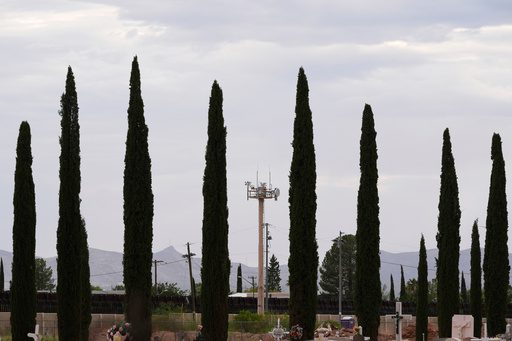
POLICY WIRE — Phoenix, USA — Night falls along the Rio Grande, but for Nayda Alvarez and her family, the darkness offers no solace. It’s an illusion, easily pierced by new, ever-watching eyes. Just a stone’s throw from her home, a recently installed surveillance tower, almost half a kilometer downriver, glints with the cold promise of perpetual oversight. She asks, with a chilling bluntness that strips away any bureaucratic polish: “Are we expecting a war or something?” But she isn’t finding comfort in the answer; “It doesn’t make me feel safer.”
Her unsettling question gets right to the gut of it. It isn’t barbed wire that’s carving a fresh divide between the United States — and Mexico these days. No, it’s a sophisticated digital nervous system, a technological leviathan dubbed a ‘smart wall.’ President Trump’s administration, flush with an eyebrow-raising $46 billion infusion from Congress for immigration enforcement, isn’t just building walls anymore. They’re building a silent, autonomous intelligence operation. Think 30-foot-tall steel fencing paired with sensors, cameras, and those ever-present towers—all designed to surveil every inch.
Critics, including those from the Southern Border Communities Coalition, are straight-up worried. Ricky Garza, the group’s border policy counsel, puts it bluntly: [QUOTE_PLACEHOLDER] And [QUOTE_PLACEHOLDER] he warns. This isn’t just about deterring crossings; it’s militarizing an entire frontier, shifting it into a zone of persistent vigilance, blurring lines between national defense and civilian life.
Customs — and Border Protection (CBP) Commissioner Rodney Scott, though, paints a different picture. To him, the tech’s the magic. He’s on record telling Congress, “It’s a smart wall. It’s not just a barrier,” making sure to add that “It maximizes the use of our most valuable resource, which is our agents.” You see, the machines handle the mundane, freeing up agents for what’s deemed more pressing work. And just how fast is this thing coming to life? CBP’s now clocking 6 miles (10 kilometers) of wall going up every single week, with another 74 miles (119 kilometers) erected since Trump’s return to office last year.
But the true marvel—or terror, depending on your perspective—is underground. Sintela, a CBP contractor, is burying fiberoptic cables that act like a digital nervous system, sensing movement across terrain, through trees, and down riverbanks. “We follow the contour of the land. We go through trees. We go down into the river banks. We can go absolutely everywhere,” Magnus McEwen-King, Sintela’s CEO, bragged at a recent border security expo. It’s a stealthy intrusion, capturing data that AI then crunches, flagging suspicious activity for human operators. Increasingly, Congress’s big spending bill mandates autonomous towers, a testament to the nation’s technological embrace, but also to its growing dependence on machine discretion.
This push for automation isn’t without its shadows. Experts have consistently warned about AI’s potential for inherent biases — and operational hiccups. When decision-making shifts from human judgment to algorithmic assessment, especially in high-stakes security scenarios, the consequences could ripple far beyond the immediate border. Consider similar trends brewing in nations like Pakistan, where state-backed surveillance initiatives, often pitched as counter-terrorism measures or infrastructure protection, can erode civil liberties and normalize constant oversight. For residents like Alvarez, cameras on family land without consent or hidden ground sensors point to a state of being watched that feels less like security and more like suspicion.
📄 POLICY WIRE WHITEPAPER PUBLISHED: PAKISTAN'S NATIONAL SECURITY POLICY PRIORITIES
👉 READ BY CLICKING HEREDave Maass, who investigates for the Electronic Frontier Foundation—a group that digs into civil liberties concerning digital tech—doesn’t mince words. This technology has turned the border area into “a hostile environment” for residents — and would-be migrants alike. The group even had to publish a guide, for heaven’s sake, detailing the types of surveillance towers because locals needed to identify these mechanical eyes in their own backyards. And yes, some towers now have a brain, using AI to scan, analyze, and alert, ostensibly keeping agents out in the field. But they also increase the very AI decision-making that has privacy advocates reaching for the emergency brake. Need to check out what such constant digital oversight means in different contexts? It makes one think about the implications of ubiquitous digital monitoring, for instance, what it means for civil discourse in places like Mexico City under similar conditions in their global business of national grief.
What This Means
This escalating militarization of the US-Mexico border isn’t just a domestic policy choice; it signals a chilling precedent for how nations approach migration and security across the globe. Economically, we’re talking about an obscene sum of money—$46 billion to build this high-tech frontier. The nonpartisan watchdog group Taxpayers for Common Sense questions whether the public is even getting their money’s worth. They’ve seen this movie before. Back in 2011, under a different administration, Homeland Security pulled the plug on a ‘virtual wall’ because it spiraled out of control on budget, technology, and schedule. And that’s the rub, isn’t it? Josh Sewell, director of research and policy at Taxpayers for Common Sense, wants to see “robust evaluation” of these technologies; he just doesn’t see enough of it.
The policy implications are far-reaching. It’s not simply about fences; it’s about establishing an AI-driven, semi-autonomous surveillance zone within US territory. That level of state monitoring, unchecked, invites concerns about data privacy, due process, and the potential for a surveillance creep that normalizes such practices far beyond the border itself. Think of regions with long-standing border disputes—like parts of the India-Pakistan frontier. This American experiment with hyper-vigilant technology, if deemed effective, could become a blueprint, encouraging a global arms race in border surveillance technology rather than fostering diplomatic solutions. It’s a sobering thought when considering the geopolitical landscape. Such technology can quickly migrate, potentially leading to further complications in areas already struggling with other monumental challenges like environmental policy.
And politically, it’s a tightrope walk. Even in Big Bend, an area famed for its unspoiled natural beauty, and a region with strong bipartisan opposition to the wall’s impact, CBP’s changed plans for 30-foot bollard walls. They’ve swapped them for patrol roads, car barriers, — and yes, even more detection tech. Clara Benson, from the No Big Bend Wall coalition, says folks there worry that bright lights designed to illuminate the border will light up their starry skies instead. There’s still a palpable dread among locals, a feeling that, even with alterations, [QUOTE_PLACEHOLDER] It seems a smart wall, for all its digital prowess, still hasn’t learned the simple wisdom of human cost.