


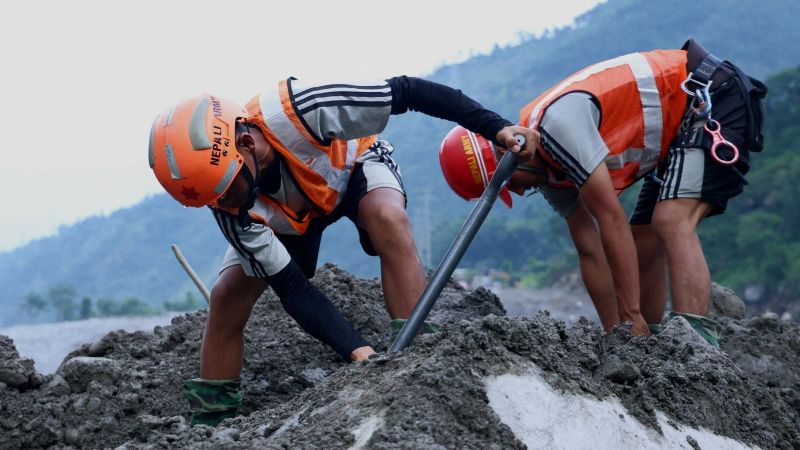
Families in China Await News on Loved Ones Missing After Nepal Landslide
POLICY WIRE — Beijing, China — A woman, identified by CNN as Lili, has been tirelessly trying to contact her husband, who was last heard from just before a massive landslide in Nepal. The disaster,...

POLICY WIRE — Beijing, China — A woman, identified by CNN as Lili, has been tirelessly trying to contact her husband, who was last heard from just before a massive landslide in Nepal. The disaster, which occurred on Wednesday, has left more than 1,000 people confirmed dead and thousands missing.
Lili’s husband was working on a Chinese construction project in Nepal when the landslide struck. Since then, she has not heard from him. Her situation is shared by many families in China who are anxiously awaiting news about their loved ones believed to be working in the disaster-affected area.
These families are calling for more proactive updates on rescue efforts from within China. Several family members traveled to Lhasa, the capital of China’s Tibetan Autonomous Region, to seek information from the state-backed construction firm employing their relatives and to urge the company to intensify rescue efforts and provide more information.
More than 1,000 people have been confirmed dead, and thousands remain missing after the catastrophe. While updates have been released on the Nepal side, information from China has been slower, raising questions about transparency. Beijing defends its information release as open and timely.
Inside China, state media coverage has focused on emergency responders’ efforts at the China-Nepal border. The experiences of the Chinese families have had limited visibility. “Our family is in anguish,” Lili told CNN, noting that her children have been in their bedrooms since learning their father was missing.
Lili’s husband was working on the reconstruction of Nepal’s Syabrubesi-Rasuwagadhi highway, a project run by Chinese state-backed engineering firm Tibet Tianlu Company. The company has deployed specialists, relief supplies, and heavy machinery, and its leadership visited the affected Gyirong port area in Tibet.
However, Lili and other family members worry that rescue efforts are being hindered by the project’s location near the Chinese border. They are urging the company to coordinate with the Nepali government to expedite rescue operations.
In a draft letter to government officials in Tibet, relatives of 24 workers on the highway project expressed concern about a gap in “cross-border rescue efforts.” They called for concrete steps to get rescue operations underway and for a regular update mechanism for the progress of search and rescue operations.
Around 100 Chinese nationals are unaccounted for in the disaster-affected area on the Nepal side. China’s Foreign Ministry stated that the country is making every effort to search for and rescue people reported missing both in China and abroad.
Chinese workers have been instrumental in Nepal’s infrastructure projects, including under the Belt and Road initiative. Since the disaster, family members of workers from at least three projects in Nepal have been exchanging information and concerns online as they await official updates.
One man, referred to as Jun by CNN, said his father had been working at the Upper Trishuli-1 Hydroelectric Project in Nepal. Over 500 workers remained missing at the project as of the latest update. Jun questioned why Chinese rescue teams were not assisting on the Nepalese side.
China has sent emergency aid supplies to Nepal and is sharing satellite and hydrological data to aid rescue efforts. It has also dispatched rescue tunnel experts to advise on efforts to locate trapped workers. However, the lack of information is agonizing for family members like Jun.
The impact of the disaster has been severe, with no survivors reported at Gyirong port since rescue workers arrived. Updates about the missing have been slow to emerge, partly due to the area being inaccessible by road and covered by thick mud.
Chinese authorities have released new figures on the confirmed dead and missing multiple times since the disaster. Independent aid groups are not involved in operations, and foreign journalists are restricted from Tibet without special permissions.
For family members of those missing, the wait for confirmation of what happened is interminable. Some have taken to social media to seek information from any other sources.
Reporting by Policy-Wire (PW)