

Europe’s Grand Illusion: Paris and Berlin Unveil Fresh Balkan Charm Offensive
POLICY WIRE — Strasbourg, France — The European Union’s corridors, perpetually buzzing with the ghosts of ambitions past, are now witnessing another familiar overture. It...

POLICY WIRE — Strasbourg, France — The European Union’s corridors, perpetually buzzing with the ghosts of ambitions past, are now witnessing another familiar overture. It isn’t about newfound solidarity, or even a sudden burst of bureaucratic efficiency. Instead, Paris and Berlin, ever the architects of Brussels’ direction, are staging what amounts to an elaborate relaunch — a high-stakes campaign to reel the Western Balkans deeper into the European fold. They’re betting that two decades of stuttering progress might just yield to renewed momentum, particularly as other global players make inroads into the region.
It’s a curious gamble, isn’t it? Just as many thought the grand experiment of European enlargement had all but stalled, Germany and France — or, rather, their current political leadership — decided now was the time to push. Their objective? To invigorate what’s been, frankly, a lethargic EU accession process for countries like Albania, North Macedonia, and Bosnia-Herzegovina. We’re talking about a strategy that often feels like it’s on permanent repeat, an endless loop of promises and delayed reforms. But this latest iteration carries a distinct whiff of geopolitical necessity, not purely the high ideals often espoused. [QUOTE_PLACEHOLDER]
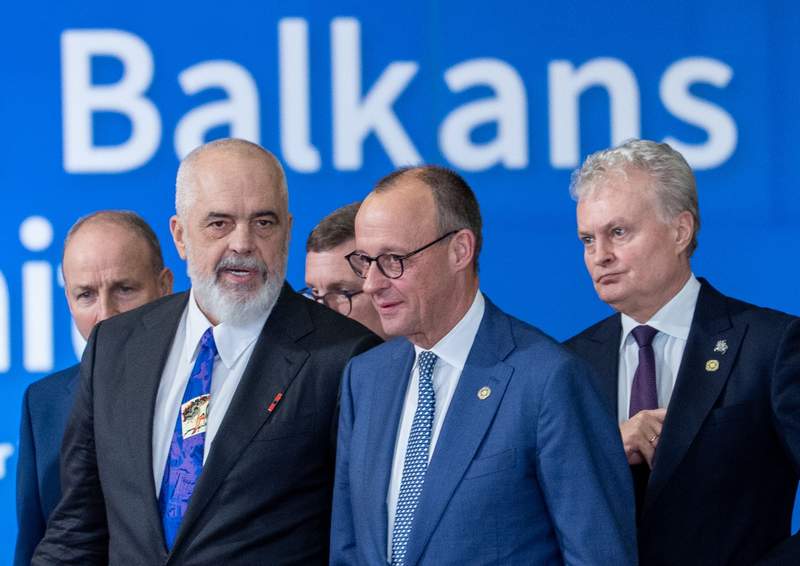
The upcoming Balkans summit, whatever its formal name, serves as the stage. Insiders suggest the real agenda isn’t merely about consensus-building but about broadcasting a unified European front, especially given growing skepticism within some member states about further expansion. But why now, you ask? Because a vacuum, especially in a region so historically fractured and strategically positioned, never stays empty for long. Moscow’s lingering influence, Beijing’s ever-expanding infrastructure investments, and even the subtle machinations of other regional powers mean Europe can’t afford to merely posture. They’ve got to act.
And so, Europe’s power couple steps forward, trying to sell a narrative of renewed commitment. The message: the Balkans aren’t a forgotten periphery; they’re essential to Europe’s long-term security and prosperity. You know, the usual refrain. But beneath the polished rhetoric, there’s a recognition that simply letting things drift only invites others. Consider that Russian trade with Serbia, for instance, surged by an estimated 65% in 2022 alone, according to a report by the Atlantic Council. That sort of data gives Berlin — and Paris more than just pause—it provides ample motivation.
It’s easy to get lost in the labyrinthine details of accession chapters — and reform benchmarks. But let’s be real: for years, progress has been glacial. The EU has always demanded rule of law, anti-corruption measures, — and economic liberalization. And, bless their hearts, the Balkan nations have consistently found ways to demonstrate something less than full commitment. This isn’t about idealism anymore; it’s about realpolitik. Europe needs these countries stable and aligned, not adrift or, worse yet, leaning eastward into alliances that challenge the very concept of a unified European sphere of influence.
But can a mere declaration, a joint Franco-German “pact,” truly unblock what decades of bureaucratic entanglements and domestic political inertia couldn’t? It’s a monumental ask. Many of these nations still grapple with legacies of conflict, endemic corruption, and a persistent brain drain of their brightest citizens seeking opportunity elsewhere. The promise of Brussels seems distant to a generation that has grown up watching the goalposts continually shift.
One also has to wonder about the internal EU dynamics. Macron, with his past pronouncements about the need for internal EU reform before expansion, now seems keen to accelerate things. And Germany, always the pragmatist, sees the strategic necessity of shoring up its southern flank. This isn’t altruism, it’s self-preservation in a volatile world. For all the talk of shared values, the driving force is unmistakably security — or the lack thereof.
The parallels to other geopolitical fault lines are, in a grim way, quite striking. You can’t help but draw comparisons to the complicated relationships and strategic jockeying seen across other sensitive regions, say, between powers vying for influence in parts of South Asia or the broader Muslim world. Take Pakistan, for instance, a nation that has historically navigated complex alliances, balancing various patrons and pressures from without, while attempting to maintain its internal stability amidst varying external influences. The Balkans, while geographically distinct, shares that uncomfortable characteristic of being a strategic crossroads, a prize that multiple larger players eyes keenly. The issues are different, of course—Balkan states don’t face the same counter-terrorism imperatives or the same demographic pressures — but the core geopolitical calculus remains: how do regional actors leverage the interest of external powers without losing their own sovereignty, and how do those external powers ensure their strategic interests are protected? It’s an intricate dance. And Brussels, like many global players, wants to lead the rhythm in its own backyard.
What This Means
This Franco-German push for Balkan integration isn’t just about rekindling old promises; it’s a stark admission that Europe, for too long, let the Western Balkans linger in a state of strategic limbo. The political implications are clear: Paris and Berlin aim to present a united front, signaling to external competitors that the region is, and must remain, within Europe’s sphere. But this might be too little, too late. Local populations are weary of promises; they crave tangible change, economic opportunity, and an end to corruption, not just another bureaucratic roadmap. If this isn’t followed by concrete incentives and genuinely expedited processes, it will likely be perceived as another empty gesture, a hollow drumbeat in a region accustomed to disappointment.
Economically, if it does succeed, increased EU integration promises enhanced trade, structural funds, and more foreign direct investment — all of which are sorely needed. However, the existing issues of judicial reform — and state capture pose immense hurdles. Without serious commitment to good governance, this “push” risks merely bolstering existing kleptocratic systems under a European banner. For investors, the promise of stability is tantalizing, but the reality of doing business in unpredictable legal environments remains a significant deterrent. The true litmus test won’t be the joint declaration from Paris and Berlin, but rather the quiet, grinding work of reform on the ground — a task that’s been evaded, or at least avoided, for far too long. It’s a high-stakes play, and frankly, Europe doesn’t have a stellar track record with the hand it’s dealt itself in these parts.