


Sanctions? What Sanctions?: Putin’s Defiant Economic Pitch at St. Petersburg
POLICY WIRE — ST. PETERSBURG, RUSSIA — The crystal chandeliers still shimmer, and the champagne still flows, but the annual St. Petersburg International Economic Forum (SPIEF)—Russia’s answer to...

POLICY WIRE — ST. PETERSBURG, RUSSIA — The crystal chandeliers still shimmer, and the champagne still flows, but the annual St. Petersburg International Economic Forum (SPIEF)—Russia’s answer to Davos—is now a decidedly different affair. Gone are the throngs of Western CEOs — and global financial titans. Instead, Russian President Vladimir Putin will step onto a stage stripped bare of familiar faces, his audience comprising a patchwork of delegates from countries less keen on—or perhaps just unable to enforce—Western sanctions. It’s not about global integration anymore, is it? It’s about showcasing defiance, an alternative worldview, — and making do.
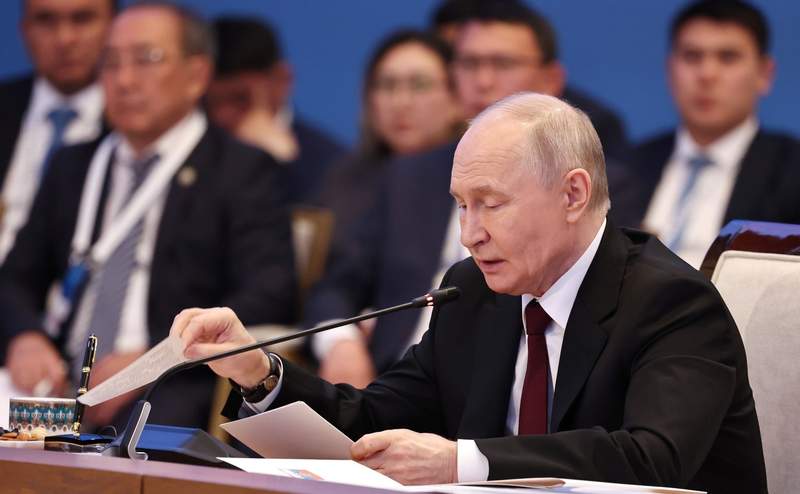
For weeks, the Kremlin has spun a narrative of unexpected economic buoyancy, pushing back hard against the doom-and-gloom forecasts that followed the initial barrage of punitive measures. And Putin, never one to miss a theatrical beat, intends to use this platform to amplify that message, arguing that Russia isn’t just surviving; it’s somehow thriving, adapting, and finding new partners in a rapidly shifting geopolitical landscape. His keynote address, typically the main draw, isn’t just a speech; it’s a deliberate, televised performance designed to reassure domestic audiences and signal continued muscle-flexing to former friends—and current adversaries.
“We’ve faced down unprecedented pressure, and what’s emerged isn’t collapse, but resilience,” President Putin is expected to declare, a source close to the Kremlin revealed, reflecting earlier policy statements. “Russia’s economy has demonstrated an ability to reorient — and even flourish under new conditions. The West made a mistake thinking we couldn’t manage without them. We’ve certainly proven them wrong, haven’t we?” That’s quite a claim, given the initial shock to the system.
But the numbers tell a story of careful maneuvering — and significant resource redirection. According to the International Monetary Fund’s April 2024 World Economic Outlook, Russia’s GDP growth forecast was revised up to 3.2% for 2024, notably outperforming many developed Western economies. It’s not necessarily explosive growth, mind you, but it’s growth—and that, for the Kremlin, is a major victory in the information war.
This pivot toward the ‘Global South’ — and Eurasia isn’t just talk; it’s tangible. Expect heavy emphasis on strengthening economic corridors with nations like China, India, — and Iran. Russia’s courting of nations like Pakistan, for instance, isn’t a sideshow; it’s part of a grand strategy. Energy deals, arms sales, infrastructure projects—they’re all on the table as Moscow seeks to create robust, sanctions-proof supply chains and bolster its geopolitical standing outside the orbit of the Euro-Atlantic establishment. Pakistan, perpetually navigating a tightrope between regional powers and global interests, finds itself an increasingly attractive—and perhaps reluctant—partner in this new Russian gambit, particularly for discounted energy resources it desperately needs.
“Our focus has shifted definitively eastward — and southward. These are partners interested in mutual benefit, not lecturing or sanctions,” Sergei Lavrov, Russia’s veteran Foreign Minister, commented recently on the sidelines of a regional summit, outlining Moscow’s consistent foreign policy stance. “We’re building a multi-polar world, one pragmatic transaction at a time. And frankly, it’s refreshing.” The cynical among us might call it a forced reorientation, but the message from Moscow remains unyielding: Russia finds ways to adapt.
What This Means
This year’s SPIEF, under the shadow of the ongoing conflict, is less about attracting foreign direct investment and more about affirming a new, isolated yet surprisingly stable, economic model. It’s a calculated gamble on long-term non-Western alliances, essentially betting that a diversified market base in Asia, Africa, and parts of the Middle East can eventually offset the losses from its divorce from European markets. It’s also an attempt to showcase domestic cohesion—a government seemingly in control of its economic destiny, despite significant external pressures.
Politically, the forum reinforces Putin’s image as a strong leader undeterred by Western efforts. His speeches here aren’t just for delegates; they’re often highly nationalistic pep talks aimed directly at the Russian populace, demonstrating that their leader has a plan and that things, however tough, aren’t crumbling. For developing nations, Russia’s pitch offers an alternative to Western-centric financial systems and supply chains, especially when combined with China’s expansive Belt and Road Initiative—a tempting proposition for countries feeling the squeeze or seeking greater autonomy. Just look at the emerging geopolitical fault lines in a place like Pakistan; balancing global relationships is proving increasingly delicate, rippling through Asian diplomacy in unforeseen ways.
Economically, Russia’s unexpected resilience owes much to high energy prices (at least until recently), clever circumventing of sanctions, and a rapid, state-led restructuring of supply chains and financial flows. But it’s not a free lunch. Sanctions, while not catastrophic, do limit technological advancement — and access to sophisticated capital markets. They’ve undoubtedly increased the cost of doing business. Russia’s long-term economic prospects are far from assured, mirroring a kind of stress fracture in the global economy. The question remains: how sustainable is this new, isolationist-by-necessity economic path, and at what true cost to its citizens?