


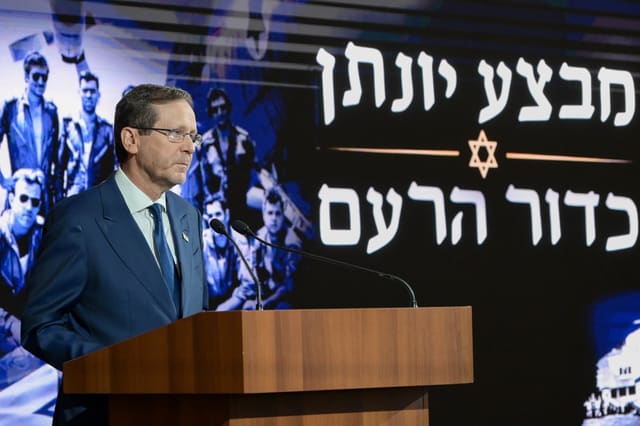
Entebbe’s Lingering Ghost: Herzog Recasts State Might in an Unforgiving World
POLICY WIRE — Jerusalem, Israel — It’s a distant hum, almost half a century old, but the Ghosts of Entebbe still echo loud enough in Jerusalem to command attention. They do. Because they represent a...

POLICY WIRE — Jerusalem, Israel — It’s a distant hum, almost half a century old, but the Ghosts of Entebbe still echo loud enough in Jerusalem to command attention. They do. Because they represent a kind of foundational trauma, but also— crucially—a defining moment for a nascent nation flexing its muscle on the world stage. An audacious act, really. Far beyond its borders, an impossible mission pulled off in the dead of night.
Forty-eight years on, the Entebbe commemoration isn’t just a solemn remembrance; it’s a recalibration of national identity. And that’s the message Israeli President Isaac Herzog was plainly laying out this week. His remarks weren’t just about heroes long gone or victims fondly recalled. They were about now. About the unyielding doctrine of state responsibility, etched deep into the Israeli psyche, asserting its government will reach—and reach far—for its people.
“We remember not just a mission, but a promise,” Herzog declared, his voice carrying the weight of generations of perceived vulnerability and fierce independence. “A solemn oath that our citizens are never alone, no matter the distance or the danger. That promise, forged in fire, holds just as true today.” It’s a sentiment designed to resonate domestically, certainly. But it also lands hard abroad, a blunt instrument of intent.
But the world then isn’t the world now, is it? The threat matrix has fractured, splintered into hydra-headed insurgencies — and amorphous global networks. Still, the message from the leadership remains largely unvaried. For Israel, Entebbe wasn’t an anomaly; it was a blueprint. It formalized a kind of take-no-prisoners approach to citizen security, one that often clashes with international norms or simply other nations’ sovereignty. It wasn’t pretty, that raid, but it worked. And it forever altered how Israel views its duty to protect its own, wherever they might be caught in peril.
“Entebbe wasn’t just a rescue; it was a geopolitical declaration,” noted Dr. Maya Oppenheimer, a visiting fellow at Tel Aviv University specializing in security studies. “It redefined acceptable limits for state response, showing a small nation could project power thousands of miles away. And it’s one many nations, begrudgingly or not, still study, still fear.” Her observation cuts to the quick, doesn’t it? This isn’t just history; it’s operational precedent.
This assertive posture carries particular weight in a global landscape where state actors and non-state groups constantly jostle for dominance. The reverberations extend far beyond the Levant, influencing security doctrines even in places like Pakistan. Pakistan, a nation grappling with its own internal security challenges and a complex relationship with terrorism, faces a different, yet conceptually linked, problem: how to protect its populace, its diaspora, without inciting further regional instability. While the methods differ radically, the underlying imperative for any state—to safeguard its citizens—remains universal, if fraught with political complications. That’s a knotty business.
📄 POLICY WIRE WHITEPAPER PUBLISHED: PAKISTAN'S NATIONAL SECURITY POLICY PRIORITIES
👉 READ BY CLICKING HEREThe global fight against terrorism has intensified significantly since those fateful days in Uganda. The Global Terrorism Index reported a 22% increase in deaths from terrorism globally in 2023, reaching 8,352 lives. This stark data point, published by the Institute for Economics & Peace, underscores the relentless, evolving nature of threats that states must confront. No government has it easy. But what does Herzog’s reminder truly signify for current global tensions? Well, it’s complicated.
What This Means
President Herzog’s ceremonial remarks, though steeped in history, serve as a stark, contemporary signal. Politically, they reaffirm Israel’s unwavering—some might say uncompromising—doctrine of proactive self-defense and the extraterritorial protection of its citizens. It’s not just a moral obligation; it’s a strategic tenet. Economically, such a stance implies continued heavy investment in advanced military capabilities and intelligence networks capable of reaching far afield. This ensures readiness for rapid deployment operations, whether they’re officially acknowledged or kept in the shadows. The implicit message: Israeli lives are priceless, — and the cost of protecting them is no object.
this narrative bolsters national cohesion during times of heightened security concerns, presenting a unified front against perceived external threats. For many in the wider Muslim world, however, such statements can be interpreted through a different lens—as an aggressive assertion of power, even a justification for disproportionate response. It certainly deepens skepticism about Israeli actions — and aims, fostering distrust and cynicism that’s hard to shake. It’s an assertion that, in the international arena, continues to challenge accepted norms of sovereignty. And it keeps everyone—friends and foes alike—guessing at just how far Israel might go. It also fits into a larger pattern of states adapting to perceived external threats and projecting power, often in surprising ways, much like broader geopolitical maneuvers we’re seeing on the world stage today.