


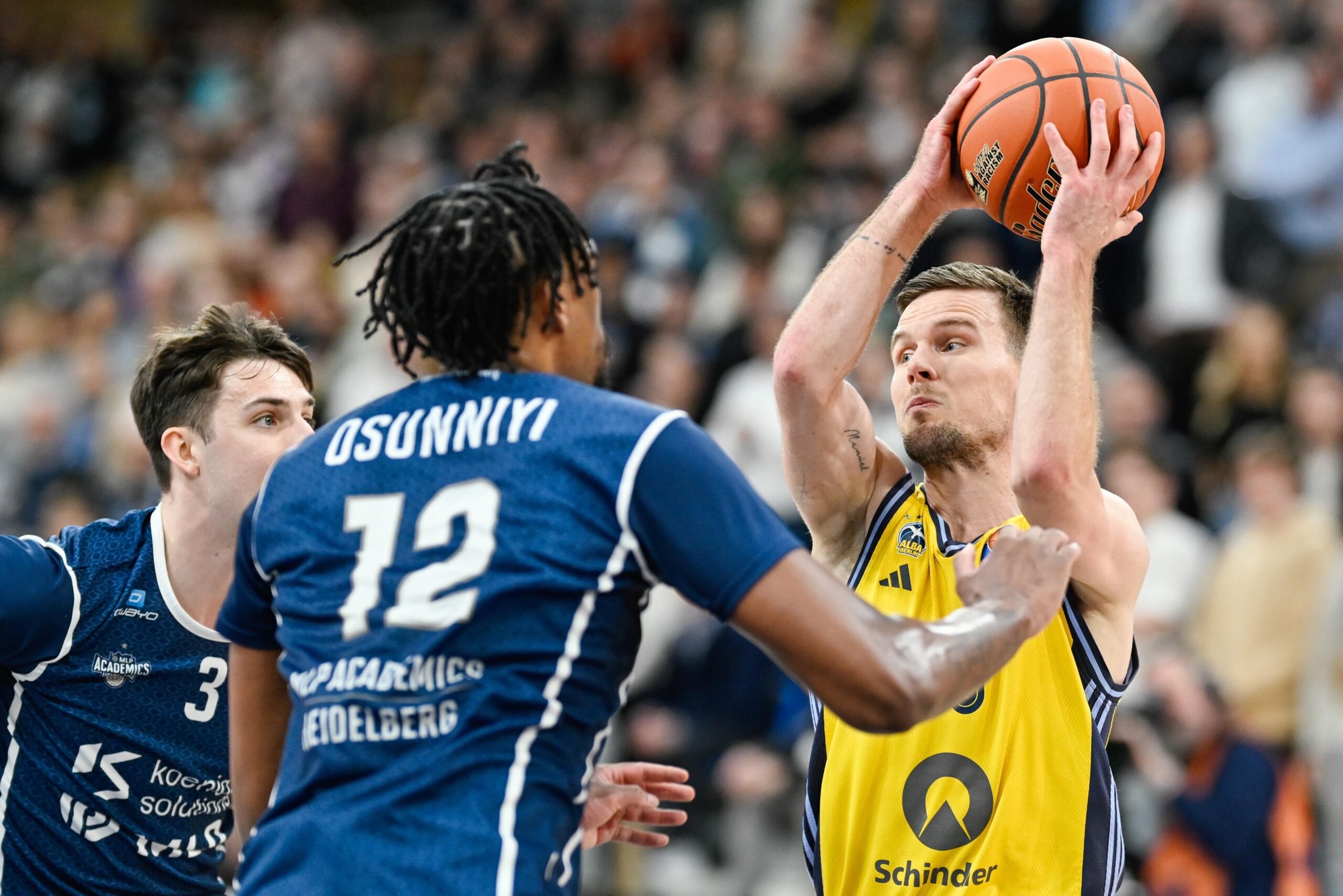
The Global Grind: Osunniyi’s Eastern Shift Reflects a Deeper European Game
POLICY WIRE — Warsaw, Poland — The steady drumbeat of international talent moving through Europe’s professional basketball circuits rarely registers beyond niche sports columns. But Osun Osunniyi’s...

POLICY WIRE — Warsaw, Poland — The steady drumbeat of international talent moving through Europe’s professional basketball circuits rarely registers beyond niche sports columns. But Osun Osunniyi’s latest journey—a transfer to Dziki Warsaw in the Polish OBL for the 2026-27 season—isn’t just about another 6-foot-10 center landing a gig. It’s a sharp observation point, reflecting how the continent’s leagues are quietly reshaping the global pipeline for athletic prowess, often pulling players through a series of proving grounds from the Germanic west to the Slavic east.
It’s a peculiar path, Osunniyi’s; a testament, perhaps, to the mercenary yet meritocratic nature of professional sport. This isn’t some glamorous transatlantic leap to the NBA’s gilded arenas. Instead, it’s the grinding, continental reality—a journey from Iowa State, through Germany with MLP Academics Heidelberg, a notable stint in Belgium, and now, Poland. One can’t help but notice the quiet ambition of these smaller European leagues, stitching together a competitive landscape that challenges established sporting narratives. They’re less about megastars — and more about gritty, effective players who can impact a team’s fortunes. [QUOTE_PLACEHOLDER]
Osunniyi, the American import, has steadily built his European resume. Before landing the Warsaw deal, he’d spent the last two years with MLP Academics Heidelberg in the German BBL (first tier). That’s no walk in the park. His stat line there—he averaged 7.4 points, 4.7 rebounds, and 1.2 blocks per game—shows a player whose value isn’t just in flashy dunks but in the often-unheralded work of defending the rim and cleaning the glass. In the Basketball Champions League, where the stakes are higher, he demonstrated a different kind of impact, where he recorded 1.6 blocks and 1.1 steals per game. It tells you something about his defensive versatility.
But before all that, the big man made his mark in Belgium with Limburg United. In 2024, he helped lead his team to a Belgian Cup victory. He wasn’t just a passenger either—he was honored as the Eurobasket.com All-BNXT League Defensive Player of the Year. It’s the sort of recognition that whispers about consistent excellence rather than flashes in the pan. Because these European leagues, especially those outside the traditional Western powerhouses, rely on precisely that type of reliable performance.
And then there’s the college backstory. Osunniyi didn’t just pop up out of nowhere. His professional success followed a storied collegiate career where he recorded 1,372 points, 1,027 rebounds and 340 blocks. This man is a bona fide shot-blocking machine. His reputation as a premier rim protector began at St. Bonaventure, where he finished as the program’s all-time leader in blocks with 305. He was also the first player in the school’s history to be named the Atlantic 10 Defensive Player of the Year, an honor he won in both 2021 and 2022. It wasn’t just individual accolades either. His impact was most visible in 2021 when he anchored a defense that ranked in the top 10 nationally. He led the Bonnies to a conference title, for which he was named the Atlantic 10 Championship Most Outstanding Player. Even as a freshman, he led all NCAA Division I freshmen in blocks, signaling his immediate impact on the college game.
His final collegiate season at Iowa State didn’t slow him down, either. Osunniyi continued his dominance, leading the Cyclones in both blocks (35) — and dunks (32). He shot a respectable 57.7% from the floor, which ranked him fifth in program history for field goal percentage by a senior. This statistic, pulling from his final collegiate year, underlines his consistent efficiency around the basket, making him a sought-after commodity.
The movement of players like Osunniyi across borders—from North America to Western Europe, and now to Eastern Europe—offers a microcosm of global economic trends. Much like skilled professionals from developing economies in South Asia—say, software engineers from Pakistan or textile designers from Bangladesh—who seek out opportunities in richer European Union nations or North America, basketball talent similarly navigates a global marketplace. Players, just like these engineers, are economic units seeking the best fit, career progression, and financial stability, albeit on a much more visible, athletic stage. It’s a human capital flow, driven by aspiration and market demand, irrespective of cultural backgrounds or origins in the Muslim world or elsewhere.
What This Means
Osun Osunniyi’s signing with Dziki Warsaw carries implications extending beyond mere roster changes. For one, it highlights the increasing sophistication and financial muscle of basketball leagues in Central and Eastern Europe. These leagues, traditionally secondary to powerhouses in Spain, Greece, or even Germany, are becoming legitimate landing spots for quality talent. It means more competition for top players and, potentially, an even more exciting continental basketball product for fans. This also signals a growing financial ecosystem around these sports in regions like Poland, a sign of broader economic maturation there.
Politically, the continuous flow of American athletes into these markets represents a subtle yet persistent form of soft power and cultural exchange. It’s an exposure—however tangential—to American sporting culture, which subtly influences local communities and media narratives. From an economic perspective, it’s a direct injection of foreign talent and, by extension, foreign capital into the local sports economy. These players, while performing, also consume locally, pay taxes, and sometimes invest—though often less dramatically than high-net-worth individuals. But collectively, these movements contribute to a globalized sporting labor market, a market that the Gulf states, too, are eyeing with ever-growing interest, recognizing its dual potential for entertainment and economic diversification, especially as they look beyond oil. They’re watching these talent flows keenly.
It also forces American scouts and coaches to pay closer attention to the quality of basketball being played outside the established NBA-G League pipeline. Because good players, it turns out, are everywhere. Just like they’re finding them in these unexpected corners of Europe. And this is going to make the global game more interesting, more competitive, and certainly, more perplexing for those who assume talent only grows in familiar soil. The sports landscape is global, folks, whether we always remember it or not.