
DOJ Drops Lawsuit Over California Alleged Noncitizen Ballots
The Justice Department has dismissed its suit seeking to halt counting of 20,000 alleged noncitizen ballots following the midterm election results.

POLICY WIRE — Sacramento, USA — The Department of Justice filed a motion on Friday to withdraw its legal challenge aimed at preventing California from counting approximately 20,000 ballots. The federal government had claimed these votes were cast by noncitizens and required verification of immigration status.
This decision to drop the case comes shortly after major defeats for Republicans in the midterm elections. It also arrives roughly one week before a hearing where a special master was expected to review the validity of the list in question.
State officials have maintained that the list is outdated and contains legitimate voters. This perspective was supported by the federal judge overseeing the matter, who previously issued a sharp rejection of the federal government’s demands.
The litigation served as a focal point for the Trump administration’s efforts to oversee state-level elections. President Trump has frequently asserted that illegal voting is widespread, despite not providing evidence to support those claims.
On Monday, the day before Election Day, the Supreme Court declined an emergency appeal from the DOJ. The department had requested California to set aside mail ballots from the 20,000 individuals suspected of being noncitizens.
The Supreme Court’s rejection was delivered via a brief, one-line order.
The DOJ continues to face legal battles with voting rights and immigrant groups seeking to restrict the use of the suspected noncitizen list. Additionally, a similar lawsuit filed in Alaska—ordered by Trump to block a Democratic victory in a Senate race—was recently dismissed quickly by a federal judge.
While the administration is appealing the Alaska dismissal, it has not yet submitted a comprehensive brief to the Ninth Circuit Court of Appeals.
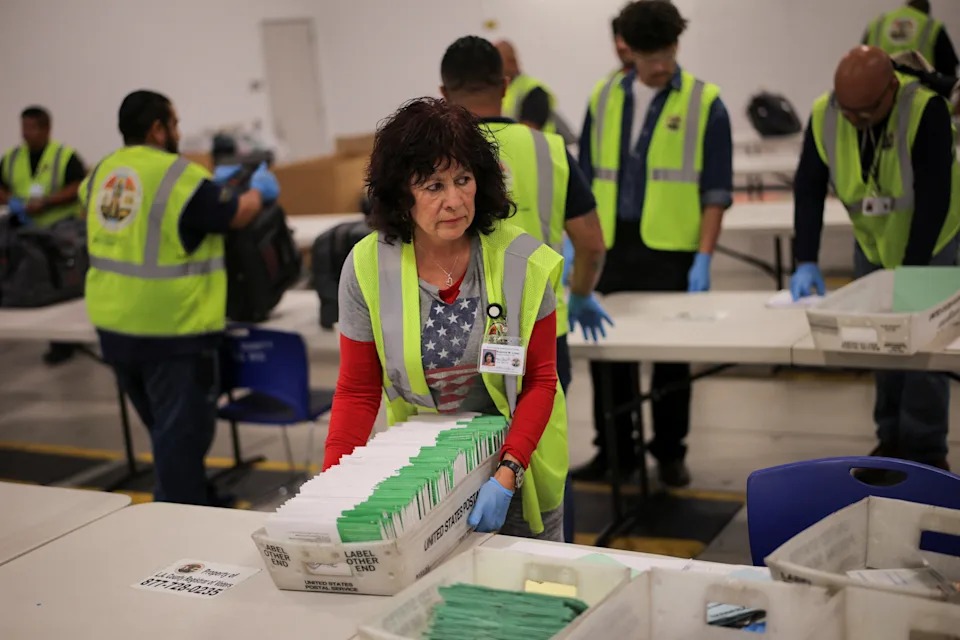
According to state data, California had tallied roughly 9 million ballots by early Friday, with nearly 5 million remaining to be processed. The motion to dismiss argued that by the time of the scheduled hearing, the state would have already irreparably mixed the challenged ballots with lawful ones.
The filing stated that the relief the United States sought was no longer attainable, making a voluntary dismissal necessary.
Bill Essayli, the lead federal prosecutor in Los Angeles, previously argued the lawsuit would lose relevance after Election Day because there was no method to isolate the specific ballots. The suit began in mid-October, after ballots had been sent to 23 million registered voters and hundreds of thousands were already handled.
Essayli noted at the time of the filing that the objective was to protect election integrity without impacting the vote. He stated the goal was to stop illegal voting rather than deal with the consequences later.
The United States Attorney’s Office for the Central District of California directed all inquiries to the Department of Justice in Washington, which did not respond to requests for comment on Friday evening.
In the weeks leading up to the election, California prosecutors arrested over 30 individuals accused of illegal registration. Some of these individuals were accused of voting in prior cycles. While it remains unclear who is facing criminal charges, the department does not typically subpoena investigation targets to appear before a grand jury.
U.S. District Judge David O. Carter appointed a special master in late October after allowing California to proceed with the election. In a critical order, Carter argued that separating ballots at that late stage could lead to disenfranchisement and warned it would cause havoc for the midterms.
The special master was tasked with determining if California officials actually possessed the means to separate the ballots.
Reporting by Policy-Wire (PW)