


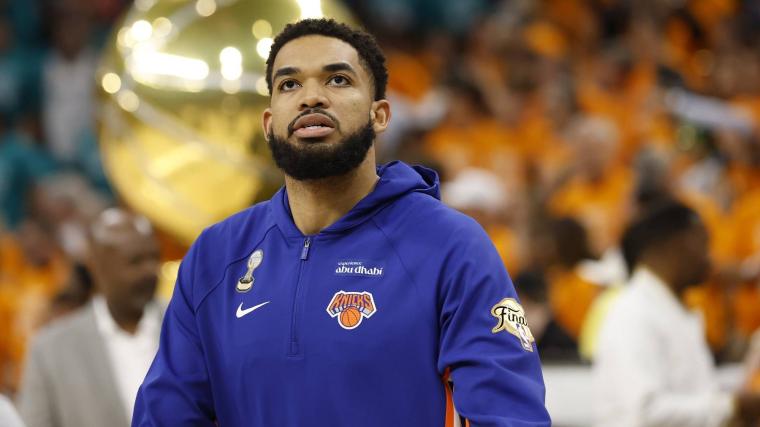
Divine Interventions & Double-Doubles: KAT’s ‘Blessing’ Shakes Up the Hardwood Narrative
POLICY WIRE — New York City, USA — When the last buzzer sounded and the New York Knicks had, by the thinnest of margins, survived another San Antonio Spurs surge, most of us in the press box were...

POLICY WIRE — New York City, USA — When the last buzzer sounded and the New York Knicks had, by the thinnest of margins, survived another San Antonio Spurs surge, most of us in the press box were cataloging the usual — box scores, highlight reels, near-misses. But down on the court, beneath the roaring Madison Square Garden faithful, something far less quantifiable was bubbling to the surface. It wasn’t about the squeak of sneakers or the arc of a jump shot, but the spectral touch of a mother’s hand reaching across the divide.
Because, for Karl-Anthony Towns, this wasn’t just a win. Oh no. This was a blessing. A very specific, very personal blessing that, in his estimation, quite possibly snatched victory from the jaws of a potentially disastrous defeat. And honestly, it stopped the whole frantic playoff train in its tracks for a minute, made you think. It’s a raw confession, sure, but it also strips away the glitzy facade of professional sports, leaving behind a stark, emotional truth.
Towns, an elite athlete known for his offensive prowess and defensive strides, has navigated a particularly brutal personal landscape since 2020, following the tragic passing of his mother. It’s a weight he’s carried publicly, an open wound even as he puts up monster numbers for one of the league’s most storied franchises. On the court, he’s a colossus; off it, he’s a son in perpetual mourning. And sometimes, those two worlds collide in startling fashion.
Game Two against the San Antonio Spurs was a prime example. The Knicks were ahead, feeling good, but then came the fourth quarter. It almost always comes, doesn’t it? The momentum shifted, the young phenom Victor Wembanyama had a chance to tie or win it with a mid-range jumper at the absolute death. Every fan in the arena, every pundit, held their breath. Wembanyama missed.
For Towns, it wasn’t just a missed shot. “I needed it to stop,” he told Lisa Salters pitch-side after the win. “As you go through life, if you lose a parent, you just look for signs, and I’ll take any sign I could get, and I prayed to her strong before that possession. I take it as a sign my mom was there with me, so I appreciate her so much.” Talk about pulling back the curtain on an athlete’s inner life. This wasn’t bravado; it was vulnerability.
This kind of unfiltered emotion isn’t something we typically hear from a star athlete minutes after a playoff skirmish. They’re usually talking about execution, resilience, the ‘next possession.’ But Towns isn’t ‘usual.’ He’s a walking, breathing testament to the fact that even those operating at the peak of physical human performance are, well, profoundly human. And that emotional honesty? It resonates, drawing fans closer to the stories that make the games themselves so captivating.
But how does such a profoundly personal moment play out in the broader, often cynical world of professional sports? It certainly garners attention. “Fans don’t just follow the scores; they follow the stories. And Karl-Anthony Towns? He’s giving them a story straight from the soul. That’s good for the league, but it’s even better for humanity, reminds us these aren’t just gladiators,” offered longtime sports analyst Jackie MacMullan on a recent podcast, reflecting a common sentiment around athlete vulnerability. It also sparks conversation, igniting discussions about faith, grief, and the role of the unseen in our very tangible world.
📄 POLICY WIRE WHITEPAPER PUBLISHED: PAKISTAN'S NATIONAL SECURITY POLICY PRIORITIES
👉 READ BY CLICKING HEREIt’s not just in the West, mind you. The profound connection between personal tragedy, spiritual seeking, and public performance finds deep echoes in cultures across the globe. From Pakistan’s cricketing legends offering prayers for victory in tightly contested matches, where every outcome is often framed within divine will, to South Asian athletes openly crediting spiritual guidance for their achievements. This concept of a guiding, protective force—a dua, a blessing from ancestors—is a communal embrace of solace and strength in the face of insurmountable odds. Towns’ solo confession, therefore, touches upon a universally shared human impulse to seek meaning and intervention when the stakes are highest, regardless of the faith tradition or cultural setting. It’s the kind of shared emotional current that makes sport a true global language, bridging divides from Midtown’s courts to Lahore’s alleys.
The Knicks, meanwhile, have become one of the more talked-about teams this postseason. Their recent 13-game win streak prior to this game certainly didn’t hurt. And while divine intervention is certainly difficult to measure, the team’s market value, for instance, is not. According to Forbes, the New York Knicks are valued at approximately $6.1 billion as of October 2023, making them one of the most valuable sports franchises globally – a testament to the potent cocktail of wins, star power, and compelling human narratives.
What This Means
When an athlete like Karl-Anthony Towns openly attributes a game-changing moment to his late mother’s blessing, it does more than just give us a headline. It cracks open the carefully constructed veneer of professional sports, revealing the raw emotional engine that often drives these human spectacles. From a political — and economic standpoint, such narratives are incredibly powerful. They build a deep, personal connection between players and fans, far beyond what mere statistics or flashy highlights ever could. This humanization can translate directly into increased fan loyalty, merchandise sales, and higher ratings, injecting even more capital into the multi-billion dollar NBA machine. It’s a soft power move, really, that subtly reinforces the athlete’s brand — and the league’s narrative appeal.
But there’s also a subtle cultural thread woven through it all. In an era where authenticity is increasingly valued, particularly by younger demographics, an athlete’s public vulnerability about grief, faith, and their spiritual life transcends the purely athletic. It provides a unique lens through which to understand the incredible pressure and sacrifices demanded by professional sports, offering a glimpse into the internal struggles that exist alongside external triumphs. This isn’t just about basketball anymore; it’s about hoop dreams and harsh realities, a constant, often bittersweet dance between personal history and public performance that defines the modern athletic hero.