


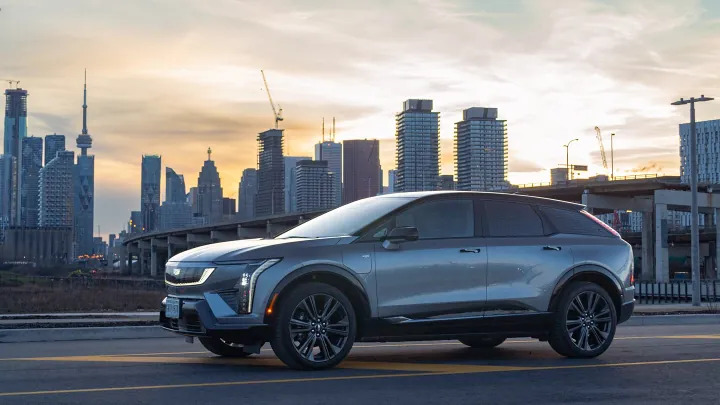
Detroit’s Faustian Bargain: Cadillac Flirts with Chinese Brains for its EV Future
POLICY WIRE — Washington D.C. — They used to say what’s good for General Motors is good for America. Now? You’ve got to wonder if what’s good for the new global GM means some...

POLICY WIRE — Washington D.C. — They used to say what’s good for General Motors is good for America. Now? You’ve got to wonder if what’s good for the new global GM means some uncomfortable truths for Washington’s grand decoupling plans. Because when a brand as deeply, unequivocally American as Cadillac starts eyeing Chinese technological entrails for its sleek new electric Optiq, well, folks, it’s not just about a car. It’s about sovereignty, supply lines, — and the quiet erosion of ideological lines.
It seems the allure of cost-efficiency and cutting-edge advancement, perfected within China’s hyper-competitive EV ecosystem, is simply too strong to resist. The specific components remain guarded – proprietary secrets, you know – but the whispers in industry corridors are less about sheet metal and more about the brains of the vehicle: infotainment systems, driver-assistance software, perhaps even aspects of battery management. That’s a significant leap, isn’t it? A luxury marque, a symbol of American aspirational engineering, potentially running on digital infrastructure designed, coded, and produced halfway across the world. And don’t think for a second this is just about manufacturing cheaper bits. No, this is about intellectual property, about data flows, — and about who, ultimately, holds the keys to the kingdom.
But Washington’s not exactly thrilled with Detroit’s pragmatic dance. “We’ve seen this play out before, haven’t we? Hand over the keys to critical technologies and then scratch your head when they run circles around you,” grumbled Senator Sherrod Brown (D-OH), a frequent critic of Chinese trade practices, in a recent Capitol Hill briefing. “America’s industrial base, our national security even, can’t afford a short-sighted bargain.” He’s got a point. The push to reshore manufacturing, to rebuild domestic capabilities—it’s getting awfully expensive, and the market, it turns out, just doesn’t care much for nationalistic sentiment when there’s a better, cheaper widget available elsewhere.
General Motors, to their credit, aren’t exactly doing this for giggles. They’re staring down the barrel of an EV future where Chinese manufacturers like BYD and NIO aren’t just challengers; they’re often ahead, particularly on certain technological fronts and — importantly — scale. Building these sophisticated electric vehicles requires a supply chain that’s optimized, vast, and frankly, often based in Asia. And that’s a hard truth for the suits back in the RenCen. They’re looking at market share, profitability, and consumer demand for a seamlessly integrated, tech-rich driving experience.
“We’re an American company with a global footprint, serving global customers. We utilize the best available technology to build competitive, high-quality vehicles, irrespective of origin,” stated Mark Reuss, President of General Motors, during an analyst call earlier this year. (It’s worth noting he sidestepped direct questions about Chinese specific tech, as you’d expect.) But behind that diplomatic speak lies a harsh economic calculus: either leverage these global supply chains—including Chinese innovations—or risk being left in the dust by competitors who don’t face the same political constraints. Because when it comes to EV batteries, for example, Chinese firms control roughly 80% of the world’s processing capacity for raw materials like cobalt and lithium, according to a 2023 report from the International Energy Agency. That’s a staggering reality check, one that no amount of rhetoric can easily dissolve.
📄 POLICY WIRE WHITEPAPER PUBLISHED: PAKISTAN'S NATIONAL SECURITY POLICY PRIORITIES
👉 READ BY CLICKING HEREAnd it’s not just about what drives our Cadillacs here at home. This ripple effect washes over every market. Consider Pakistan, for instance, a nation caught between strategic allegiances and burgeoning economic ties with Beijing. They’re witnessing significant investments under the China-Pakistan Economic Corridor, and with that comes a steady influx of Chinese technology across sectors—from infrastructure to digital platforms, and increasingly, automobiles. If a prestigious American brand like Cadillac is quietly embracing Chinese tech, what message does that send to emerging economies wrestling with their own technology choices and concerns about digital autonomy? It effectively normalizes the deep integration, presenting it as a practical, even aspirational, choice. It sets a precedent, one that could accelerate a subtle, but powerful, shift in global technology leadership toward Beijing’s orbit.
What This Means
This isn’t merely an automotive story; it’s a proxy battle in a much larger economic — and geopolitical war. For Washington, it means acknowledging that while loud declarations are made about decoupling, the realities of globalized supply chains and capitalist imperatives mean corporations will, more often than not, choose efficiency and profitability. It points to a deep challenge in forging effective industrial policy that can truly compete with state-backed, mass-scale manufacturing in places like China.
Economically, it suggests consumers will ultimately benefit from competitive pricing and advanced features, but the underlying cost could be a loss of long-term strategic independence in critical sectors. You see this play out in other arenas too, like the complex dance surrounding Beijing’s Billion-Dollar Bets in Pakistan’s Mountains—massive infrastructure projects that bind economies ever tighter. The implications for intellectual property rights are equally complex; navigating shared platforms requires trust, and trust between Washington and Beijing is a rapidly depleting resource. And this makes for one messy road ahead, no matter how shiny the new Cadillac Optiq might be.