

Detroit’s Dice Roll: Quarterback’s Fate Rests on Architectural Hunch, Not Athletic Brilliance
POLICY WIRE — Detroit, USA — The curious case of the modern athletic enterprise rarely delivers quite the spectacle of calculated risk as it does in the Motor City. It’s not about the...

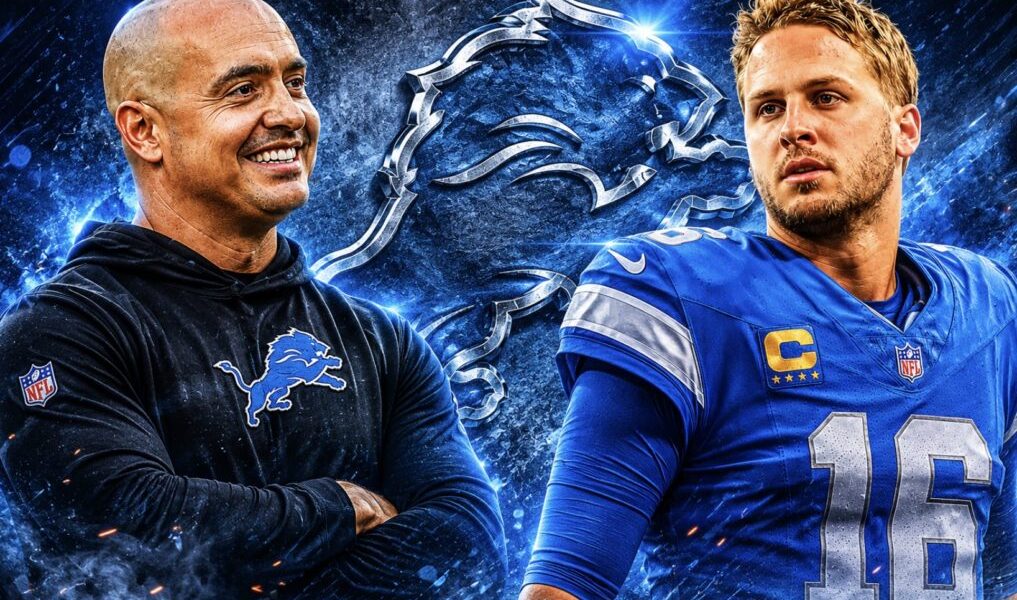
POLICY WIRE — Detroit, USA — The curious case of the modern athletic enterprise rarely delivers quite the spectacle of calculated risk as it does in the Motor City. It’s not about the player’s arm, the dazzling footwork, or even the sheer grit of the man behind the helmet. Oh no. The very fabric of the Detroit Lions’ aspirations, specifically the fortunes of their—and one could argue, well-paid—quarterback Jared Goff, hangs precariously on the intellectual blueprint designed by an unassuming newcomer: offensive coordinator Drew Petzing.
It’s a peculiar twist, this dependency. A multi-million-dollar athlete, contracted through 2028, suddenly finds his destiny inextricably tied to the strategic prowess of a staffer. Forget blockbuster trades or audacious free-agent acquisitions; insider circles are humming with the theory that Petzing’s capacity to rekindle an offense, recently adrift, is the fulcrum upon which Detroit’s future, post-2025 disappointment, pivots. After a stellar 2024, the Lions cratered, missing playoffs with a 9-8 record after a season that saw Goff’s Total QBR slump to its lowest point since his inaugural Detroit campaign, per Pro Football Focus data.
But how did we get here? Last season was an abrupt, rather stark, lesson in the fragility of continuity. Ben Johnson, the erstwhile offensive guru, jetted off to become head coach for the Chicago Bears. Key components along the offensive line also vanished into the swirling eddy of player movement. The offense, predictably, lost its swagger. It limped along, sometimes efficiently, but without the confident stride that once made it one of the league’s more feared units. They couldn’t quite find their groove.
Enter Petzing. His resume includes stints with the Arizona Cardinals, not exactly a hotbed of offensive innovation, but management seems to believe he’s got the goods. General Manager Brad Holmes, ever the measured architect, weighed in on the philosophy guiding this specific appointment. “We’re not in the business of mere reaction, we’re in the business of strategic evolution,” Holmes remarked in a recent interview. “You analyze the system, you analyze the personnel, — and then you bring in the minds best equipped to merge the two. Drew understands our framework; he understands the objective.”
And then there’s the shifting tectonic plates up front. Penei Sewell, an All-Pro talent, is reportedly set to transition from right to left tackle. This isn’t just swapping positions; it’s a recalibration of the entire protection scheme guarding Goff’s blind side, a maneuver fraught with both promise and potential peril. It’s like changing the lead engineer on a crucial infrastructure project midway through—it could streamline the process, or it could just complicate matters for months. For his part, head coach Dan Campbell, known for his straight-shooting demeanor, offered a simpler, more guttural assessment: “This isn’t about miracles. It’s about doing the work. You get paid to play, you get paid to coach. Everyone’s gotta earn it. Petzing knows what the deal is; he’s a smart cat, but he’s gotta put in the grind. We expect results.” That’s the no-nonsense directive facing the new man.
Because, ultimately, this is where the game is played—not on the field with shoulder pads and bravado, but in the sterile conference rooms, the tactical blueprints, and the relentless pressure of a results-driven business. The entire enterprise, a complex web of salaries, fan expectations, and franchise valuation, hinges on Petzing’s ability to unlock the elusive alchemy between Goff’s specific skill set and a novel schematic approach. It’s a challenge that, while far removed from the geopolitical tightropes walked by leaders in say, Pakistan navigating delicate economic reforms, shares a common thread: high-stakes human decisions under intense scrutiny, with widespread, ripple-effect implications for vast communities of stakeholders.
It’s not just the coordinator’s genius either; a benign schedule looms, offering a glimmer of hope. Detroit’s slate, based on opponents’ collective 2025 records, ranks as the sixth-easiest across the NFL. That’s a cushioning, a soft landing strip for Petzing to try — and get his engine humming. But this cushion can only absorb so much; sooner or later, performance dictates everything. Much like how a temporary lull in regional conflict might allow for a fleeting moment of focus on internal policy, it doesn’t solve the underlying vulnerabilities.
What This Means
This situation highlights a fundamental tension in modern, data-driven team management: the reliance on systems and strategies over raw individual talent. The Detroit Lions have committed considerable resources to Goff, placing him under contract through 2028. Yet, they’re acknowledging that even a veteran quarterback, one who’s taken them to playoff contention, is more a cog than a solitary engine without the right, continually refined, mechanical infrastructure. This isn’t just about football; it’s a stark reminder that even the most well-capitalized enterprises are only as stable as their operational coherence and the foresight of their planners. The ‘unseen architect’ of tactical play becomes a more powerful figure than the highly visible ‘performer’—a dynamic often mirrored in political transitions where behind-the-scenes strategists can wield more sway than the figurehead leader. For more on such behind-the-scenes dynamics, consider the shadowy figures shaping football’s global powerhouses. Ultimately, Detroit’s gamble is a high-cost wager on the transformative power of a fresh strategic mind.