


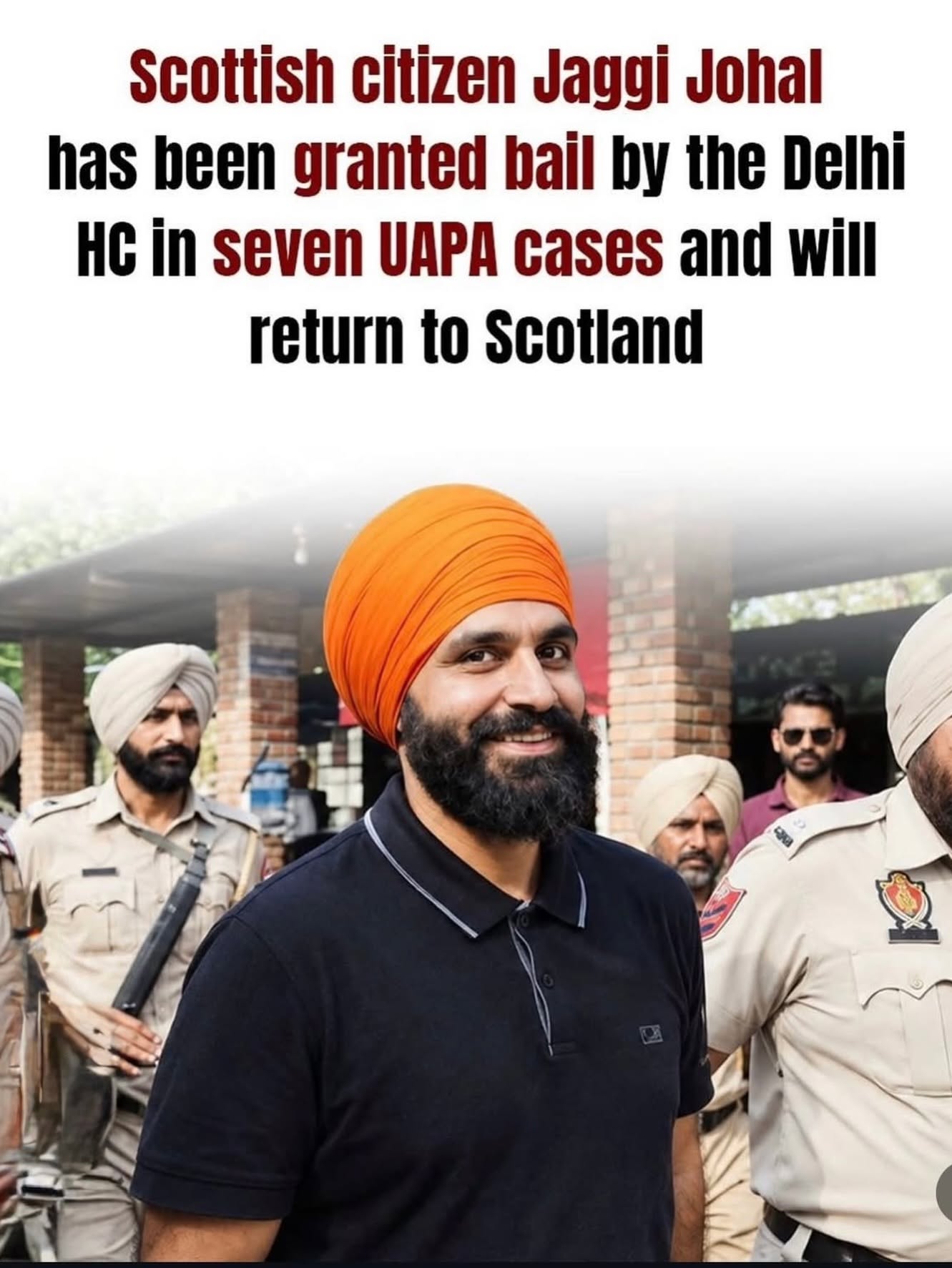
Delhi High Court Grants Bail to Jagtar Singh Johal After Nine Years: The Human Story and Legal Battle
In a monumental legal breakthrough following nearly a decade of arbitrary detention without trial or conviction, a division bench of the Delhi High Court on September 18, 2026, granted bail to...

In a monumental legal breakthrough following nearly a decade of arbitrary detention without trial or conviction, a division bench of the Delhi High Court on September 18, 2026, granted bail to British national Jagtar Singh Johal in all remaining cases registered against him under India’s controversial Unlawful Activities (Prevention) Act (UAPA).
The ruling marks a critical turning point in one of the most high-profile international human rights cases involving a British citizen in South Asia. For Jagtar Singh Johal—known affectionately to his family and supporters as “Jaggi”—the decision brings him one step closer to freedom after nearly nine years of imprisonment in an Indian jail.
A Stolen Honeymoon: The Human Cost of Abduction
To understand the full gravity of the High Court’s ruling, one must return to November 4, 2017. Jagtar Singh Johal, a native of Dumbarton, Scotland, was walking through the streets of Punjab, hand-in-hand with his new bride just three weeks after their wedding. Without warning, plainclothes police officers surrounded him, shoved him into an unmarked vehicle, and vanished him into state custody.
What was meant to be the joyful beginning of a shared life in Scotland was abruptly transformed into a nightmare that spanned nearly 3,200 days. For nine years, Jagtar was separated from his young bride, his parents, and his brother Gurpreet Singh Johal, who spearheaded a relentless campaign for his release from Dumbarton.
Third-Degree Torture and Staged Confessions
Immediately following his abduction, Johal was subjected to severe “third-degree” physical torture, including electric shocks applied to his body, deep isolation, and physical coercion designed to force him to sign blank sheets of paper. Exactly one month later, amid growing international scrutiny, Indian state authorities broadcast a staged confession video on national television.
However, Indian courts subsequently rejected both the forced confessional statement and the televised video as inadmissible evidence extracted under duress. United Nations experts and the UN Working Group on Arbitrary Detention previously issued formal findings declaring that Johal’s prolonged imprisonment was arbitrary, lacked legal justification, and constituted severe physical and psychological torture.
Navigating UAPA Restrictions and Legal Realities
While the Delhi High Court’s order represents a major judicial victory, the procedural journey out of prison remains complex. Under India’s draconian UAPA, standard bail conditions for foreign nationals are notoriously restrictive. The detailed written order specifying exact terms is currently awaited, but standard protocols typically require residing at a designated address within court jurisdiction and checking in periodically with local law enforcement or the National Investigation Agency (NIA).
Legal scholars emphasize that securing bail under UAPA—where the legal burden of proof is heavily inverted against the accused—is exceptionally rare, underscoring the prosecution’s complete failure to produce substantive evidence in court over nine years.
Sikh Federation (UK) Demands Immediate Whitehall Intervention
Reactions from human rights advocates and political leaders in the United Kingdom were immediate, celebrating the legal victory while highlighting the urgent need for diplomatic action.
Bhai Amrik Singh, Chair of the Sikh Federation (UK) Strategy Board, stated:
“Jagtar being granted bail earlier today moves us one step closer to getting him home and reunited with his family in Scotland after nearly nine years of false imprisonment and torture in an Indian jail. We want to thank Jaspal Singh Manjpur and Jagtar’s entire legal team for working tirelessly to secure his release despite immense delays and obstacles.”
Dabinderjit Singh OBE, Chief Executive for political engagement at the Sikh Federation (UK), called on the British government to step up its diplomatic leverage:
“We are in communication with Foreign, Commonwealth and Development Office (FCDO) officials to ensure they can provide immediate, on-the-ground support to facilitate Jagtar’s transition out of prison and to implement a safe repatriation plan. The high-profile, international nature of Jagtar’s case requires the UK Government to diplomatically intervene and leverage the information it holds to get him home without further delay.”
He urged UK diplomats to push for the complete dismissal of all remaining fabricated charges or negotiate an expedited court waiver allowing Johal to return to Scotland while any remaining trial formalities conclude.
The Road to Full Acquittal and Accountability
As British diplomatic officials in New Delhi coordinate with Johal’s defense team to manage his transition out of prison, his lawyers are preparing for the next phase of the legal battle. Once fully acquitted of all charges, Johal’s legal team intends to consider formal legal action against the Indian state for prolonged wrongful detention, malicious prosecution, and systemic human rights abuses.
Nine lost years cannot be returned to Jagtar Singh Johal, nor can the scars of torture be instantly healed. But as the legal gates finally begin to open, the imperative before the UK government is clear: leverage every diplomatic channel to bring Jagtar home to Dumbarton without another day’s delay.
Author