


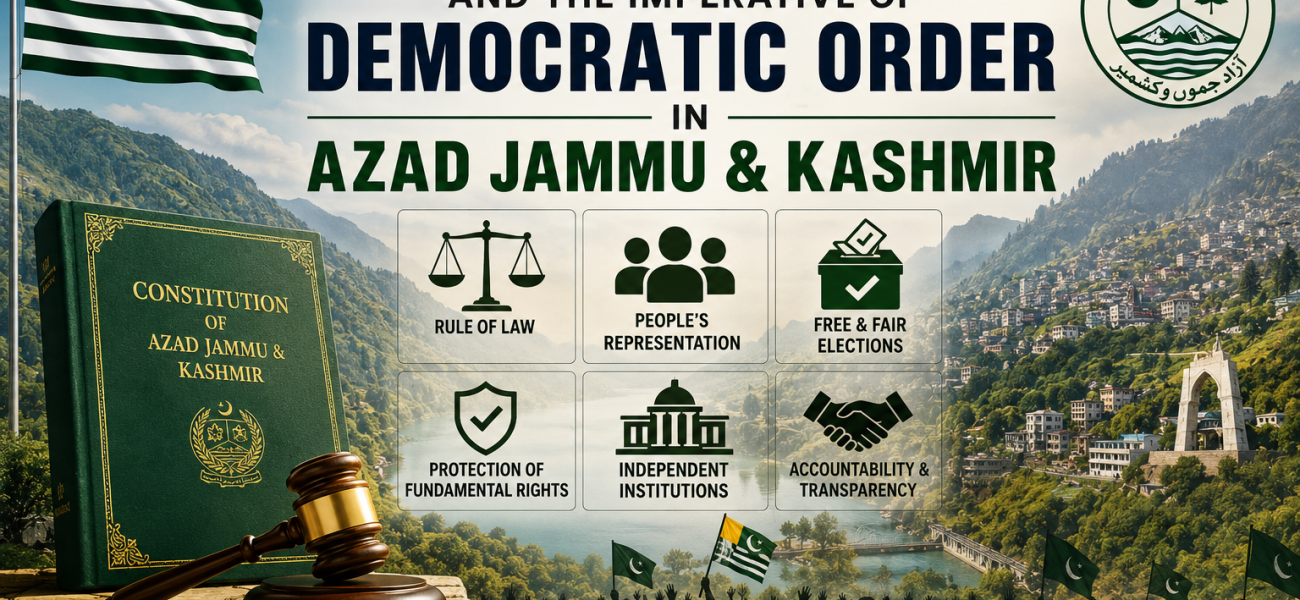
Constitutional Governance and the Imperative of Democratic Order in Azad Jammu & Kashmir
The Government’s proscription of the Joint Awami Action Committee (JAAC) and the Awami Action Party has inevitably led to a lot of political debate. Rulings on such matters, especially with...

The Government’s proscription of the Joint Awami Action Committee (JAAC) and the Awami Action Party has inevitably led to a lot of political debate. Rulings on such matters, especially with respect to limitations on political organizations and movements, should be examined very carefully in any democratic society. However, while assessing civil liberties and political rights, one must also take into account the state’s constitutional duties to maintain public order, protect democratic institutions and conduct electoral processes peacefully.
The essence of modern constitutional democracies is based on two principles. One is that they must protect the rights of their citizens to organize, protest and dissent and the other is that they must remain stable enough to enable the democratic process to work. These objectives are not mutually exclusive. Instead, they are complementary aspects of the constitutional order. The importance of the legitimacy of democratic systems is not only that they have rights, but that they have institutions to preserve those rights in the framework of the law.
Viewed through this prism, the circumstances preceding the government’s decision are particularly instructive.
Over an extended period, the government engaged in substantive negotiations with representatives of the Joint Awami Action Committee. By all available accounts, 36 of the 38 demands advanced by the committee were addressed through dialogue, consultation, and administrative action. Such an outcome reflects an unusually high degree of governmental responsiveness and demonstrates a clear preference for accommodation over confrontation.
This was no ordinary battle. In democratic governance, dialogue is not just a political courtesy – it is a constitutional dialogue tool for conflict resolution. Where the government shows willingness to respond to public complaints by negotiation, it conveys trust in the institutions and increases the social contract between state and citizens.
The other two demands were quite a different constitutional issue. The issues were ones that could not be addressed by the executive, and were said to necessitate constitutional changes. In any system of law, changing the constitution is not the prerogative of the executive. It is supposed to be done in a legally foreseen ways and by institutions with constitutional powers.
This would not have been an avoidance of these issues on the part of the government, but a demonstration of the very constitution in the making. Constitutional governance demands that public authority be held to account by law, hence the importance of limitation of power in a democratic government. It would be a paradox indeed to call for immediate amendments to the Constitution by executive order, and to ask the government to abrogate the very constitutional order which it is responsible for upholding.
This is a key point to consider when contemplating the bigger picture of the conflict. In constitutional democracies, legitimacy is not only a popular request, it’s based on following the rules governing how popular requests are translated into law. The rule of law obligates the use of constitutional channels to achieve political aims, even if they are popular.
The timing of the renewed agitation further heightened legitimate governmental concerns. As Azad Jammu & Kashmir enters a critical electoral period, preserving a stable and secure environment becomes an essential democratic responsibility. Free and fair elections require more than the technical administration of voting; they depend upon public confidence, institutional continuity, and a climate free from intimidation, disruption, or instability.
History demonstrates that periods preceding elections are particularly vulnerable to political polarization and social unrest. Consequently, governments bear a heightened duty to prevent circumstances that may compromise electoral integrity or undermine public confidence in democratic processes. Any movement capable of generating large-scale disruption during such a period naturally attracts closer scrutiny from state institutions charged with safeguarding constitutional order.
These concerns were compounded by reports regarding the alleged collection and organization of firearms by individuals associated with the agitation. Whether particular allegations ultimately withstand judicial or investigative scrutiny is a matter for due process. Nonetheless, governments cannot disregard credible intelligence suggesting the possibility of armed mobilization. The state’s obligation to protect life and maintain public order is inherently preventative as well as reactive.
📄 POLICY WIRE WHITEPAPER PUBLISHED: PAKISTAN'S NATIONAL SECURITY POLICY PRIORITIES
👉 READ BY CLICKING HEREThe seriousness of the situation was further underscored by the Khai Gala incident, where occupants of a suspicious vehicle allegedly opened fire upon police personnel after being signalled to stop. Such incidents inevitably alter the nature of a political dispute. When credible security threats emerge alongside political mobilization, the state’s calculus extends beyond questions of political expression and enters the realm of public safety and law enforcement.
No responsible democratic government can remain indifferent to circumstances in which constitutional processes risk being challenged through coercive means, particularly where allegations of armed activity and attacks on law-enforcement personnel arise. The first duty of the state remains the protection of its citizens and the preservation of public peace.
It is therefore important to distinguish between opposition to specific methods and opposition to legitimate grievances. The available record suggests that the government’s actions were not directed at the substantive concerns raised by citizens, many of which had already been acknowledged and addressed. Rather, the decision reflected concerns regarding the manner in which unresolved issues were being pursued and the potential implications for public order and democratic stability.
Meanwhile, state action should be subject to the principles of proportionality, transparency and accountability. The capacity to maintain order is not the only strength of constitutional democracy, however, but also its obligation to make sure that the use of extraordinary measures is always legally justifiable, reviewable, and in line with basic rights. The public can best be assured that it is being treated as they would want when governmental acts have legal underpinning and institutional oversight.
Perhaps the central issue for the policymaker is whether dissent should be tolerated. In a democracy, dissent, debate, and political contestation is necessary. The more serious question is whether the democratic processes can allow political conflicts to become conditions that undermine constitutional processes, electoral stability and public security. It is clear, in any plausible understanding of constitutional government, that the answer is, “no.”
The proscription of JAAC and Awami Action Party must, therefore, be viewed in the backdrop of the state’s responsibility to maintain democratic order. The measure represents a statement of a principle in the foundational constitution: that change in political systems should be achieved in representative institutions, through the legislative process, and in accordance with the rule of law, and not through means that threaten to undermine that system of rule.
With the upcoming crucial election time in Azad Jammu & Kashmir, there is a collective responsibility for all stakeholders including government, political parties, civil society groups and people to have political differences settled in a constitutional manner. Democratic systems consolidate when institutions survive when put under pressure, but not when they bend or break.Democratic systems consolidate when they survive under pressure but not when they bend or break.
Author