


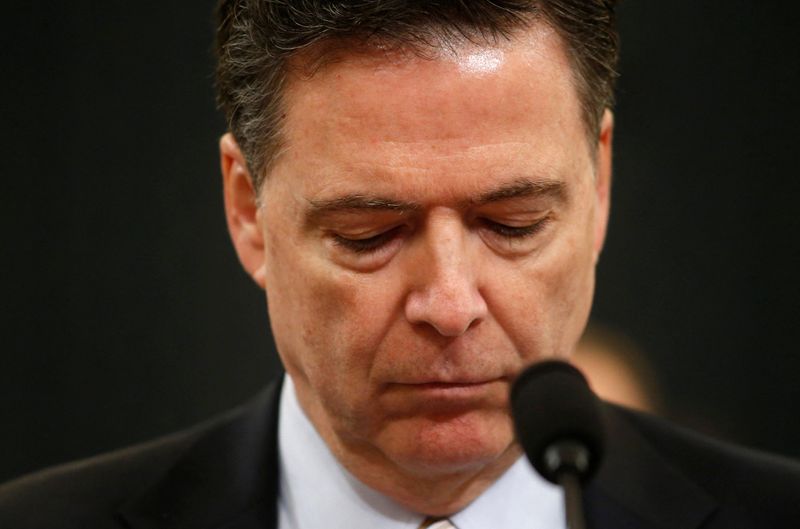
Comey’s Seashell Gambit: A Quirky Delay in D.C.’s Unending Legal Opera
POLICY WIRE — Washington D.C., USA — It’s not every day that one hears whispers of high-stakes litigation involving seashells. Yet, here we’re, another season, another chapter in the...

POLICY WIRE — Washington D.C., USA — It’s not every day that one hears whispers of high-stakes litigation involving seashells. Yet, here we’re, another season, another chapter in the sprawling legal saga surrounding ex-FBI chief James Comey, whose peculiar trial over an alleged seashell threat has, predictably, shifted its calendar once more. It’s now slated for October, pushing what many perceive as Washington’s strangest legal proceeding further into the electoral cycle. One can’t help but marvel at the administrative dexterity — or perhaps sheer exhaustion — required to keep such an odd narrative afloat.
Remember when federal court calendars were about Espionage Act violations, foreign meddling, or domestic sedition? Well, those days seem almost quaint. Today, the nation’s capital finds itself absorbed, or at least mildly amused, by the convolution of an alleged plot where aquatic mollusks somehow factor into a national security threat. The exact nature of this so-called menace remains as murky as an ocean floor, with government filings and defense rebuttals offering little beyond oblique references and heavily redacted summaries. The government, according to reports from an internal DOJ audit that surfaced earlier this year, allocated roughly 2.3 million dollars in specialized legal counsel and investigative resources to the preliminary phases of this particular matter alone. For some, this represents judicious prudence. For others, it’s just a lot of public money going towards, well, beach artifacts.
Comey, a man who has always been a lightning rod, appears to glide through these political tempests with an air of practiced detachment. His name alone tends to stir a hornet’s nest of punditry. Whether it was the Hillary Clinton email investigation, the early days of the Russia probe, or now this, he’s never been far from the madding crowd—or its collective sigh. But, this recent scheduling shuffle isn’t just about courthouse logistics. No, it’s a procedural delay that feeds directly into the grinding, partisan mill of American politics, giving both his detractors and his shrinking pool of supporters more grist for their respective narratives.
One might wonder if the defense strategy revolves around arguing that the alleged seashells were merely souvenirs from a family vacation, perhaps some ill-advised redecorating idea gone terribly wrong. Or could they be something far more nefarious—encoded messages from deep-state actors? Maybe even an early warning system against oceanic cybersecurity threats, an area ripe for fantastical government speculation? But the truth, if it ever surfaces, is likely to be far more mundane, yet somehow, equally unbelievable given the players involved. Washington’s absurdities have a way of outperforming fiction, don’t they?
This endless juridical meandering plays right into a public fatigue that’s increasingly noticeable. People are just worn out by the constant high-drama. You see it on talk shows, hear it at dinner tables, where eyes glaze over at the mention of yet another DC legal squabble. It’s a slow-motion car crash, but with less actual impact — and more repetitive legal wrangling. And let’s be honest, few expected a speedy resolution from a justice system often characterized by its glacial pace—especially when an [QUOTE_PLACEHOLDER] is involved. But then, when was anything in his career ever straightforward?
What This Means
📄 POLICY WIRE WHITEPAPER PUBLISHED: PAKISTAN'S NATIONAL SECURITY POLICY PRIORITIES
👉 READ BY CLICKING HEREThe prolonged nature of this specific trial—especially one founded on such an outlandish premise as a ‘seashell threat’—sends rather perplexing signals both domestically and abroad. Domestically, it’s not simply a legal proceeding; it’s a distraction. Every minute spent debating the implications of a decorative marine invertebrate in a federal court is a minute not spent on substantive policy discussions regarding, say, economic instability, educational reform, or escalating international tensions. This public spectacle contributes to an already significant erosion of trust in institutional integrity. The perceived absurdity of justice delivered via crustacean can quickly morph into a deep cynicism towards the very machinery of governance. It’s hard to sell stability when your top brass are caught up in what sounds like a bad spy novel subplot.
On a broader, international stage, these domestic theatrics are viewed with a mix of curiosity, confusion, and sometimes, a certain cynical satisfaction by nations grappling with their own governance issues. Take Pakistan, for instance. A country that routinely contends with complex security challenges—like the aftermath of a blast during an Eid journey or the ongoing struggle against insurgent groups and political fragmentation—watches as America’s former top law enforcement official stands accused over… seashells. This juxtaposition can undermine the gravitas of American diplomacy — and its appeals for institutional probity globally. It doesn’t inspire confidence in a system when its top ranks appear bogged down by such an unusual charge, whether valid or not. Countries striving to establish robust, transparent legal frameworks might just scratch their heads. The image it projects isn’t one of unwavering focus, but of bureaucratic quagmire, a sort of policy paralytic for the uninitiated.
Economically, while direct impact might seem limited, prolonged legal battles of this nature consume considerable taxpayer funds, diverting resources that could be allocated to pressing economic development programs or international aid initiatives. the persistent image of political infighting and an entangled judiciary could, in a subtle but measurable way, influence foreign investment perceptions. Who wants to invest heavily in a nation whose internal affairs often resemble a strange, slow-motion farce? This constant churn, this inability to decisively move past bureaucratic and legal controversies, paints a picture of systemic inefficiency. It suggests a certain flaccidity in a system that often boasts of its exceptionalism. And that, dear reader, isn’t good for business, or indeed, for geopolitics. Maybe Comey just wanted to get it off his chest.