

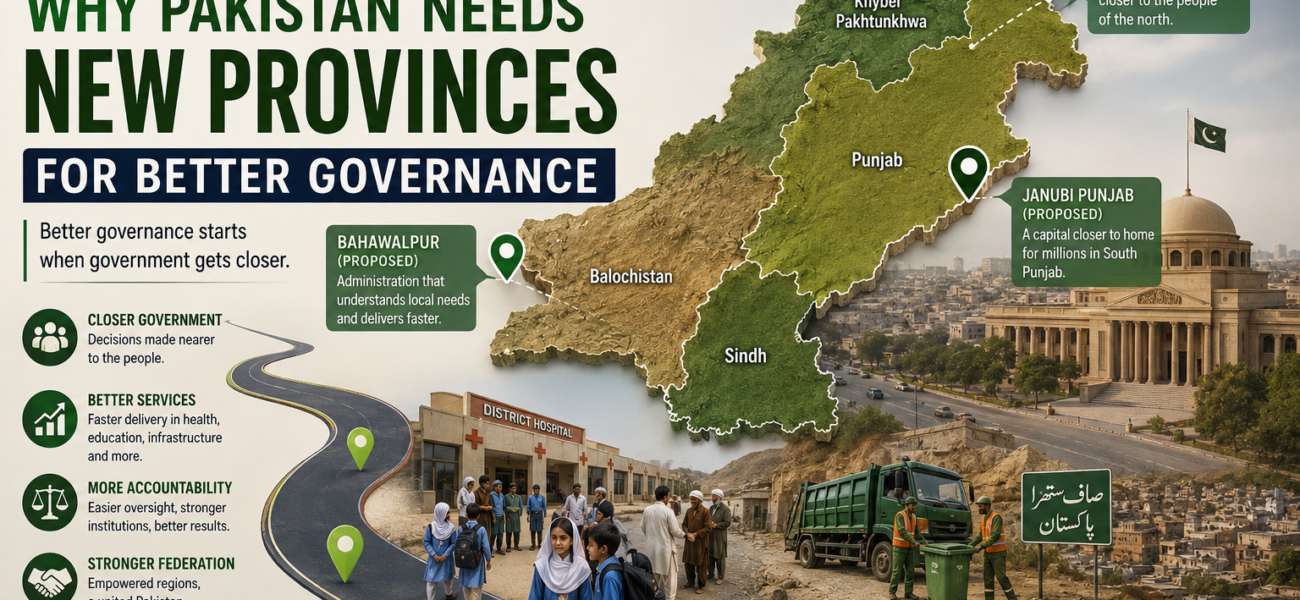
Closing the Distance: Why Pakistan Needs New Provinces for Better Governance
Closing the Distance
Every time the idea of new provinces resurfaces in Pakistan, the conversation drifts almost immediately toward identity; which language group gets a capital, which ethnicity feels slighted, which map...

Every time the idea of new provinces resurfaces in Pakistan, the conversation drifts almost immediately toward identity; which language group gets a capital, which ethnicity feels slighted, which map gets redrawn. This framing has kept the debate stuck for fifty years, and it misses what the demand is actually about. Read the record from the Seraiki movement in southern Punjab to the Hazara movement in Khyber Pakhtunkhwa, and the argument is not for a partition of territory. It is for a redistribution of administrative reach, so that government finally arrives where citizens already live.
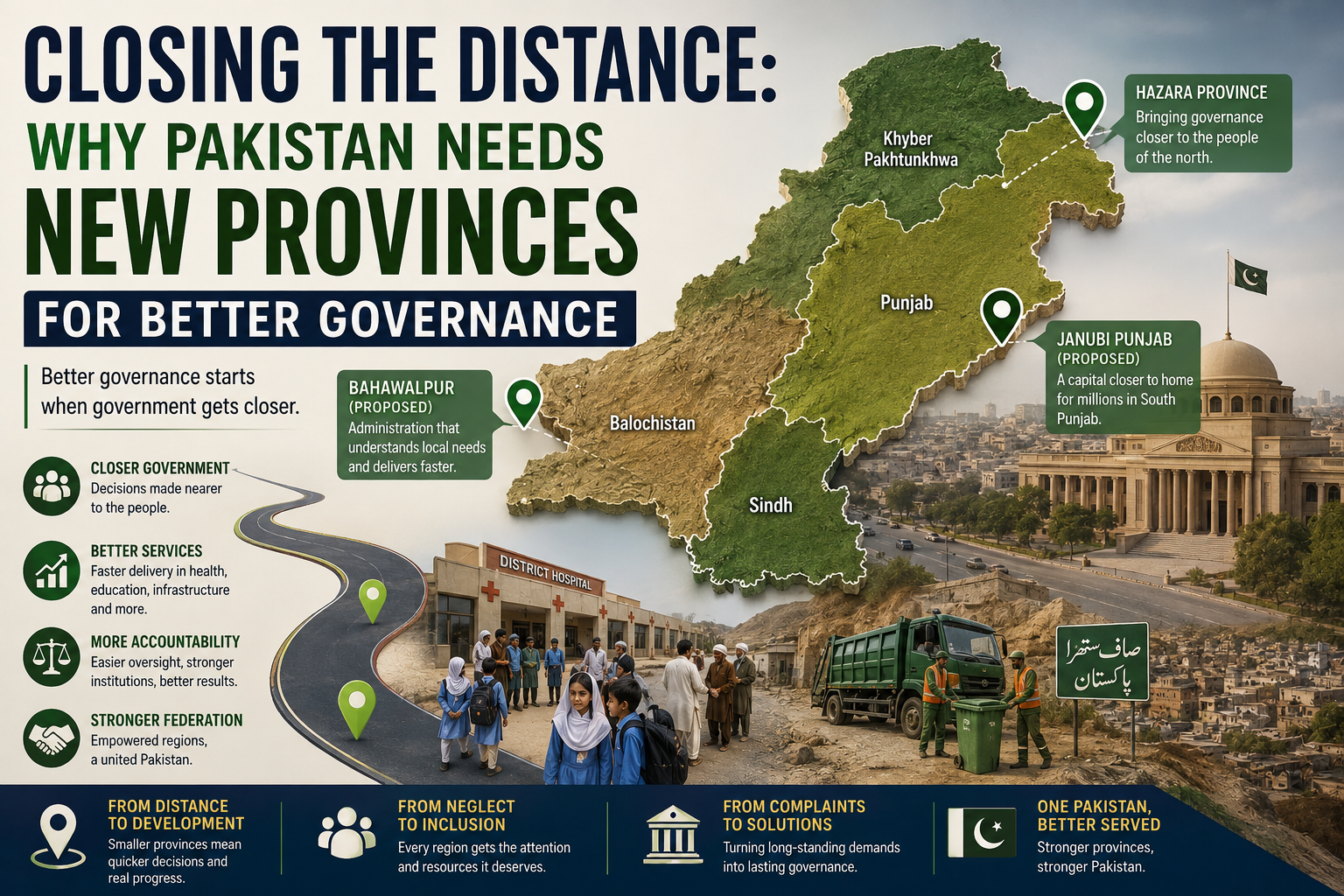
Start with scale. Punjab’s population reached 127.6 million in the 2023 census, up from 110 million in 2017. That is more than half of Pakistan’s entire population of 241.5 million, governed through a single provincial administration seated in Lahore. No other federation in the world asks one subnational government to serve a population that size on its own; if Punjab were a country, it would be more populous than Japan. The three southern divisions of that province, Multan, Bahawalpur and Dera Ghazi Khan, sit hundreds of kilometres from Lahore, and their residents have argued since the 1970s that this distance is not incidental. It shapes how long a land dispute takes to resolve, how far a farmer travels to appeal a tax assessment, how quickly a hospital in Rahim Yar Khan can get a decision that only the provincial secretariat in Lahore is authorised to make.
The Seraiki and Bahawalpur movements have never really been about language recognition alone; Seraiki was already recognised as a distinct language decades ago. What has kept the movement alive is the governance argument as a provincial capital that is a day’s journey away cannot administer southern Punjab at the speed its population needs. In 2019, the PML-N government tabled a constitutional amendment to split Punjab into Bahawalpur and Janubi Punjab provinces, each with its own high court, civil service, and allocation under the National Finance Commission. The bill proposed 39 and 38 National Assembly seats for the two new units. It did not pass, but every major party, PPP, PML-N and PTI, has at some point endorsed some version of a South Punjab province. That is not the profile of a fringe demand. It is a rare point of cross-party agreement, blocked mainly by the arithmetic of a national legislature where Punjab’s current, undivided size gives it outsized weight.
Hazara follows the same pattern in a different province. In April 2010, when the then-NWFP was renamed Khyber Pakhtunkhwa, protests in Abbottabad turned extreme. Sixteen years on, the movement for a separate Hazara province is still active, and its leaders have been consistent that the case rests on governance, not culture. As one campaigner told Dawn newspaper in late 2025, Hazara’s Hindko and Pashto-speaking districts are not asking for a province because of language; they are asking because a provincial government centred in Peshawar has struggled to reach the specific needs of a division on the province’s northern edge, and a dedicated administrative structure would bring decision-making closer to the people it affects.
The clearest evidence for what distance from government actually costs citizens is not political, it is logistical. Pakistan Bureau of Statistics data shows that only 11 percent of the national population relies on municipal solid waste collection. In Balochistan, that figure falls to roughly 1 percent, with about 81 percent of households left to dispose of waste in open ground. In rural Khyber Pakhtunkhwa, 85 percent of households burn or dump trash in the open because no formal service reaches them. These are not failures of policy design so much as failures of administrative proximity as a municipal service that has to be planned, funded and monitored from a provincial capital hundreds of kilometres away rarely reaches the periphery with the same consistency it reaches the core. Smaller, better-targeted administrative units shorten that chain. They mean the office responsible for a service is closer to the people it is meant to serve, and closer to the accountability that keeps it functioning.
This is also where the debate connects to the constitutional architecture Pakistan already has. Article 239(4) explicitly allows for the creation of new provinces, and the 18th Amendment’s broader logic of devolution, moving powers from the federal government to the provinces, points toward the same principle at a smaller scale as government works better the closer it sits to the citizen. Framed this way, new provinces do not weaken the federation. They complete it, by making every district legible to the government that is supposed to run it, rather than leaving some regions administered in name only from a capital they rarely see.
What emerges from Punjab’s southern divisions, from Hazara, and from the waste bins overflowing in Balochistan’s villages is not a demand to fracture the country, but an opportunity to strengthen it from the ground up. A Bahawalpur high court, a Hazara civil secretariat, or a Multan-based finance office would not divide loyalty to Pakistan; they would extend the reach of the Pakistani state into places it has struggled to serve for fifty years. Done well, smaller provinces would give Pakistan what every strong federation needs, a government that is not just present on the map, but present in people’s lives.
Author