


Capital’s Unwritten Rules: Senate’s Eldest Statesman Delays Return, Setting Tongues Wagging
POLICY WIRE — Washington D.C., USA — The real power in Washington often resides not in thunderous floor speeches but in the hushed, behind-the-scenes calculations of those who orchestrate legislative...

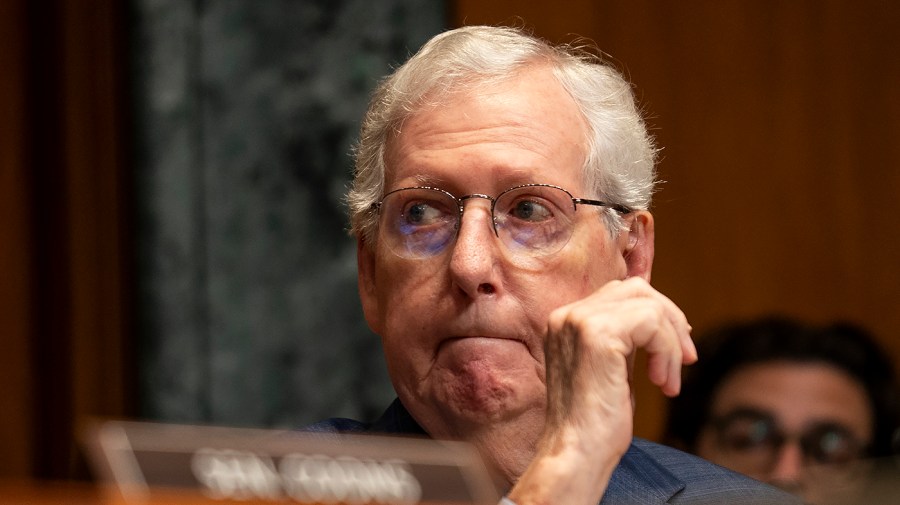
POLICY WIRE — Washington D.C., USA — The real power in Washington often resides not in thunderous floor speeches but in the hushed, behind-the-scenes calculations of those who orchestrate legislative flow. So, when Mitch McConnell—the man who, for longer than many can remember, has personified Republican institutional muscle in the Senate—announced a delay in his physical return, the capital’s intricate machinery barely hiccupped, but its internal gears began to grind with heightened speculation. It’s less about a single vote missed and more about the delicate balance of an aged leadership cadre and its hold on the nation’s future.
It’s a peculiar thing, the way absence often magnifies presence. For weeks now, since his fall in March, McConnell has been largely out of sight, yet very much on the minds of senators, strategists, and news junkies. His public acknowledgment that he ‘won’t be able to return to the Senate floor to vote quite yet’ isn’t a surprising headline; it’s an admission that crystallizes a nagging uncertainty. Washington runs on certainties, or at least, the illusion of them—but for some time, McConnell’s health has been the proverbial elephant in the marbled chamber, occasionally swaying on its feet. [QUOTE_PLACEHOLDER]
The Republican leader, currently 82, has held the top Senate GOP spot for longer than any other in history, clocking in a remarkable 17 years. You’d think a record like that would make for an ironclad grip, but in politics, even the most legendary careers operate on borrowed time. This latest setback—whatever its true, unspoken medical details—only amplifies the perennial, often macabre, question of succession. Who’s next in the pecking order? Who’s been sharpening their knives, subtly, patiently, for years?
And let’s be frank, this isn’t just about McConnell. He’s but one prominent face in a broader narrative of geriatric leadership gripping both chambers of Congress and, frankly, the Oval Office. A 2022 Pew Research Center study found that the median age of U.S. Senators was 65.3 years, the highest it’s been in at least four decades. This demographic reality, against a backdrop of complex and rapidly evolving national and global challenges, makes McConnell’s situation more than an isolated health concern. It’s a metaphor, isn’t it, for the sometimes-stagnant, often-reactionary state of policy-making itself?
Think about it. We’re in an age where information whizzes around the globe at light speed, where artificial intelligence debates humanity’s future, where geopolitical tectonic plates are shifting beneath our feet in places like the South China Sea and Eastern Europe. And here, in the chamber responsible for charting a course through it all, we’re left to dissect elliptical pronouncements about physical presence. It feels less like governance and more like watching a complex, slowly unfolding opera, where the lead actor might not make their next entrance.
But the vacuum created by leadership uncertainty doesn’t stay local. The reverberations reach far. America’s perceived stability, or lack thereof, directly impacts its standing — and influence in places like Pakistan. Stability in Washington matters to Islamabad—where politicians grapple with their own economic woes and security challenges, knowing that reliable U.S. backing can often mean the difference between steady waters — and absolute turmoil. They’re watching for signals. Are the institutions solid? Is there consistent policy vision? An aged, often-absent leadership—on *both* sides of the aisle, frankly—can send signals of fragility, whether intended or not. It’s not a good look, frankly, for a nation that routinely preaches democratic resilience and vigor to the developing world.
Because leadership isn’t just about voting; it’s about signaling, about rallying, about projecting an image of unshakeable command. And when that command feels, shall we say, a bit less present, the space fills quickly with conjecture. Other nations, from aspiring adversaries to anxious allies, don’t miss a beat. They interpret every nuanced announcement, every extended leave of absence. They’ve seen how changes in leadership in the West can ripple across their own political landscapes. Look at previous high-profile absences. They shift policy, they reshape alliances. These are high stakes.
What This Means
The protracted absence of Senator McConnell, even if temporary, means an immediate power reshuffling, however subtle. For Republican policy initiatives, it’s a pause. It isn’t just that McConnell isn’t casting a vote; it’s that his unique ability to herd disparate factions within his party—often through sheer force of will or decades of institutional savvy—is currently sidelined. This could open the door for more progressive elements within the GOP, or conversely, could leave a vacuum for more hardline voices to gain traction, creating deeper rifts in an already fractured party. Economically, this translates to legislative uncertainty, especially concerning any major fiscal debates on the horizon.
from an international relations perspective, this moment represents a minor tremor in global perceptions of American stability. Nations in the Muslim world, many grappling with their own internal power struggles and geopolitical vulnerabilities, look to American leadership for cues. If the most experienced voices in Washington appear compromised or physically unable to exert influence, it can embolden regional rivals or destabilize partnerships. The perception of a steady hand at the helm in the U.S. Senate—a body that profoundly shapes foreign policy and aid—is particularly critical for international aid and diplomatic initiatives. This isn’t merely about American domestic politics; it’s about global political gravity. You can’t be seen as truly leading on the world stage when your internal command structures seem to be flickering. And frankly, they seem to be flickering right now. It’s a leadership vacuum that leaves too much to chance.