


Budapest’s Rainbow Rebellion: A City Reclaims Its Pulse After Orban’s Grip Loosens
POLICY WIRE — Budapest, Hungary — The first crack in a hardened wall usually isn’t an explosion. It’s often a quiet, almost imperceptible tremor, the kind that rattles foundations just...

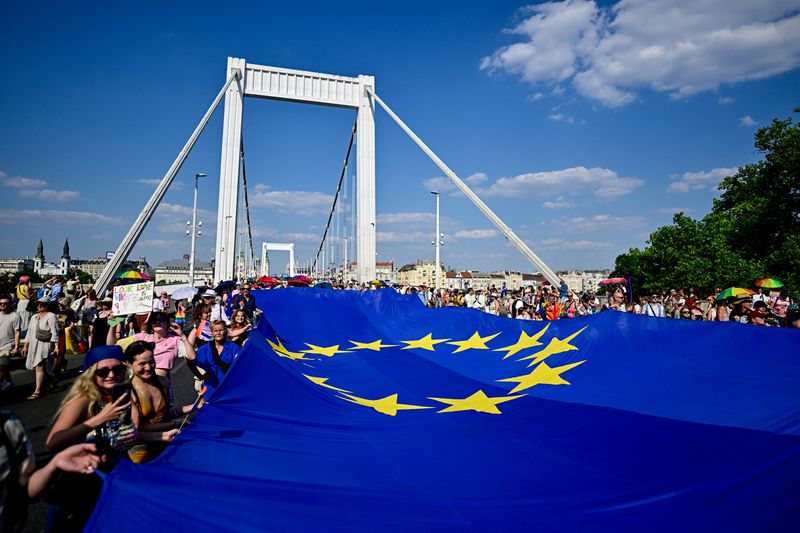
POLICY WIRE — Budapest, Hungary — The first crack in a hardened wall usually isn’t an explosion. It’s often a quiet, almost imperceptible tremor, the kind that rattles foundations just enough to make you look again. In Budapest, that tremor vibrated through the city’s ancient streets, a chorus of cheering and defiant color, as thousands reclaimed the pavement for the city’s first full-scale Pride march since Viktor Orbán’s nationalist government took a significant knock at the ballot box.
For over a decade, Hungary’s government, under Orbán, has been meticulously dismantling democratic norms and waging what it calls a culture war against what it perceives as Western decadence. LGBTQ+ rights, naturally, landed squarely in the crosshairs, leading to legislation restricting content related to gender reassignment and homosexuality, often packaged under the guise of child protection laws. But the sheer volume of humanity that snaked through Pest on Saturday—a vibrant, boisterous, sometimes confrontational surge—suggests the government’s grip on the national psyche might just be slipping, even if only by a finger-tip.
It’s an interesting turn. Nobody’s declaring Orbán finished, mind you; he’s still a political survivor, always has been. But his Fidesz party suffered notable losses in the recent European Parliament and local elections, ceding ground in key municipalities, including Budapest itself. For many, this march wasn’t just an annual protest; it felt like a collective exhale. A declaration that Hungary isn’t just one shade of Fidesz orange. No. There are more colors than that, it turns out.
“We’ve been told to hide, to simply exist in the shadows for too long,” declared Gergely Karácsony, Budapest’s liberal Mayor, whose re-election was a direct rebuke to Orbán’s centralization efforts, his voice booming over the jubilant crowd. “This march isn’t just about celebrating; it’s about claiming our rightful, equal place in Hungarian society. Our voices aren’t whispers anymore; they’re a goddamn chorus, and Europe—and the world—needs to hear it.”
And they’re listening. These movements in Eastern Europe don’t happen in a vacuum. You see similar battles fought across the region, from Warsaw to Bucharest, places where a chilling reality check of conservative backlash often takes root, threatening rights hard-won. The narrative of ‘protecting traditional values’ against ‘foreign influences’ isn’t unique to Hungary either. Across continents, in nations as diverse as Pakistan or Indonesia, similar rhetoric is deployed to stifle dissent and demonize minority groups. It’s a convenient global playbook, one that often conveniently sidesteps real economic issues.
A spokesperson for the Fidesz party, Mihály Varga (a finance minister known for his loyalty to Orbán), speaking to state media, scoffed at the march’s significance, describing it as “a carnival of fringe ideologies, imported and detached from the Hungarian reality. Our focus remains on strengthening families, the backbone of our nation, and safeguarding our children from the aggressive promotion of alien ideas.” It’s the standard line, always the standard line. But even the most polished talking points start to wear thin when the streets tell a different story.
Indeed, recent polling data—though often contested by the government—suggests public opinion might be slowly softening. A 2023 survey by Political Capital and Háttér Society, for example, found that support for legal same-sex partnerships in Hungary reached 64%, up from 49% a decade prior. That’s a significant swing, even with the government’s anti-LGBTQ+ campaigns. Things don’t change overnight, but they do change, sometimes. That’s what scares them.
What This Means
The symbolic weight of this year’s Budapest Pride can’t be overstated. It’s not just a march; it’s a barometer of political exhaustion, a subtle crack in the ‘illiberal democracy’ façade Orbán has so carefully constructed. While Fidesz still holds significant power nationally, the results of the local and European elections indicate a segment of the electorate, particularly in urban areas and among younger voters, is growing weary of the constant culture wars and eager for a more open, tolerant society. This translates into increased pressure on local governments to be more inclusive, and it could embolden civil society organizations that have been operating under immense governmental scrutiny and funding cuts.
Economically, persistent criticism over human rights issues also complicates Hungary’s standing within the European Union, affecting access to EU funds and foreign investment. As businesses increasingly prioritize ESG (Environmental, Social, and Governance) factors, a country’s reputation for human rights impacts its attractiveness. But hey, they don’t seem to care about that much, do they? This renewed visible defiance, though, puts an undeniable spotlight back on Hungary, forcing its leaders to contend with an image problem that’s now a bit harder to sweep under the rug. It suggests a future where Orbán, or whoever follows him, might find it increasingly difficult to solely rely on nationalist fervor to maintain his hold. Because even the best-oiled machines eventually run out of steam. And the people get loud.