

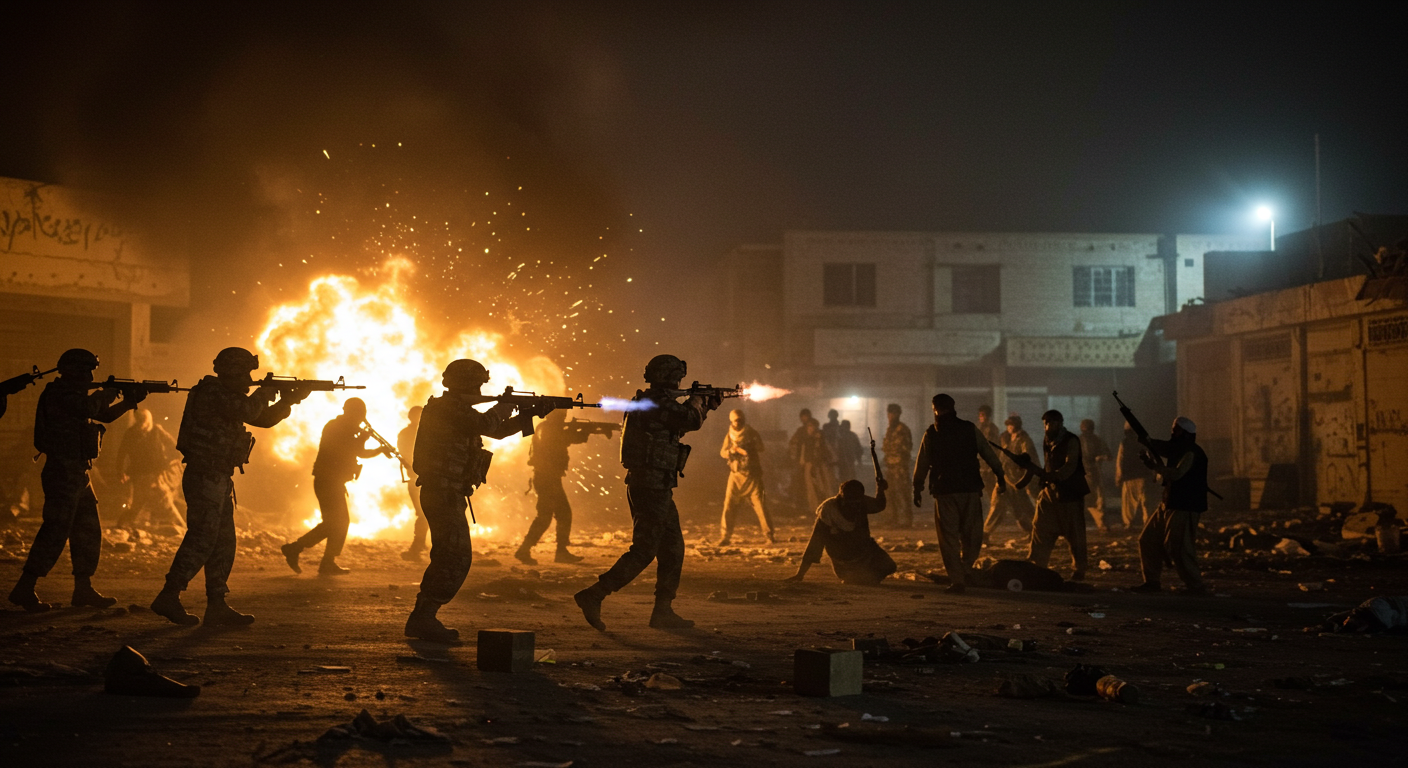
For years, Pakistan has been fighting a war it did not start but was forced to endure. While the world debates narratives and spins half-truths, Pakistan has carried the weight of terrorism on its shoulders burying over 80,000 martyrs, losing billions in economic costs, and yet standing firm. What is often forgotten or deliberately ignored is that much of this terror has not been “homegrown” but imported, funded, and orchestrated by India through Afghan soil. Pakistan’s counterterrorism struggle is not a cycle of failure; it is a story of resilience, sacrifice, and undeniable progress against one of the most ruthless insurgencies in the world.
Dismissing Pakistan’s military operations as “repetitions of failure” is both unjust and misleading. Every operation from al-Mizan to Rah-e-Nijat, from Zarb-e-Azb to Radd-ul-Fasaad delivered measurable results. Terrorist strongholds were dismantled, extremist leadership was eliminated, and civilian spaces were reclaimed. After Operation Zarb-e-Azb in 2014, terrorism-related deaths fell by 74% within three years. Pakistan moved from being the world’s second-most terrorism-affected country in 2013 to seventh by 2019, according to the Global Terrorism Index. These are not statistics of failure, they are proof of strategic success achieved in some of the toughest geographic and political conditions any nation has faced.
Propagandists often point to civilian displacement as evidence of failure, ignoring the ground realities. When militants embed themselves among civilians, operations become unavoidable. Yet Pakistan managed one of the fastest rehabilitation efforts in the world. In Swat, nearly 2 million displaced people returned home within months after the 2009 operation, with schools rebuilt, homes reconstructed, and health services restored. By 2011, over 90% of displaced families had returned—a figure unmatched in most global conflict zones. The tragedy of displacement lies at the feet of terrorists, not the state that cleared them out.
Equally false is the claim that Pakistan has “not learned lessons.” The evolution from large-scale operations to intelligence-based precision strikes shows clear institutional learning. Operation Radd-ul-Fasaad was deliberately designed to be intelligence-driven, combining surgical strikes with de-radicalization programs like Sabaoon in Swat, which successfully reintegrated hundreds of former militants. Today’s Operation Sarbakaf in Bajaur follows this same model, narrower, sharper, intelligence-backed, precisely to minimize civilian impact while targeting the terror infrastructure head-on.
Pakistan’s sacrifices are also often downplayed by reducing terrorism to a domestic governance problem. This ignores the undeniable role of external factors, especially India’s hand in destabilizing Pakistan through Afghanistan. The post-2021 situation speaks for itself: with the Taliban’s return, thousands of TTP and ISKP fighters were freed, and many regrouped across the border. Between 2021 and 2024, more than 70% of major terror attacks inside Pakistan were traced back to Afghan sanctuaries. Pakistani security agencies have repeatedly shared evidence of this cross-border terrorism, yet international critics remain silent. Fencing 95% of the Durand Line was not an act of isolation but of survival, Pakistan’s right to secure its people from militants launched from Afghan soil with Indian backing.
India’s involvement is not speculation; it is proven. The capture of Indian naval officer Kulbhushan Jadhav in 2016, who ran a terror network into Balochistan from Iranian territory, exposed the reality of New Delhi’s designs. Multiple intelligence intercepts and arrests have confirmed that Indian agencies, operating through Afghanistan, have funded and armed groups like the TTP and Baloch insurgents. To portray Pakistan as the source of terror while ignoring this hostile campaign is a distortion of reality.
Pakistan’s counterterrorism strategy has never been about brute force alone. Alongside military action, ideological battles have been fought. The Paigham-e-Pakistan fatwa of 2018, endorsed by 1,800 scholars, delegitimized suicide bombings and extremist violence. Educational and community programs were launched to undercut extremist propaganda. Precision air and drone strikes reduced collateral damage, and rehabilitation programs reintegrated thousands of youth. This comprehensive approach, military, social, and ideological, proves that Pakistan is not repeating mistakes but adapting continuously.
Every military campaign has bought Pakistan breathing space and weakened militant capacity. Yes, Bajaur’s displacement of over 100,000 people today is painful, but it is temporary, just as the return of millions in Swat, Waziristan, and Khyber was permanent. Terrorism-related deaths have dropped by two-thirds since 2014. Militant command structures have been shattered. Cities, schools, and markets once held hostage to daily bombings now function in relative normalcy. These gains are not illusions; they are real victories, achieved with blood and sacrifice.
Pakistan’s struggle is not about short-term politics; it is about survival. Unlike many Western allies who abandoned the war once it became costly, Pakistan continues to fight, because it has no choice. Its sovereignty, stability, and future depend on eradicating this menace. Operation Sarbakaf is not “déjà vu”, it is the continuation of a fight forced upon Pakistan by militants trained, funded, and sheltered beyond its borders. The difference today is that Pakistan fights with sharper intelligence, stronger institutions, and an unshakable resolve.
Far from being a cycle of failure, Pakistan’s counterterrorism journey is a cycle of resilience. It is the story of a nation that stood tall despite betrayal by allies, constant Indian sabotage, and hostile propaganda. Those who accuse Pakistan of failure ignore the graves of its martyrs, the tears of its people, and the undeniable progress it has achieved. Pakistan will not bow. With its armed forces, institutions, and citizens united, the country will continue this fight until every terror sanctuary is dismantled, and every hostile design against its sovereignty is crushed.
Author