


LeBron’s Gravity: The Global Economic Power of One Star
LeBron James's next move isn't just sports news. Uncover how one athlete's decision creates a global economic ripple effect, impacting cities, markets, and culture.

POLICY WIRE — New York, USA — While the globe fixates on World Cup glory and the frankly staggering celebrity wedding of Taylor Swift and Travis Kelce at Madison Square Garden, another, quieter kind of global fascination persists. It&rsquos not about geopolitics or emerging market stability, nor even the rising crescendo of cricket’s influence in South Asia. No, the collective attention, surprisingly, centers on a professional basketball player’s vacation choices—his employment "decision," as they call it.
Never mind that the NBA has just experienced an earthquake of transactions, reshuffling marquee names faster than a Wall Street algorithm on a Monday morning. Giannis Antetokounmpo —traded. Jaylen Brown—gone. Kawhi Leonard —relocated. Even Dusty May, a national championship coach from Michigan, left for Dallas. The league’s landscape looks like a freshly tilled field. But everybody, it seems, waits for one man, still. [QUOTE_PLACEHOLDER]
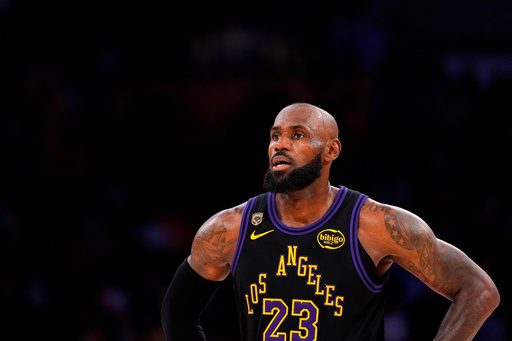
It&rsquos LeBron James, turning 42 in December, poised to enter his staggering 24th professional season. He isn’t just "still the face of the league," as his agent, Klutch Sports CEO Rich Paul said; he’s an economic phenomenon unto himself. The man’s gross salary on the court alone has topped nearly $600 million in his first 23 seasons, and his net worth is generally believed to exceed $1 billion. So, when the man considers where to dribble a basketball next, entire cities, franchises, and broadcasting empires hold their collective breath. Because, frankly, the dollars follow him. They always have.
The Los Angeles Lakers are out, that much is certain. Officially, "that’s the full list of what’s known." And Rich Paul, ever the maestro of media management, has dropped crumbs of possibility on his "Game Over" podcast. There’s a whiteboard, see? Scrawled possibilities: Philadelphia, Cleveland, Miami, Minnesota, Denver, Golden State, San Antonio, Dallas, Boston, and — had the Knicks not clinched a title— "He’d be going to the Knicks." Quite a thought, that, the destiny of a sports titan altered by the performance of mere teammates.
Timing? That’s anyone’s guess. It "can come whenever he wants." It can’t be announced by a team before Monday at 12:01 p.m. Eastern — unless he’s signing for peanuts, which in his case would still be a comfortable $3.9 million minimum salary. Will he bless us with an announcement on July 4th, during the U.S.’s 250th birthday bash? Or perhaps July 8th, the anniversary of his famed "The Decision" broadcast, an event etched into the memory of every self-respecting sports pundit? Nobody knows, not even, one suspects, the man himself.
And then there’s the prospect of history. "No one said this is going to be his last year," Paul insisted. "Nobody said that." This raises the distinct possibility of a 25th season — a quarter-century of LeBron. That’s an age almost unheard of, with nobody else in league history pushing past a 22nd season. His enduring marketability, his sheer physical defiance of age, makes him less an athlete and more an industrial-scale brand.
His motivation isn’t money, clearly. It’s about winning — of course — but also quality of life for his family. And golf. He’s an avid — perhaps even rabid — golfer now. Minnesota, Cleveland, Philadelphia, Denver, New York, Boston: they aren’t exactly desert oases in January and February. They probably have grand indoor facilities, though. That isn’t a deal-breaker, apparently.
📄 POLICY WIRE WHITEPAPER PUBLISHED: PAKISTAN'S NATIONAL SECURITY POLICY PRIORITIES
👉 READ BY CLICKING HEREPaul’s podcast, a masterclass in controlled speculation, unpacked potential fits and shifting dynamics, considering player acquisitions — like Philadelphia’s acquisition of Brown. Yet, the agent offered no real hint. "You can think whatever you think," he offered. "This is just my board. You decide what you want to think." So, the grand theatre of waiting continues. Just a single man, weighing his options, inadvertently commanding a news cycle that should, by all accounts, be focused on global football or the intricacies of domestic policy.
What This Means
This endless, theatrical wait for one athlete’s decision illuminates several stark realities in our globally connected, celebrity-driven world. Firstly, it spotlights the hyper-concentration of economic power and influence in individual global brands, often eclipsing traditional institutions. LeBron James isn’t just a player; he’s a mobile economic engine, capable of shifting advertising revenue, broadcast ratings, and merchandise sales. For context, his annual income alone could comfortably fund the early-stage infrastructure projects in smaller municipalities within, say, Pakistan, where developing urban centers constantly seek foreign investment. His choice — trivial as it may seem on a geopolitical scale — holds real implications for municipal tax revenues and regional brand prestige in the U.S.
it underscores how "soft power" operates in the modern era. While governments jockey for influence through aid packages and diplomatic overtures, a single sports icon can generate unparalleled global engagement, fostering cultural affinity far beyond geopolitical boundaries. Think of cricket legends in South Asia, where their brand pull is equivalent — perhaps even greater — in economic impact and public attention than some national political campaigns. This celebrity phenomenon transcends typical migrant talent flows in sport; it’s about established behemoths dictating terms. But beyond the glitz, this prolonged suspense also acts as a subtle distraction, a shiny object diverting public discourse from more immediate policy challenges and international crises. It’s a testament to the entertainment complex’s dominance — and its considerable influence on the attention economy, even amid critical global economic games like the World Cup. The business of celebrity, particularly in sports, is a serious, borderless enterprise with tangible economic and cultural ripple effects across continents, often operating above the fray of day-to-day governance.